Aristotle
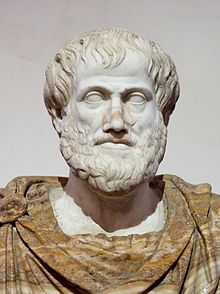
Aristotle is a towering figure in ancient Greek philosophy, making contributions to logic, metaphysics, mathematics, physics, biology, botany, ethics, politics, agriculture, medicine, dance and theatre. He was a student of Plato who in turn studied under Socrates. He was more empirically-minded than Plato or Socrates andis famous for rejecting Plato's theory of forms. As a prolific writer and polymath, Aristotle radically transformed most, if not all, areas of knowledge he touched. It is no wonder that Aquinas referred to him simply as "The Philosopher." In his lifetime, Aristotle wrote as many as 200 treatises, of which only 31 survive. Unfortunately for us, these works are in the form of lecture notes and draft manuscripts never intended for general readership, so they do not demonstrate his reputed polished prose style which attracted many great followers, including the Roman Cicero. Aristotle was the first to classify areas of human knowledge into distinct disciplines such as mathematics, biology, and ethics. Some of these classifications are still used today.
Poetics
Aristotle's Poetics is the earliest surviving work of dramatic theory and the first extant philosophical treatise to focus on literary theory. This has been the traditional view for centuries. However, recent work is now challenging whether Aristotle focuses on literary theory per se (given that not one poem exists in the treatise) or whether he focuses instead on dramatic musical theory that only has language as one of the elements.
限會員,要發表迴響,請先登入


