Ithaca
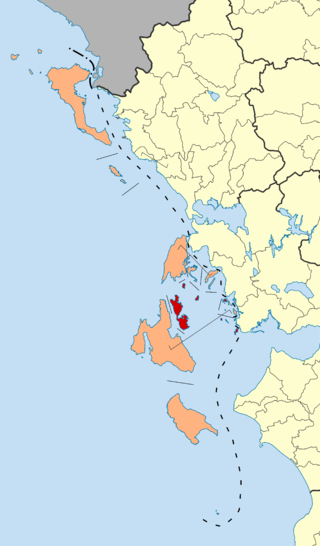
Ithaca is a Greek island located in the Ionian Sea, off the northeast coast of Kefalonia and to the west of continental Greece.
An Interactive Map of Odysseus' 10-Year Journey in Homer's Odyssey
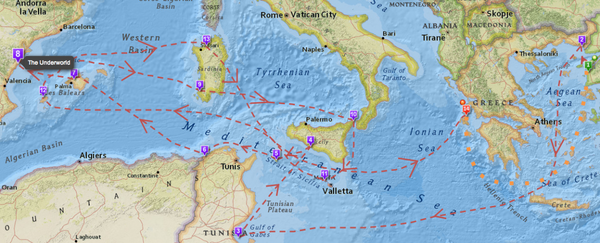
The Odyssey, one of Homer’s two great epics, narrates Odysseus’ long, strange trip home after the Trojan war. During their ten-year journey, Odysseus and his men had to overcome divine and natural forces, from battering storms and winds to difficult encounters with the Cyclops Polyphemus, the cannibalistic Laestrygones, the witch-goddess Circe and the rest. And they took a most circuitous route, bouncing all over the Mediterranean, moving first down to Crete and Tunisia. Next over to Sicily, then off toward Spain, and back to Greece again.
Shakespeare SONNET 18
Shall I compare thee to a summer's day?
Thou art more lovely and more temperate:
Rough winds do shake the darling buds of May,
And summer's lease hath all too short a date:
Sometime too hot the eye of heaven shines,
And often is his gold complexion dimm'd;
And every fair from fair sometime declines,
By chance, or nature's changing course, untrimm'd;
But thy eternal summer shall not fade
Nor lose possession of that fair thou ow'st;
Nor shall Death brag thou wander'st in his shade,
When in eternal lines to time thou grow'st;
So long as men can breathe or eyes can see,
So long lives this, and this gives life to thee.
Homeric Epithets A characteristic of Homer's style is the use of epithets, as in "rosy-fingered" dawn or "swift-footed" Achilles. Epithets are used because of the constraints of the dactylic hexameter (i.e., it is convenient to have a stockpile of metrically fitting phrases to add to a name) and because of the oral transmission of the poems; they are mnemonic aids to the singer and the audience alike.
Invocation-
As a supplication or prayer it implies to call upon God, a god, goddess, or person, etc. When a person calls upon God, a god, or goddess to ask for something (protection, a favour, his/her spiritual presence in a ceremony, etc.) or simply for worship, this can be done in a pre-established form or with the invoker's own words or actions. An example of a pre-established text for an invocation is the Lord's Prayer
Metapher
A metaphor is a figure of speech that refers, for rhetorical effect, to one thing by mentioning another thing. It may provide clarity or identify hidden similarities between two ideas. Where a simile compares two items, a metaphor directly equates them, and does not use "like" or "as" as does a simile. One of the most commonly cited examples of a metaphor in English literature is the "All the world's a stage" monologue from As You Like It:
All the world's a stage,
And all the men and women merely players;
They have their exits and their entrances[...]
—William Shakespeare, As You Like It, 2/7
Simile
A simile is a figure of speech that directly compares two things. Although similes and metaphors are similar, similes explicitly use connecting words (such as like, as, so, than, or various verbs such as resemble), though these specific words are not always necessary. While similes are mainly used in forms of poetry that compare the inanimate and the living, there are also terms in which similes and personifications are used for humorous purposes and comparison.
For example:
"O My Luve's like a red, red rose." "A Red, Red Rose," by Robert Burns.
限會員,要發表迴響,請先登入


