Ceres(mythlogy)
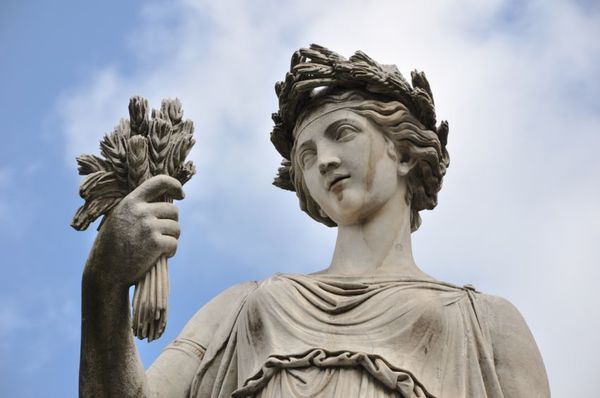
In ancient Roman religion, Ceres was a goddess of agriculture, grain crops, fertility and motherly relationships. She was originally the central deity in Rome's
so-called plebeian or Aventine Triad, then was paired with her daughter Proserpina in what Romans described as "the Greek rites of Ceres".
Ceres is the only one of Rome's many agricultural deities to be listed among the Dii Consentes, Rome's equivalent to the Twelve Olympians of Greek mythology. The Romans saw her as the counterpart of the Greek goddess Demeter, whose mythology was reinterpreted for Ceres in Roman art and literature.
Demeter
In ancient Greek religion and Greek mythology, Demeter is the goddess of the harvest and agriculture, who presided over grains and the fertility of the earth.
Though Demeter is often described simply as the goddess of the harvest, she presided also over the sacred law, and the cycle of life and death. She and her daughter Persephone were the central figures of the Eleusinian Mysteries that predated the Olympian pantheon. In the Linear B Mycenean Greek tablets of circa 1400–1200 BC found at Pylos, the "two mistresses and the king" may be related with Demeter, Persephone and Poseidon. Her Roman equivalent is Ceres.
Persephone
In Greek mythology, Persephone, also called Kore or Cora, is the daughter of Zeus and the harvest goddess Demeter, and is the queen of the underworld. Homer describes her as the formidable, venerable majestic princess of the underworld, who carries into effect the curses of men upon the souls of the dead. Persephone was married to Hades, the god-king of the underworld.
限會員,要發表迴響,請先登入


