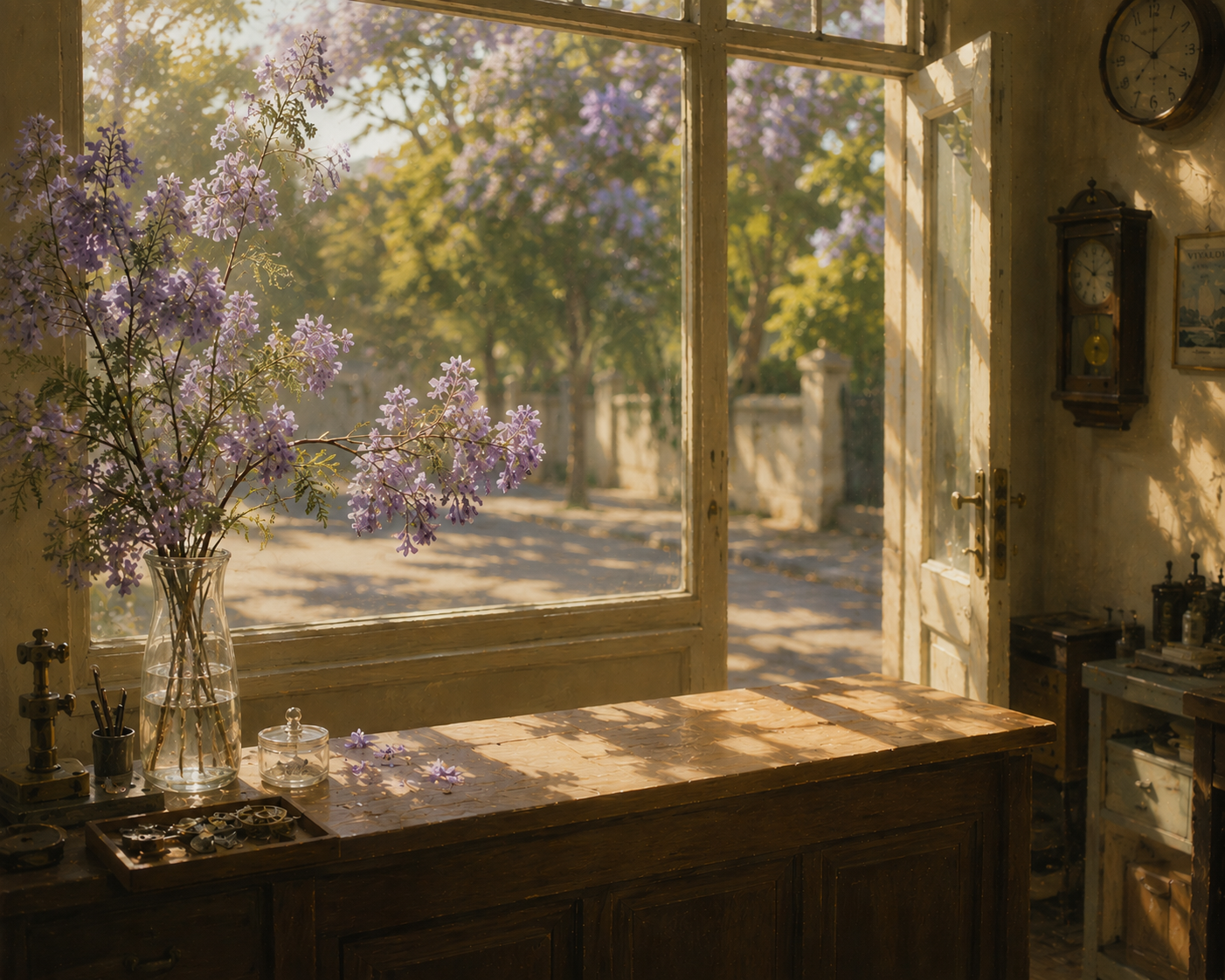
《長夏無盡》
滄桑流落兩撇鬍,歲月撐起這小腹,開頭這兩句讓林清河變成有肉身、有年齡、有點可笑、甚至有些狼狽的人物。他摸索翻譯莎翁,情感卻在翻譯過程中與莎翁不斷交融,甚至讓莎翁詩句支配情感。系列至《擒縱之間》,幾篇小說由詩句孕育,由詩句塑造人物,起始皆從譯文。莎翁這幾首十四行詩皆完成於2025年冬春交替之時,採用五言成雙十字對照英文五音步。至於韋瓦第,四季十四行詩本身翻譯更早,完成於2011年。書寫這一系列,之前譯文回顧不少,文字盡付歲月,感慨莫過於斯。
《擒縱之間》看似描寫愛情,其實書寫歲月,時光才是主角。機械時間,時間被鐘錶拆解,擒縱結構將時光的連續,格式成分秒。音樂時間,時間被季節感受,音符旋律將時光的往復,譜寫成樂章。文學時間,時間被文字重塑,詩詞歌賦將時光的流轉,書寫成滄桑。生命時間,時間被人生承受,悲歡離合將時光的流逝,寄託成回憶。林清河藉由修錶抓住機械時間,聆聽四季感受音樂時間,翻譯莎翁體悟文學時間,透過曉婷經歷生命時間。這位主角,起始結束皆聆聽茶花女的告別往昔,卻告別不了往昔,尋尋覓覓或許不是愛情,而是知己。
歲月流逝,究竟什麼恆久不遺忘?《擒縱之間》試著回答,從威爾第到包益多,從上校的軍錶修復到託付,從老婦人的普通女錶到完美先生的父親遺物,甚至清河與曉婷的關係,屢次追問古老難題,得到的答案始終是心意。《將臨》將心意帶入語言的虛假與真實,《從未兌現》將心意放入濃縮咖啡反覆飲啜,《擒縱之間》則將心意放入歲月珍藏。
曉婷代表清河眼中不滅的夏日,但不是永恆。試問永恆可得乎?既知時光留不住,清河只能保存,卻不佔有,而他保存的方式必須是放開,否則年華會老死於擒得瞬間。「但願記得某名,歲月價值同樣記取。」清河不言情,只說記取。真正要求的不是不要離開,而是不要讓這段時間變得毫無價值。所以「記得」在這裡不是佔有,是保存。他的情感是老派的,像是唐宋遺民,莎翁詩句的翻譯也是如此。
袁承墨面對愛情,徘徊於兩女;林清河遇見愛情,羞赧於歲月⸺皆是不知所措。林清河拆解擒縱結構,他能修復鐘錶時間,卻無法跨越歲月鴻溝,就算孑然而孤獨,心意寧不辜負。這不是中年男子愛上年輕女子,最後與她分離;而是終身以修復、保存、校準時間的職人,終於明白:真正尊重時間,不是留住,而是離去時允許離去。江詩丹頓這份贈別,珍貴的不是錶本身,而是清河終於把時間主權交還曉婷:自動上鏈,自己的呼吸與步伐讓錶繼續行走;不再為她校準,也不再要求她留下。
不再因此牽掛,縱橫四海最瀟灑,長夏無盡時光答。

Endless Summer
"The years settle into my moustache; time fills out this modest belly." These opening lines give Lin Qinghe a body, an age, something faintly comic, even a touch of awkwardness. He gropes his way through translating Shakespeare, yet his emotions continually mingle with Shakespeares in the act of translation, until Shakespeares verses begin to govern his own feelings. By the time the series reaches The Escapement, several stories have been conceived through poetry and shaped by poetry, each beginning in translation. These Shakespeare sonnets were all completed around the turn of winter and spring in 2025, rendered in paired five-character lines, ten Chinese characters set against the English iambic pentameter. As for Vivaldi, the sonnets of The Four Seasons were translated much earlier, in 2011. In writing this series, I found myself returning again and again to those earlier translations—so much of my writing has been entrusted to the years; there is no deeper lamentation than this.
The Escapement appears to be about love, yet what it truly explores is time. Time is the protagonist. Mechanical time: watchmaking breaks time apart, while the escapement divides the continuity of hours into seconds. Musical time: the seasons are felt as time, melody turning its recurrence into movements. Literary time: language reshapes time, verse turning its passage into the marks of age. Lived time: time is borne by a life, joy and parting entrusting its passing to memory. Lin Qinghe grasps mechanical time through repairing watches, senses musical time through listening to The Four Seasons, comes to understand literary time through translating Shakespeare, and experiences lived time through Hsiao-ting. From beginning to end, this protagonist listens to Violettas Addio del passato in La Traviata, bidding farewell to the past, yet he cannot bid the past farewell himself. What he has been seeking, perhaps, is not love, but a kindred spirit.
As the years pass, what remains forever unforgotten? The Escapement attempts an answer. From Verdis letter to Boito; from the repair and eventual entrusting of the colonels military watch; from the old womans ordinary ladies watch to Mr Perfects fathers pocket watch; and even in the relationship between Qinghe and Hsiao-ting—the same ancient question is asked again and again. The answer, every time, is the same: heartfelt intention. The Nearing placed this intention within the falsehood and truth of language. Never Redeemed placed it inside an espresso, sipped again and again. The Escapement places it in the keeping of the years.
Hsiao-ting stands in Qinghes eyes as an undying summer, yet not an eternity. Can eternity ever be attained? Time cannot be held—only preserved, never owned. And the only way to preserve it is to let it go; otherwise the years would die in the very instant of being seized. "Receive it with all your heart, as it is given with all mine. May you keep my name in remembrance — and with it, the worth that the years have held." Qinghe does not speak of love. He speaks only of remembrance. What he truly asks is not that she never leave, but that this time not be rendered worthless. Thus to "remember" here is not to possess, but to preserve. His sensibility is old-fashioned, like that of a remnant of the Tang-Song world; the Shakespeare he translates carries the same temperament.
Yuan Chengmo, facing love, wavers between two women; Lin Qinghe, meeting love, is abashed before the gulf of years—both are simply at a loss. Lin Qinghe can dismantle the escapement and restore the time of a watch, yet he cannot cross the gulf of age. Even left solitary and alone, he would not betray this heartfelt intention. This is not the story of a middle-aged man falling for a young woman and finally parting from her. It is the story of a craftsman who has spent his whole life repairing, preserving, and calibrating time, at last understanding: true respect for time is not to hold it fast, but to allow it to depart when departure comes. What makes the Vacheron Constantin a precious parting gift is not the watch itself, but that Qinghe finally returns time to Hsiao-ting: self-winding, its movement sustained by her own breath and stride. He will no longer calibrate time for her, nor ask her to remain.
No longer troubled by the need to hold on, she may cross the seas as freely as she wishes.
Endless summer—time itself gives the answer.
河水再流:
擒縱之間







限會員,要發表迴響,請先登入
 1樓. 吹起了自然風2026/08/21 17:38
我喜歡 時光 這兩個字, 在有限的時間維度裏, 創造無時間制約的... 隨興美好經歷並且值得回憶.
唉 歲月 這兩個字 總催人老.
時光總是悠閒的,歲月是有重量的。美好的時光,愜意的時光.... 深河 於 2026/08/22 02:48回覆


