Class Notes
1. W.H. Auden
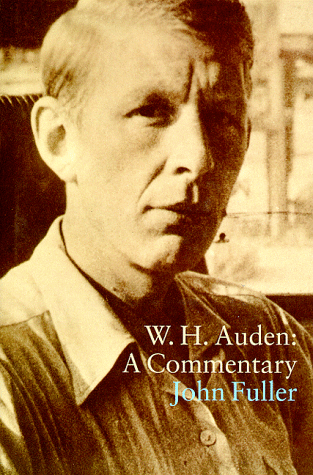
Wystan Hugh Auden was an English poet, who later became an American citizen. He is best known for love poems such as "Funeral Blues," poems on political and social themes such as "September 1, 1939" and "The Shield of Achilles," poems on cultural and psychological themes such as The Age of Anxiety, and poems on religious themes such as "For the Time Being" and "Horae Canonicae."
Auden's poetry was noted for its stylistic and technical achievement, its engagement with politics, morals, love, and religion, and its variety in tone, form and content.
He came to wide public attention at the age of twenty-three, in 1930, with his first book, Poems, followed in 1932 by The Orators. Three plays written in collaboration with Christopher Isherwood in 1935–38 built his reputation as a left-wing political writer. Auden moved to the United States partly to escape this reputation, and his work in the 1940s, including the long poems "For the Time Being" and "The Sea and the Mirror," focused on religious themes. He won the Pulitzer Prize in Poetry for his 1947 long poem The Age of Anxiety, the title of which became a popular phrase describing the modern era.In 1956–61 he was Professor of Poetry at Oxford; his lectures were popular with students and faculty and served as the basis of his 1962 prose collection The Dyer's Hand.
2. Stop all the Clocks, cut off the telephone
Stop all the clocks, cut off the telephone,
Prevent the dog from barking with a juicy bone,
Silence the pianos and with muffled drum
Bring out the coffin, let the mourners come.
Let aeroplanes circle moaning overhead
Scribbling on the sky the message He Is Dead,
Put crepe bows round the white necks of the public doves,
Let the traffic policemen wear black cotton gloves.
He was my North, my South, my East and West,
My working week and my Sunday rest,
My noon, my midnight, my talk, my song;
I thought that love would last for ever: I was wrong.
The stars are not wanted now: put out every one;
Pack up the moon and dismantle the sun;
Pour away the ocean and sweep up the wood.
For nothing now can ever come to any good.
The poet calls for the clocks to be stopped, the telephone to be cut off, and the dog and pianos silenced. The coffin will be brought out to the mourners with a muffled drum and under the moan of airplanes that spell out the message, “He Is Dead.” Doves are to be decked with bows around their necks, and the traffic policemen are to wear black cotton gloves.
The poet thinks of the deceased as “my North, my South, my East and West,” his work and his rest, his noon and his midnight, his talk and his song. He incorrectly thought their love would last forever.
The stars, moon, sun, ocean, and forests, the poet writes, should be sent away; they are no longer needed, and “nothing now can ever come to any good.”
As with many of his poems, there is a mingling of the high and the low. This is in the style of a classical elegy, though it features informal language and objects of everyday life such as a telephone.
The poem appears from the perspective of a man (seemingly the poet himself) deeply mourning the loss of a lover who has died. He begins by calling for silence from the everyday objects of life—the telephone and the clocks—and the pianos, drums, and animals nearby. He doesn’t just want quiet, however; he wants his loss writ large. He wants the life of his lover—seemingly a normal, average man—to be proclaimed to the world as noble and valuable. He wants airplanes to write the message “He Is Dead” in the sky, crepe bows around doves, and traffic policemen wearing black gloves. What seems unbearable to him is the thought that this man’s passing from life to death will be unmarked by anyone other than the poet.
In the third stanza the poet reminisces about how much the man who died meant to him. It is a beautifully evocative section that illustrates the bond between the two; note the theme of completeness in the language, which covers all four primary compass directions and all seven days of the week. Similarly, “noon” and “midnight” together cover, by synecdoche (parts standing for the whole), all hours of the day. The stanza, at the same time, reveals the tragedy of human life, which is that everyone must die and that almost everyone will experience being severed from a loved one; love does not, after all, last forever in this world.
限會員,要發表迴響,請先登入


