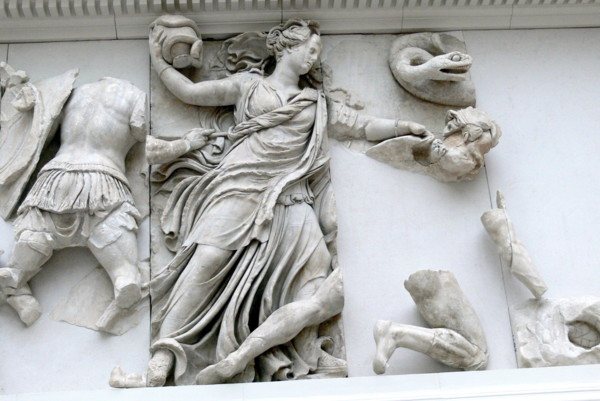
In Greek mythology, the Moirai or Moerae, often known in English as the Fates, were the white-robed incarnations of destiny; their Roman equivalent was the Parcae . Their number became fixed at three: Clotho (spinner), Lachesis (allotter) and Atropos (unturnable).

The Garden of Eden or often Paradise is the biblical "garden of God", described most notably in the Book of Genesis chapters 2 and 3, and also in the Book of Ezekiel. The "garden of God", not called Eden, is mentioned in Genesis 13, and the "trees of the garden" are mentioned in Ezekiel 31. The Book of Zechariah and the Book of Psalms also refer to trees and water in relation to the temple without explicitly mentioning Eden.

The Adam's apple, or laryngeal prominence is a feature of the human neck, and is the lump or protrusion that is formed by the angle of the thyroid cartilage surrounding the larynx.
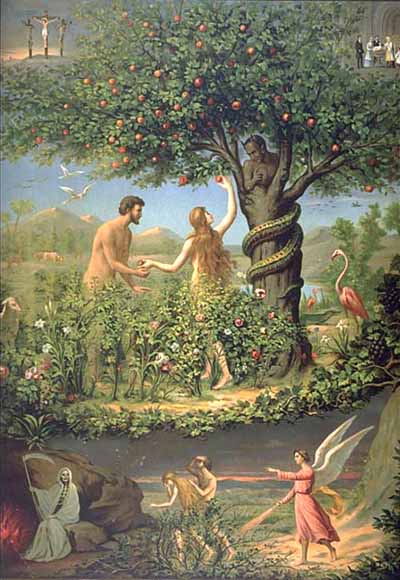
Original sin, also called ancestral sin, is the Christian doctrine of humanity's state of sin resulting from the fall of man, stemming from Adam and Eve's rebellion in Eden, namely the sin of disobedience in consuming from the tree of knowledge of good and evil. This condition has been characterized in many ways, ranging from something as insignificant as a slight deficiency, or a tendency toward sin yet without collective guilt, referred to as a "sin nature", to something as drastic as total depravity or automatic guilt of all humans through collective guilt.
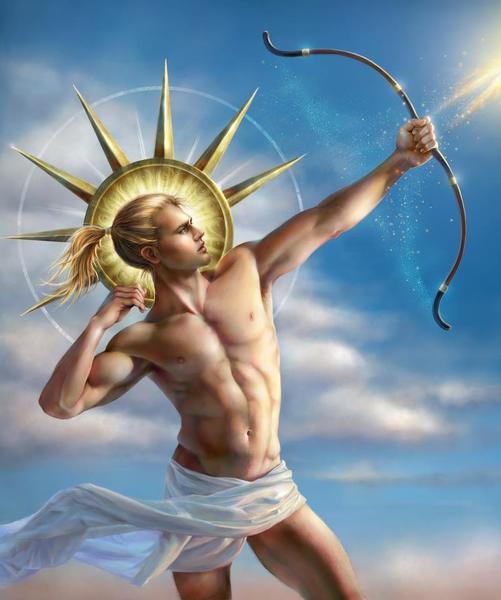
Apollo is one of the most important and complex of the Olympian deities in classical Greek and Roman religion and Greek and Roman mythology. The ideal of the kouros (a beardless, athletic youth), Apollo has been variously recognized as a god of music, truth and prophecy, healing, the sun and light, plague, poetry, and more. Apollo is the son of Zeus and Leto, and has a twin sister, the chaste huntress Artemis. Apollo is known in Greek-influenced Etruscan mythology as Apulu.
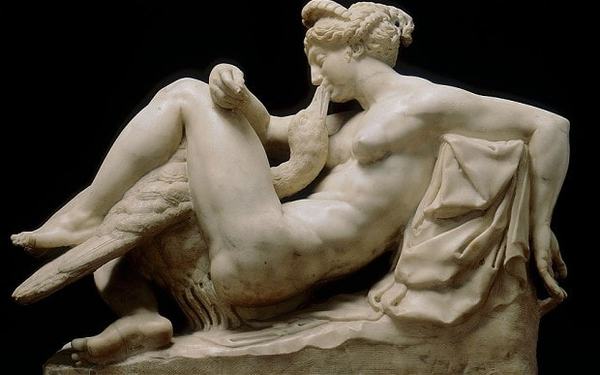
Leda and the Swan is a story and subject in art from Greek mythology in which the god Zeus, in the form of a swan, seduces or rapes Leda. According to later Greek mythology, Leda bore Helen and Polydeuces, children of Zeus, while at the same time bearing Castor and Clytemnestra, children of her husband Tyndareus, the King of Sparta. In the W. B. Yeats version, it is subtly suggested that Clytemnestra, although being the daughter of Tyndareus, has somehow been traumatized by what the swan has done to her mother.
限會員,要發表迴響,請先登入


