● Vocabulary
hypo: under
1. under, beneath, or below: hypodermic
2. lower; at a lower point: hypogastrium
3. less than: hypoploid
.
para: at or to one side of, beside, side by side
e.g., paragraph (a distinct portion of written or printed matter dealing with a particular idea, usually beginning with an indentation on a new line.)
e.g., paralysis (a state of helpless stoppage, inactivity, or inability to act)
e.g., parallel (extending in the same direction, equidistant at all points, and never converging or diverging)
.
paraphrase /ˈpærəˌfreɪz/
: to express what someone else has said or written using different words, especially in order to make it shorter or clearer
e.g., Could you paraphrase your diagnosis of my medical condition, using simpler language?
.
genuine /ˈdʒenjuɪn/
: real, rather than pretended or false
e.g., We are doing everything we can to help people to work towards genuine democracy.
.
liquid paper
 p.s. Correction fluid
A correction fluid or white-out, is an opaque, white fluid applied to paper to mask errors in text. Once dried, it can be written over. It is typically packaged in small bottles, and the lid has an attached brush (or a triangular piece of foam) which dips into the bottle. The brush is used to apply the fluid onto the paper.
Before the invention of word processors, correction fluid greatly facilitated the production of typewritten documents.
One of the first forms of correction fluid was invented in 1951 by the secretary Bette Nesmith Graham, founder of Liquid Paper.
.
typewriter
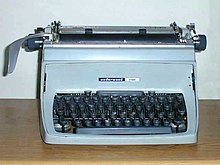 A typewriter is a mechanical or electromechanical machine for writing in characters similar to those produced by printer's movable type by means of keyboard-operated types striking a ribbon to transfer ink or carbon impressions onto paper. Typically one character is printed on each keypress. The machine prints characters by making ink impressions of type elements similar to the sorts used in movable type letterpress printing.
upload.wikimedia.org/wikipedia/commons/9/9e/Typewriter_Wiki.webm
.
● Poetry
Poetry is a form of literature that uses aesthetic and rhythmic qualities of language—such as phonaesthetics, sound symbolism, and metre—to evoke meanings in addition to, or in place of, the prosaic ostensible meaning.
Poetic subgenres:
1. Narrative poetry: Edward Arlington Robinson’s “Richard Cory”
Like a work of (prose) fiction, a narrative poem tells a story; in other words, it has a plot related by a narrator, though its plot might be based on actual rather than made-up events.
2. Lyric Poetry: William Wordsworth’s “I wandered lonely as a cloud”
The word lyric derives from the ancient Greeks, for whom it designated a story poem chanted or sung by a single singer to the accompaniment of a stringed instrument called a lyre.
3. The Dramatic Monologue: Bruce Springsteen’s “Nebraska”
A subgenre of poem that by residing somewhere in between lyric and dramatic poetry.
www.youtube.com/watch?v=I2Vz_Sk8gZ8
------------------------------------------------------------------------------------
The Art of Reading Poetry
Archibald Macleish, "Ars Poetica"
www.poemhunter.com/poem/ars-poetica-2/

.
- Lyric Poetry
William Wordsworth’s “I wandered lonely as a cloud”
.
- The Carpe Diem Poem
Carpe diem is a Latin aphorism, usually translated "seize the day", taken from the Roman poet Horace's Odes (23 BC).
poetry.about.com/od/ourpoemcollections/a/carpediempoems.htm
-- Andrew Marvell, “To His Coy Mistress”
poetry.about.com/library/weekly/blmarvelllove.htm

.
-- Robert Herrick, “To the Virgins, To Make Much of Time”
poetry.about.com/od/poems/l/blherricktovirgins.htm

.
● Poetry and History
www.english.hawaii.edu/criticalink/aristotle/gloss/gloss9.html
Since life is not a plot, it is not sufficient for a poet simply to record events as they happen. Such a chronicle is history, but not poetry. Even if history were cast into the same kind of meter as is used in tragedy, Aristotle argues, it would only be history in verse. A poet "should the maker of plots rather than verses" (54), for plots, more than merely organizing events into a coherent structure, serve to represent the universal laws of probability. The true difference between historians and poets, Aristotle states, is that the former records what has happened, while the latter represents what may happen.
Poetry is more "philosophical" than history, according to Aristotle, because in order to unfold a plot in a manner that is convincing to the audience, the poet must grasp and represent the internal logic, the necessity, of the outcome of those events.
Aristotle condemns poets that simply string episodes together, and reminds his readers that tragic plots must not only be coherent but also inspire "fear or pity" in the audience. He concludes this chapter with a suggestive analysis of surprise in drama: a surprising development in a tragedy is most effective when it does not merely produce shock at an unexpected occurance, but rather has an "air of design" (54) and seems to be the necessary, inevitable (but still frightening) outcome of a chain of actions.
.
● Synecdoche
A synecdoche (/sɪˈnɛkdəkiː/; from Greek, meaning "simultaneous understanding") is a figure of speech in which a term for a part of something refers to the whole of something, or vice versa.
A synecdoche is a class of metonymy, often by means of either mentioning a part for the whole, or conversely the whole for one of its parts. Examples from everyday English-language idiomatic expressions include "bread and butter" for "livelihood", "suits" for "businessmen", "boots" for "soldiers", etc.
.
● 奚永慧勇敢走自己的路
下一則: WEEK 11 文導筆記 (Approaches to Literature)
限會員,要發表迴響,請先登入


