What Are Little Boys Made Of?
"What Are Little Boys Made Of?" is a popular nursery rhyme dating from the early 19th century. It has a Roud Folk Song Indexnumber of 821.
- What are little boys made of?
- What are little boys made of?
- Snips and snails
- And puppy-dogs' tails
- That's what little boys are made of
- What are little girls made of?
- What are little girls made of?
- Sugar and spice
- And everything nice (or all things nice)
- That's what little girls are made of
The rhyme appears in many variant forms. For example, other versions may describe boys as being made of "snaps", "frogs", "snakes", or "slugs", rather than "snips" as above.
.
Eddy Arnold - Little Girls And Little Boys Lyrics
Little girls and little boys often cry over broken toys
But tears which fall like gentle rain wash away the hurt and pain
Little girls and little boys when they grow older change their toys
They learn that life's a hurting game but never know who's to blame
No more a child is the saddest line ever written in the sands of time
No matter how heavy the tide of tears no more can they wash away the fears
Pretty women grown off men try but can't go back again
And they're lost like all the toys they had as little girls and boys
(Everything's lost like all the toys) they had as little girls and boys
.
.
Cumulative tale
In a cumulative tale, sometimes also called a chain tale, action or dialogue repeats and builds up in some way as the tale progresses. With only the sparest of plots, these tales often depend upon repetition and rhythm for their effect, and can require a skilled storyteller to negotiate their tongue-twisting repetitions in performance. The climax is sometimes abrupt and sobering as in "The Gingerbread Man." The device often takes the form of a cumulative song or nursery rhyme. Many cumulative tales feature a series of animals or forces of nature each more powerful than the last.
.
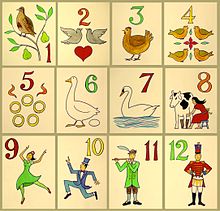
On the First day of Christmas my true love sent to me
a Partridge in a Pear Tree.
On the Second day of Christmas my true love sent to me
Two Turtle Doves
and a Partridge in a Pear Tree.
On the Third day of Christmas my true love sent to me
Three French Hens,
Two Turtle Doves
and a Partridge in a Pear Tree.
.
Toni Morrison

Toni Morrison (born Chloe Ardelia Wofford; February 18, 1931) is an American novelist, editor, and professor. Her novels are known for their epic themes, vivid dialogue, and richly detailed characters. Among her best known novels are The Bluest Eye (1970),Sula (1973), Song of Solomon (1977), and Beloved (1987). She was also commissioned to write the libretto for a new opera,Margaret Garner, first performed in 2005. She won the Pulitzer Prize and the American Book Award in 1988 for Beloved and theNobel Prize in 1993. On May 29, 2012, she received the Presidential Medal of Freedom. Morrison serves as Professor Emeritus atPrinceton University.
.
The Bluest Eye
The Bluest Eye is a 1970 novel by American author Toni Morrison. It is Morrison's first novel and was written while she was teaching at Howard University and raising her two sons on her own. The story is about a year in the life of a young black girl named Pecola who develops an inferiority complex due to her eye color and skin appearance. It is set in Lorain, Ohio, against the backdrop of America's Midwest during the years following the Great Depression. The point of view switches between the perspective of Claudia MacTeer, as a child and as an adult, and a third-person omniscient viewpoint. Because of the controversial nature of the book, which deals with racism, incest, and child molestation, there have been numerous attempts to ban it from schools and libraries.
.
http://www.douban.com/note/287128287/
童妮.摩里森(Toni Morrison)1970年出版的第一本小說,以其家鄉俄亥俄州樂仁鎮為背景,敘述遭受漠視的十一歲黑人小女孩琵可拉可望為人喜愛和關注,而祈求自己擁有白人的藍眼睛。然而,發生在琵可拉身上的一件駭人事件,讓全鎮的金盞花不見蹤影,也使他的人生走向悲劇性的毀滅。
摩里森藉由故事批判盲從主流價值觀將導致自我迷失,帶給人強烈警惕與震撼,歷久不衰。
.
Why Mosquitoes Buzz in People’s Ears
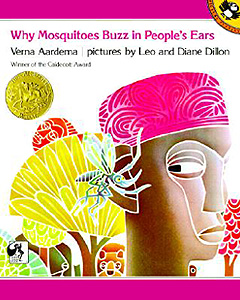
Why Mosquitoes Buzz in People's Ears: A West African Tale is a picture book by Verna Aardema and illustrated by Leo and Diane Dillon told in the form of a cumulative tale written for young children, which tells an African legend. In this origin story, the mosquito lies to a lizard, who puts sticks in his ears and ends up frightening another animal, which down a long line causes a panic. In the end, an owlet is killed and the owl is too sad to wake the sun until the animals hold court and find out who is responsible. The mosquito is eventually found out, but it hides in order to escape punishment. So now it constantly buzzes in people's ears to find out if everyone is still angry at it.
.
This story is a resource for teachers to teach the skill cause and effect: "A cause is something that makes something else happen; An effect is what happens as a result of the cause"
The idea that the mosquito is to blame for the unfortunate death of the owlet is an example of cause and effect. The actions from the other animals also offers several more examples of cause and effect as each animal does something that causes the next animal to do something. This chain of events finally causes the owlet to die. Teachers can use this text to show students how actions (causes) make other things happen (effect).
.
Characters
Mother Owl: woke up the sun each day, so the day can come.
Mosquito (annoy) lies to a lizard
Iquana (frighten)
python (scare)
rabbit (startle)
crow (alarm)
monkey (kill)
下一則: WEEK 09 英文兒童文學筆記 (English Children's Literature)
限會員,要發表迴響,請先登入


