Allegory
As a literary device, an allegory in its most general sense is an extended metaphor. Writers or speakers typically use allegories as literary devices or as rhetorical devices that convey hidden meanings through symbolic figures, actions, imagery, and/or events, which together create the moral, spiritual, or political meaning the author wishes to convey.
.
Fable
Fable is a literary genre: a succinct fictional story, in prose or verse, that features animals, mythical creatures, plants, inanimate objects, or forces of nature that are anthropomorphized (given human qualities, such as verbal communication) and that illustrates or leads to an interpretation of a moral lesson (a "moral"), which may at the end be added explicitly as a pithy maxim.
.
Parable
A parable is a succinct, didactic story, in prose or verse, which illustrates one or more instructive lessons or principles. It differs from a fable in that fables employ animals, plants, inanimate objects, or forces of nature as characters, whereas parables have human characters. A parable is a type of analogy.
.
*** HINT ***
What are the differences between “allegories”, “fables” and “parables”?
Allegory: A story in which ideas are symbolized as people. E.g., The Faerie Queene
Parable: A short story designed to teach a moral or religious lesson. E.g., The Prodigal Son
Fable: A short story in which animals or objects speaks a story, to teach a moral or religious lesson. E.g., Aesop's Fables
Notes on Quiz
www.funtrivia.com/playquiz/quiz323043b5b88.html
.
1. Thistle
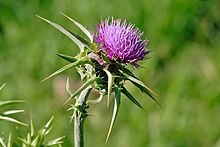
Thistle is the common name of a group of flowering plants characterized by leaves with sharp prickles on the margins, mostly in the family Asteraceae. Prickles often occur all over the plant – on surfaces such as those of the stem and flat parts of leaves.
.
2. be contented with
Today while the blossoms still cling to the vine
I'll taste your strawberries, I'll drink your sweet wine
A million tomorrows shall all pass away
Ere I'll forget all the joy that is mine today
I'll be a dandy, and I'll be a rover
You'll know who I am by the songs that I sing
I'll feast at your table, I'll sleep in your clover
Who cares what tomorrow shall bring
Today, while the blossoms still cling to the vine
I'll taste your strawberries, I'll drink your sweet wine
A million tomorrows shall all pass away
Ere I'll forget all the joy that is mine, today
I can't be contented with yesterday's glory
I can't live on promises winter to spring
Today is my moment, now is my story
I'll laugh and I'll cry and I'll sing
Today, while the blossoms still cling to the vine
I'll taste your strawberries, I'll drink your sweet wine
A million tomorrows shall all pass away
Ere I forget all the joy that is mine today
2. Carpe diem
Carpe diem is a Latin aphorism, usually translated "seize the day."
E.g., "To the Virgins, to Make Much of Time" by Robert Herrick
E.g., "To His Coy Mistress" by Andrew Marvell
.
3. The Ass Carrying Salt

http://mythfolklore.net/aesopica/aesop1884/211.htm
The same measures will not suit all circumstances.
.
4. The Fox who had Lost his Tail

http://mythfolklore.net/aesopica/aesop1884/145.htm
Advice prompted by selfishness should not be heeded.
.
5. The Lion and the Dolphin
http://mythfolklore.net/aesopica/aesop1884/41.htm
Let every one stick to his own element.
.
Aesop's Fables
Aesop's Fables or the Aesopica is a collection of fables credited to Aesop, a slave and storyteller believed to have lived inancient Greece between 620 and 560 BCE. Of diverse origins, the stories associated with Aesop's name have descended to modern times through a number of sources. They continue to be reinterpreted in different verbal registers and in popular as well as artistic media.
.
Aesop (1884) Index: http://mythfolklore.net/aesopica/aesop1884/index.htm
.
The Boy Who Cried Wolf

The Boy Who Cried Wolf is one of Aesop's Fables, numbered 210 in the Perry Index. From it is derived the English idiom "to cry wolf", defined as "to give a false alarm" in Brewer's Dictionary of Phrase and Fable and glossed by the Oxford English Dictionary as meaning to make false claims, with the result that subsequent true claims are disbelieved.
The tale concerns a shepherd boy who repeatedly tricks nearby villagers into thinking a wolf is attacking his flock. When one actually does appear and the boy again calls for help, the villagers believe that it is another false alarm and the sheep are eaten by the wolf.
The moral stated at the end of the Greek version is, "this shows how liars are rewarded: even if they tell the truth, no one believes them". It echoes a statement attributed to Aristotle by Diogenes Laërtius in his The Lives and Opinions of Eminent Philosophers, where the sage was asked what those who tell lies gain by it and he answered "that when they speak truth they are not believed". William Caxton similarly closes his version with the remark that "men bileve not lyghtly hym whiche is knowen for a lyer".
.
The Fox and the Grapes
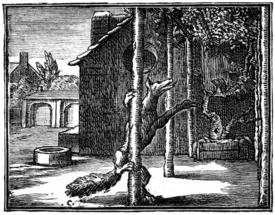
The Fox and the Grapes is one of the Aesop's fables, numbered 15 in the Perry Index. The narration is concise and subsequent retellings have often been equally succinct. The story concerns an anthropomorphized fox that tries to eat grapes from a vine but cannot reach them. Rather than admit defeat, it denies they are desirable in a rationalisation that has been identified with cognitive dissonance. The expression "sour grapes" originated from this fable.
.
The fable of The Fox and the Grapes is one of a number which feature only a single animal protagonist. There are several Greek versions as well as one in Latin by Phaedrus(IV.3) which is terse and to the point:
- Driven by hunger, a fox tried to reach some grapes hanging high on the vine but was unable to, although he leaped with all his strength. As he went away, the fox remarked 'Oh, you aren't even ripe yet! I don't need any sour grapes.' People who speak disparagingly of things that they cannot attain would do well to apply this story to themselves.
In her version of La Fontaine's Fables, Marianne Moore underlines his ironical comment on the situation in a final pun, "Better, I think, than an embittered whine".
Although the fable describes purely subjective behaviour, the English idiom "sour grapes" which develops from the story is now often used also of envious disparagement to others. Similar expressions exist in other languages, but in the Scandinavian equivalent the fox makes its comment about rowanberries since grapes are not common in northern latitudes.
.
The North Wind and the Sun
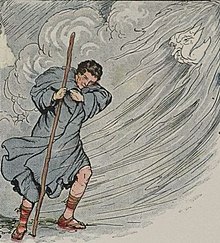

The North Wind and the Sun is one of Aesop's Fables (Perry Index 46). It is type 298 (Wind and Sun) in the Aarne-Thompson folktale classification. The moral it teaches about the superiority of persuasion over force has made the story widely known. It is also known for being a chosen text for phonetic transcriptions.
The story concerns a competition between the North wind and the Sun to decide which is the stronger of the two. The challenge was to make a passing traveler remove his cloak. However hard the North Wind blew, the traveler only wrapped his cloak tighter to keep warm, but when the Sun shone, the traveler was overcome with heat and soon took his cloak off.
Etymology & Vocabulary
1. morale: the amount of enthusiasm that a person or group of people feel about their situation at a particular time
1. E.g., Morale is low, and many people are disillusioned.
1. moral: relating to right and wrong and the way that people should behave
1. E.g., our children’s religious and moral education
.
2. be apt to: to have a tendency to do something
2. E.g., They are apt to become a little careless if you don’t watch them carefully.
.
3. assemble: to bring a group of things or people together in one place for a particular purpose
3. E.g., How long would it take to assemble a team for a project like this?
3. assembly: a part of a government consisting of people who have been elected to make laws
3. E.g., The ruling party holds only a three-vote majority in the assembly.
.
4. di-: two; more than two things
下一則: WEEK 11 英文兒童文學筆記 (English Children's Literature)
限會員,要發表迴響,請先登入


