● Vocabulary
mock /mɒk/ v. 嘲笑
to make someone or something look stupid by laughing at them, copying them, or saying something that is not kind
e.g., ‘Haven’t you finished yet?’ he mocked.
.
nature vs. nurture
The phrase nature and nurture relates to the relative importance of an individual's innate qualities ("nature" in the sense of nativism or innatism) as compared to an individual's personal experiences ("nurture" in the sense of empiricism or behaviorism) in causing individual differences, especially in behavioral traits.
nature: a basic quality or feature of something
nurture: to provide the necessary conditions for something to grow and develop
.
strait vs. channel
strait: a narrow waterway that connects two large bodies of water
strait: e.g., the Strait of Gibraltar connects the Atlantic Ocean to the Mediterranean Sea
channel: a wide waterway that passes between two neighboring land masses
channel: e.g., the English Channel separates Southern England from Northern France
.
mort, mor: mortal, death
e.g., mortal (human and not able to live for ever)
e.g., mortuary (a morgue)
e.g., mortician (someone whose job is to arrange funerals. The British word is undertaker)
.
ma: mother
e.g., matrimony (marriage)
.
radish /ˈrædɪʃ/ n. 白蘿蔔;蕪菁
a small pink or red vegetable that is eaten raw in salads

.
prominent /ˈprɒmɪnənt/ adj.
important and well known
e.g., She is likely to play a prominent part in the presidential campaign.
.
qua: four
e.g., quadrangle (a square area in a school or university surrounded on all sides by buildings)
e.g., quadruplet (a baby who is born at the same time as three other babies to the same mother)
e.g., quarter (one of four equal parts of something)
.
speaker vs. persona
A speaker in a work of literature is a character that says things does actions based on the (intended by the author) personality of that character.
A persona in a work of literature is a bit different because the persona is just basically a mouthpiece for a world view, which is different than a speaker because a speaker acts and speaks according to the intended personality, not a world view.
.
learn /lɜː(r)n/ v.
(1) to gain knowledge or experience of something, for example by being taught
(1) e.g., We’re learning fractions in maths this week.
(2) to gain new information about a situation, event, or person
(2) e.g., We were distressed to learn that American troops were the targets of the attack.
(2) e.g., It's my pleasure to learn (= get informed) that...
.
alter /ˈɔːltə(r)/ v.
to make something or someone different
e.g., This doesn’t alter the fact that what you did was wrong.
.
alternative /ɔːlˈtɜː(r)nətɪv/ adj.
different from something else and able to be used instead of it
e.g., Alternative ways of getting there will be investigated.
.
● Hyperbole
Hyperbole is the use of exaggeration as a rhetorical device or figure of speech. It is used in poems to create emphasis on a situation. It may be used to evoke strong feelings or to create a strong impression, but is not meant to be taken literally.
Hyperboles are exaggerations to create emphasis or effect. As a literary device, hyperbole is often used in poetry, and is frequently encountered in casual speech. Many times the usage of hyperbole describes something as better or worse than it really is. An example of hyperbole is: "The bag weighed a ton." Hyperbole makes the point that the bag was very heavy, though it probably does not weigh a ton.
.
● Carpe Diem
Carpe diem is a Latin aphorism, usually translated "seize the day", taken from the Roman poet Horace's Odes (23 BC).
The sentiment carries with it an awareness of the passage of time, the fleeting nature of life, and the approach of death and decay, and its exhortation to take hold of the present moment, make the most of the time we have, and live life fully has resonated down the centuries in many poems. Here are a few of the classics:
Andrew Marvell, “To His Coy Mistress” (1681)
John Donne, "The Flea" (1633)
Henry Wadsworth Longfellow, “A Psalm of Life” (1839)
.
● Eros
In Greek mythology, Eros, was the Greek god of love. His Roman counterpart was Cupid. Some myths make him a primordial god, while in other myths, he is the son of Aphrodite.
Cupid's arrows
Cupid carries two kinds of arrows, one with a sharp golden point, and the other with a blunt tip of lead. A person wounded by the golden arrow is filled with uncontrollable desire, but the one struck by the lead feels aversion and desires only to flee.
When Apollo taunts Cupid as the lesser archer, Cupid shoots him with the golden arrow, but strikes the object of his desire, the nymph Daphne, with the lead. Trapped by Apollo's unwanted advances, Daphne prays to her father, the river god Peneus, who turns her into a laurel, the tree sacred to Apollo. It is the first of several unsuccessful or tragic love affairs for Apollo.
.
● The Tempest

The Tempest is a play by William Shakespeare. It is set on a remote island, where Prospero, the rightful Duke of Milan, plots to restore his daughter Miranda to her rightful place using illusion and skilful manipulation. He conjures up a storm, the eponymous tempest, to lure his usurping brother Antonio and the complicit King Alonso of Naples to the island. There, his machinations bring about the revelation of Antonio's lowly nature, the redemption of the King, and the marriage of Miranda to Alonso's son, Ferdinand.
● "O Tell Me the Truth About Love"
"O Tell Me The Truth About Love" by W.H. Auden
www.youtube.com/watch?v=g3O2H3bV1eo
Summary and Analysis: www.gradesaver.com/w-h-auden-poems/study-guide/summary-o-tell-me-the-truth-about-love
.
● "Leda and the Swan"
"Leda and the Swan" By William Butler Yeats
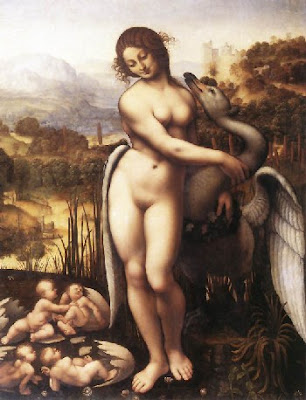
Leda
In Greek mythology, Leda was daughter of the Aetolian king Thestius, and wife of king Tyndareus of Sparta. Her myth gave rise to the popular motif in Renaissance and later art of Leda and the Swan. She was the mother of Helen of Troy, Clytemnestra, and Castor and Pollux.
Leda was admired by Zeus, who seduced her in the guise of a swan.
.
Bibliography, as a discipline, is traditionally the academic study of books as physical, cultural objects; in this sense, it is also known as bibliology. Carter and Barker (2010) describe bibliography as a twofold scholarly discipline—the organized listing of books (enumerative bibliography) and the systematic description of books as physical objects (descriptive bibliography).
.
Reminder of human morality; literally, "Remember that you must die" (Latin).
e.g., "It seemed as though, to both, there was a relief in laying down their somewhat futile activities in the presence of the vast Memento Mori which faced them." --Roman Fever, by Edith Wharton
.
love and lost; dream and adventure; life and death
.
● Four Weddings and a Funeral

Over the course of five social occasions, a committed bachelor must consider the notion that he may have discovered love.
.
● Film Poems
It's a Youtube channel.
"My videos are film (and sometimes TV) clips that quote novels or poems. My hope is that through this channel, people who aren't fans of poetry in paper form can come to appreciate it through video form."
Four Weddings and a Funeral - "Funeral Blues"
Anne of Green Gables - "The Highwayman"
Shirley Temple - "Wee Willie Winkie"
.
● Elegy 悼亡詩/輓歌
In English literature, an elegy is a mournful, melancholic or plaintive poem, especially a funeral song or a lament for the dead.
(1) since the Renaissance, usually a formal lament on the death of a particular person, but focusing mainly on the speaker’s efforts to come to terms with his or her grief; (2) more broadly, any lyric in sorrowful mood that takes death as its primary subject. An example is W. H. Auden’s "In Memory of W. B. Yeats."
p.s. 1. "Stop all the clocks, cut off the telephone" is also an elegy.
p.s. 2. Funeral Blues - Four Weddings and a Funeral
p.s. 2. www.youtube.com/watch?v=DDXWclpGhcg
-- note 1: lament (v.) to show publicly that you feel sad or disappointed about something
-- note 1: e.g., Some older people lament the loss of close local communities.
-- note 2: lament (n.) a song, poem, piece of music etc in which sadness is expressed about a death or loss
-- note 2: e.g., a young mother’s lament for the death of her son
下一則: WEEK 12 文導筆記 (Approaches to Literature)
限會員,要發表迴響,請先登入


