Etymology
mono- : one; single e.g., monogamy, monochrome, monorail
(-gamy: marriage; union; fertilization e.g., monogamy, autogamy, bigamy)
bi- : twice, two e.g., bifocal, bicycle, biennial
tri- : three e.g., triangle, trigon, trisect
qua- : four e.g., quadrangle, quarter, quart
penta- : five e.g., pentameter, pentagon, pentaprism
oct- : eight e.g., octave, octopus
.
astro- : pertaining to stars or celestial bodies, or to activities, as spaceflight, taking place outside the earth's atmosphere
e.g., astrology, astronomy, astronaut
Vocabularies
change (to become different, or to make someone or something different) After a few days the weather changed dramatically.
rotate ◎ (to move in a circle around a fixed central point, or to move something in this way) The Earth rotates 360 degrees every 24 hours.
alter ←→ (to make something or someone different) This doesn’t alter the fact that what you did was wrong.
shift ┴┴ (if an idea, attitude, or plan shifts, or if someone shifts it, it changes) Public opinion had shifted sharply to the left following the war.
switch ↑↓ (to change from one thing to another, or to make something do this) Then he switched sides and turned against his former allies.
.
lead
(noun) the main actor in a play, film, or television programme
e.g., Glenn Close was chosen as the female lead.
(verb) to be in control of an organization, group of people, or activity
e.g., She led the software development team during the project.
.
xerox /ˈzɪərɒks/ copy
a copy made by a xerographic printer
carbon copy (abbr. cc)
a copy of a document made by using carbon paper
Danaë and the Shower of Gold

The Danaë (or Danaë and the Shower of Gold) series comprises at least five oil-on-canvas paintings by the Venetian master Titian, completed between 1540 and 1570. The works are based on the mythological princess Danaë. According to Ovid she was isolated in a bronze dungeon following a prophecy that her firstborn would eventually kill her father. Although aware of the consequences, Danaë was seduced and became pregnant by Zeus (in Roman mythology Jupiter), who, inflamed by lust, descended from Mount Olympus to entice her as a shower of gold.
.
Legend of Danaë

According to Greek mythology known by Titian through Ovid's telling, when Acrisius consulted the oracle on how he would get male children, he was told that his daughter would bear a son who would kill him. Acrisius then locked up and guarded his daughter Danaë in a subterranean dungeon. Danaë, aware of the consequences, allowed herself to be seduced and impregnated by Zeus, who persuaded her to lower her defences by appearing in the form of a shower of gold.
When Acrisius learned of Danaë's son Perseus, he refused to believe Zeus's role, and cast mother and child adrift at sea in a chest. They landed at Seriphus, where Perseus was raised by Dictys. Perseus eventually fulfilled the prophecy by killing Acrisius years after—although accidentally.
Danaë was seen in the Middle Ages and Renaissance as a symbol of the corrupting effect of wealth, which could taint even feminine beauty or moral virtue.
.
Phallic symbolism
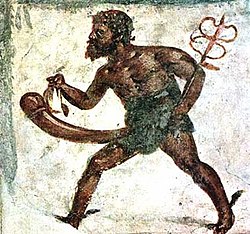
A phallus is a penis, especially when erect, an object that resembles a penis, or a mimetic image of an erect penis.
Any object that symbolically resembles a penis may also be referred to as a phallus; however, such objects are more often referred to as being phallic (as in "phallic symbol"). Such symbols often represent fertility and cultural implications that are associated with the male sexual organ, as well as the male orgasm.
Foul language
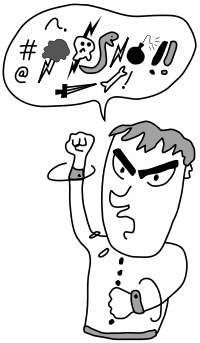
Profanity is "an offensive word" or "offensive language". It is also called bad language, strong language, coarse language, foul language, bad words, vulgar language, lewd language, swearing, cursing, cussing, or using expletives. This use is a subset of a language's lexicon that is generally considered to be strongly impolite, rude or offensive. It can show a debasement of someone or something, or show intense emotion. Profanity in this sense takes the form of words or verbal expressions that fall into the category of formulaic language.
In its older, more literal sense, the term "profanity" refers to "offensive words, or religious words", used in a way that shows the user does not respect "God or holy things", or behaviour showing similar disrespect.
Hans Christian Andersen

Hans Christian Andersen (2 April 1805 – 4 August 1875) was a Danish author. Although a prolific writer of plays, travelogues, novels, and poems, Andersen is best remembered for his fairy tales. Andersen's popularity is not limited to children; his stories, called eventyr in Danish or "fairy-tales" in English, express themes that transcend age and nationality.
Andersen's fairy tales, which have been translated into more than 125 languages, have become culturally embedded in the West's collective consciousness, readily accessible to children, but presenting lessons of virtue and resilience in the face of adversity for mature readers as well. Some of his most famous fairy tales include "The Emperor's New Clothes", "The Little Mermaid", "The Nightingale", "The Snow Queen", "The Ugly Duckling", and many more.
His stories have inspired ballets, both animated and live-action films, and plays.
.
The Emperor's New Clothes

"The Emperor's New Clothes" is a short tale by Hans Christian Andersen about two weavers who promise an emperor a new suit of clothes that is invisible to those who are unfit for their positions, stupid, or incompetent. When the Emperor parades before his subjects in his new clothes, no one dares to say that he doesn't see any suit of clothes until a child cries out, "But he isn't wearing anything at all!" The tale has been translated into over a hundred languages.
.
The Ugly Duckling

"The Ugly Duckling" is a literary fairy tale by Danish poet and author Hans Christian Andersen. The story tells of a homely little bird born in a barnyard who suffers abuse from the others around him until, much to his delight (and to the surprise of others), he matures into a beautiful swan, the most beautiful bird of all. The story is beloved around the world as a tale about personal transformation for the better. The tale has been adapted to various media including opera, musical, and animated film. The tale is completely Andersen's invention and owes no debt to fairy tales or folklore.
.
The Red Shoes

"The Red Shoes" is a fairy tale by Danish poet and author Hans Christian Andersen first published by C.A. Reitzel in Copenhagen 7 April 1845 in New Fairy Tales.
| A peasant girl named Karen is adopted by a rich old lady after her mother's death and grows up vain and spoiled. Before her adoption, Karen had a rough pair of red shoes; now she has her adoptive mother buy her a pair of red shoes fit for a princess. After Karen repeatedly wears them to church, they begin to move by themselves, but she is able to get them off. One day, when her adoptive mother becomes ill, Karen goes to attend a party in her red shoes. A mysterious soldier appears and makes strange remarks about what beautiful dancing shoes Karen has. Soon after, Karen's shoes begin to move by themselves again, but this time they can't come off. The shoes continue to dance, night and day, rain or shine, through fields and meadows, and through brambles and briers that tear at Karen's limbs. She can't even attend her adoptive mother's funeral. An angel appears to her, bearing a sword, and condemns her to dance even after she dies, as a warning to vain children everywhere. Karen begs for mercy but the red shoes take her away before she hears the angel's reply. Karen finds an executioner and asks him to chop off her feet. He does so but the shoes continue to dance, even with Karen's amputated feet inside them. The executioner gives her a pair of wooden feet and crutches, and teaches her the criminals' psalm. Thinking that she has suffered enough for the red shoes, Karen decides to go to church so people can see her. Yet her amputated feet, still in the red shoes, dance before her, barring the way. The following Sunday she tries again, thinking she is at least as good as the others in church, but again the dancing red shoes bar the way. Karen gets a job as a maid in the parsonage, but when Sunday comes she dares not go to church. Instead she sits alone at home and prays to God for help. The angel reappears, now bearing a spray of roses, and gives Karen the mercy she asked for: her heart becomes so filled with sunshine, peace, and joy that it bursts. Her soul flies on sunshine to Heaven, where no one mentions the red shoes. |
.
The Snow Queen

"The Snow Queen" (Danish: Snedronningen) is an original fairy tale written by Hans Christian Andersen (1805–1875). The story is one of Andersen's longest and most highly acclaimed stories. It is regularly included in selected tales and collections of his work and is frequently reprinted in illustrated storybook editions for children.
The Walt Disney Animation Studios film Frozen was originally developed as an adaptation of "The Snow Queen", although by the time the film was released the plot had almost nothing in common with the original story.
Dreams (1990 film)

《夢》(日語:ゆめ,英文片名:Dreams)乃日本知名導演黑澤明在1990年執導的電影,該片由八則夢境片段組成,曾入圍1990年坎城影展。
NATO phonetic alphabet

The International Radiotelephony Spelling Alphabet, commonly known as the NATO phonetic alphabet and also known as the ICAO radiotelephonic, phonetic or spelling alphabet and the ITU radiotelephonic orphonetic alphabet, is the most widely used radiotelephonic spelling alphabet. Although often called "phonetic alphabets", spelling alphabets are not associated with phonetic transcription systems such as the International Phonetic Alphabet. Instead, the International Civil Aviation Organization (ICAO) alphabet assigned code wordsacrophonically to the letters of the English alphabet so that critical combinations of letters and numbers can be pronounced and understood by those who transmit and receive voice messages by radio or telephone regardless of language barriers or the presence of transmission static.
The 26 code words in the NATO phonetic alphabet are assigned to the 26 letters of the English alphabet inalphabetical order as follows: Alfa, Bravo, Charlie, Delta, Echo, Foxtrot, Golf, Hotel, India, Juliett, Kilo, Lima, Mike, November, Oscar, Papa, Quebec, Romeo, Sierra, Tango, Uniform, Victor, Whiskey, X-ray, Yankee, Zulu.
下一則: WEEK 13 英文兒童文學筆記 (English Children's Literature)
限會員,要發表迴響,請先登入


