Week 13: The Brothers Grimm
Quiz
1. The Grimms both studied: Law
2. What money were the Grimms featured on in Europe in the late 1990s? Deutschmarks
3. In the original fairy tales, a second Snow White appears in a story with her sister: Rose Red
4. In the original story, the Frog Prince's curse was broken when the princess: Threw him against a wal
5. The Grimms also wrote: A German dictionary
6. The Grimms protested the abolition of their current German: Constitution
7. The first version of a Cinderella story appeared in: China
8. In the original version of their story, which hero(es) did not survive? Red Riding Hood
9. Which fairy tale is believed to have some basis in historical fact? The Pied Piper
10. Who directed the recent film based loosely on the life of the Brothers Grimm? Terry Gilliam
.
Brothers Grimm

The Brothers Grimm, Jacob and Wilhelm Grimm, were German academics, linguists, cultural researchers, lexicographers and authors who together specialized in collecting and publishing folklore during the 19th century. They were among the best-known storytellers of folk tales, and popularized stories such as "Cinderella" ("Aschenputtel"), "The Frog Prince" ("Der Froschkönig"), "The Goose-Girl" ("Die Gänsemagd"), "Hansel and Gretel" ("Hänsel und Gretel"), "Rapunzel", "Rumpelstiltskin" ("Rumpelstilzchen"),"Sleeping Beauty" ("Dornröschen"), and "Snow White" ("Schneewittchen").
They both attended the University of Marburg where they developed a curiosity about German folklore, which grew into a lifelong dedication to collecting German folk tales. The rise of romanticism during the 19th century revived interest in traditional folk stories, which to the brothers represented a pure form of national literature and culture. With the goal of researching a scholarly treatise on folk tales, they established a methodology for collecting and recording folk stories that became the basis for folklore studies.
- Jacob Grimm

Jacob Ludwig Carl Grimm (4 January 1785 – 20 September 1863) was a German philologist, jurist, and mythologist. He is known as the discoverer of Grimm's law (linguistics), the co-author with his brother Wilhelm of the monumental Deutsches Wörterbuch, the author of Deutsche Mythologie and, more popularly, as one of the Brothers Grimm and the editor of Grimm's Fairy Tales.
.
- Wilhelm Grimm
Wilhelm Carl Grimm (24 February 1786 – 16 December 1859) was a German author, the younger of the Brothers Grimm.
00
Lexicography
Lexicography is divided into two separate but equally important groups:
- Practical lexicography is the art or craft of compiling, writing and editing dictionaries.
- Theoretical lexicography is the scholarly discipline of analyzing and describing the semantic, syntagmatic and paradigmatic relationships within the lexicon (vocabulary) of alanguage, developing theories of dictionary components and structures linking the data in dictionaries, the needs for information by users in specific types of situations, and how users may best access the data incorporated in printed and electronic dictionaries. This is sometimes referred to as 'metalexicography'.
A person devoted to lexicography is called a lexicographer.
Fairy Tale
A fairy tale is a type of short story that typically features European folkloric fantasy characters, such as dwarves, elves, fairies, giants, gnomes, goblins, mermaids, trolls, or witches, and usually magic or enchantments. Fairy tales may be distinguished from other folk narratives such as legends (which generally involve belief in the veracity of the events described) and explicitly moral tales, including beast fables.
.
Happy ending
A happy ending is an ending of the plot of a work of fiction in which almost everything turns out for the best for the protagonists, their sidekicks, and almost everyone except the villains. A happy ending is epitomized in the standard fairy tale ending phrase, "happily ever after" or "and they lived happily ever after."
.
Protagonist
The protagonist, meaning "player of the first part, chief actor") or main character is a narrative's central or primary personal figure, who comes into conflict with an opposing major character or force (called the antagonist).
.
Antagonist
An antagonist is a character, group of characters, institution, or concept that stands in or represents opposition against which the protagonist(s) must contend. In other words, an antagonist is a person or a group of people who opposes a protagonist.
.
Sidekick
A sidekick is a slang expression for a close companion or colleague (not necessarily in fiction) who is actually, or generally regarded as, subordinate to the one he accompanies. Some well-known fictional sidekicks are Don Quixote'sSancho Panza, Sherlock Holmes' Doctor Watson, and Batman's Robin.
.
Once upon a time

"Once upon a time" is a stock phrase used to introduce a narrative of past events, typically in fairy tales and folk tales. It has been used in some form since at least 1380 (according to the Oxford English Dictionary) in storytelling in the English language and has opened many oral narratives since 1600. These stories often then end with "and they all lived happily ever after," or, originally, "happily until their deaths."
The phrase is particularly common in fairy tales for younger children, where it is almost always the opening line of a tale. It was commonly used in the original translations of the stories of Charles Perrault as a translation for the French "il était une fois", of Hans Christian Andersen as a translation for the Danish "der var engang", (literally "there was once"), the Brothers Grimm as a translation for the German "es war einmal" (literally "it was once") and Joseph Jacobs in English translations and fairy tales.
The phrase is also frequently used in such oral stories as retellings of myths, fables, folklore and children's literature.
Robert Louis Stevenson
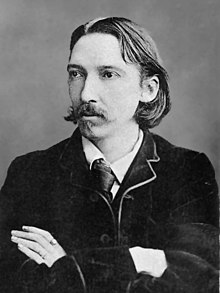
Robert Louis Balfour Stevenson (13 November 1850 – 3 December 1894) was a Scottish novelist, poet, essayist, and travel writer. His most famous works are Treasure Island, Kidnapped, and Strange Case of Dr Jekyll and Mr Hyde.
.
Treasure Island
Treasure Island is an adventure novel by Scottish author Robert Louis Stevenson, narrating a tale of "buccaneers and buried gold".

Treasure Island is traditionally considered a coming-of-age story, and is noted for its atmosphere, characters, and action. It is also noted as a wry commentary on the ambiguity of morality—as seen in Long John Silver—unusual for children's literature. It is one of the most frequently dramatized of all novels. Its influence is enormous on popular perceptions of pirates, including such elements as treasure maps marked with an "X", schooners, the Black Spot, tropical islands, and one-legged seamen bearing parrots on their shoulders.
Cinderella

"Cinderella", or "The Little Glass Slipper," is a European folk tale embodying a myth-element of unjust oppression.
Although the story's title and main character's name change in different languages, in English-language folklore "Cinderella" is the archetypal name. The word "Cinderella" has, by analogy, come to mean one whose attributes were unrecognized, or one who unexpectedly achieves recognition or success after a period of obscurity and neglect. The still-popular story of "Cinderella" continues to influence popular culture internationally, lending plot elements, allusions, and tropes to a wide variety of media.
.
葉限是唐代段成式所著筆記小說《酉陽雜俎》〈續集·卷一·支諾皋上〉中所載的一個人物。《葉限》一般被認為是童話故事《灰姑娘》的其中一個來源。《酉陽雜俎》於公元9世紀成書,早於夏爾·佩羅(Charles Perrault)於1697年所寫的《灰姑娘》(Cendrillon ou la petite pantoufle de verre)及格林兄弟於1812年所出版《格林童話》裏的《灰姑娘》(Aschenputtel)。
故事內容(click me!)
.
Rapunzel
"Rapunzel" is a German fairy tale in the collection assembled by the Brothers Grimm, and first published in 1812 as part of Children's and Household Tales. The Grimm Brothers' story is an adaptation of the fairy taleRapunzel by Friedrich Schulz published in 1790.
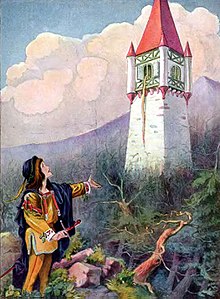
Rapunzel, Rapunzel, let down your hair, so that I may climb the golden stair.
Hansel and Gretel

"Hansel and Gretel" (also known as Hansel and Grettel, Hansel and Grethel, or Little Brother and Little Sister) is a well-known fairy tale of German origin, recorded by the Brothers Grimm and published in 1812. Hansel and Gretel are a young brother and sister kidnapped by a cannibalistic witch living deep in the forest in a house constructed of cake and confectionery. The two children save their lives by outwitting her.
Little Red Riding Hood

"Little Red Riding Hood", or "Little Red Ridinghood", also known as "Little Red Cap" or simply "Red Riding Hood", is a European fairy tale about a young girl and a Big Bad Wolf. The story has been changed considerably in its history and subject to numerous modern adaptations and readings. The story was first published by Charles Perrault.
.
Hooding ceremony

A Hooding Ceremony is a special recognition ceremony for doctoral degree candidates during which a faculty advisor and the Dean of Graduate Academics place the doctoral hood, signifying his or her success in completing the graduate program. The ceremony is similar to a graduation in that the faculty and students are dressed in academic attire. The Hooding Ceremony is in addition to and does not replace the Graduate Commencement.
.
Academic dress
Academic dress is a traditional form of clothing for academic settings, primarily tertiary (and sometimes secondary) education, worn mainly by those who have been admitted to a university degree (or similar), or hold a status that entitles them to assume them (e.g., undergraduate students at certain old universities).

下一則: WEEK 12 英文兒童文學筆記 (English Children's Literature)
限會員,要發表迴響,請先登入


