* Paradise Lost

Title page of the first edition (1667)
Paradise Lost is an epic poem in blank verse by the 17th-century English poet John Milton (1608–1674). The first version, published in 1667, consisted of ten books with over ten thousand lines of verse. A second edition followed in 1674, arranged into twelve books (in the manner of Virgil's Aeneid) with minor revisions throughout and a note on the versification. It is considered by critics to be Milton's major work, and helped solidify his reputation as one of the greatest English poets of his time.
The poem concerns the Biblical story of the Fall of Man: the temptation of Adam and Eve by the fallen angel Satan and their expulsion from the Garden of Eden. Milton's purpose, stated in Book I, is to "justify the ways of God to men".
.
* Vocabulary
1. cave (v.) To dig or hollow out.
2. labor (v.) To undergo the labor of childbirth.
3. storm (v.) To behave or shout angrily; rant and rage: stormed at his incompetence.
4. retribution (n.) Punishment administered in return for a wrong committed.
.
* Etymology
gen : birth, beginning
e.g., gene, generation, genesis
.
* Jesus Knocking on the Door

This gripping image has been used in evangelism for decades. Jesus is pictured outside of the door of the unregenerate heart, knocking through the conviction of the Gospel message, longing to come in for intimate communion.
.
* Sistine Chapel (works by Michelangeo)
http://www.vatican.va/various/cappelle/sistina_vr/index.html
.
* Pieta

The Pietà (Italian pronunciation: [pjeˈta]) is a subject in Christian art depicting the Virgin Mary cradling the dead body of Jesus, most often found in sculpture. As such, it is a particular form of the Lamentation of Christ, a scene from the Passion of Christ found in cycles of the Life of Christ. When Christ and the Virgin are surrounded by other figures from the New Testament, the subject is strictly called a Lamentation in English, although Pietà is often used for this as well, and is the normal term in Italian.
.
* fatal woman = femme fatale
A femme fatale is a stock character of a mysterious and seductive woman whose charms ensnare her lovers, often leading them into compromising, dangerous, and deadly situations. The phrase is French for "fatal woman". A femme fatale tries to achieve her hidden purpose by using feminine wiles such as beauty, charm, and sexual allure. She is an archetype of literature and art. Her ability to entrance and hypnotise her victim with a spell was in the earliest stories seen as being literally supernatural; hence, the femme fatale today is still often described as having a power akin to an enchantress, seductress, vampire, witch, or demon, having power over men.
For example:

Salome is often identified with the dancing woman from the New Testament (Mark 6:17-29 and Matthew 14:3-11, where, however, her name is not given). Christian traditions depict her as an icon of dangerous female seductiveness, notably in regard to the dance mentioned in the New Testament, which is thought to have had an erotic element to it, and in some later transformations it has further been iconized as the Dance of the Seven Veils. Other elements of Christian tradition concentrate on her lighthearted and cold foolishness that, according to the gospels, led to Johnthe Baptist's death.
A similar motif was struck by Oscar Wilde in his Salome, in which she plays the role of femme fatale. This parallel representation of the Christian iconography, made even more memorable by Richard Strauss' opera based on Wilde's work, is as consistent with Josephus' account as the traditional Christian depiction.
.
* Cain and Abel

Cain slaying Abel by Peter Paul Rubens
Cain and Abel (Hebrew: הֶבֶל ,קַיִן Qayin, Hevel) were, according to the Book of Genesis, two sons of Adam and Eve. Cain is described as a crop farmer and his younger brother Abel as a shepherd. Cain was the first human born and Abel was the first human to die. Cain committed the first murder by killing his brother. Interpretations of Genesis 4 by ancient and modern commentators have typically assumed that the motives were jealousy and anger. In the Cain and Abel story found in the Quran, the text refers to them simply as the sons of Adam (Arabic: ابني آدم).
Cain Murders Abel
8Cain told Abel his brother. And it came about when they were in the field, that Cain rose up against Abel his brother and killed him. 9Then the LORD said to Cain, "Where is Abel your brother?" And he said, "I do not know. Am I my brother's keeper?" 10He said, "What have you done? The voice of your brother's blood is crying to Me from the ground.…
.
* Parable
A parable is a succinct, didactic story, in prose or verse, which illustrates one or more instructive lessons or principles. It differs from a fable in that fables employ animals, plants, inanimate objects, or forces of nature as characters, whereas parables have human characters. A parable is a type of analogy.
Some scholars of the canonical gospels and the New Testament apply the term "parable" only to the parables of Jesus, though that is not a common restriction of the term. Parables such as "The Prodigal Son" are central to Jesus' teaching method in both the canonical narratives and the apocrypha.
.
* Samson Agonistes

Samson Agonistes (Greek for "Samson the agonist") is a tragic closet drama by John Milton. It appeared with the publication of Milton's Paradise Regain'd in 1671, as the title page of that volume states: "Paradise Regained / A Poem / In IV Books / To Which Is Added / Samson Agonistes". It is generally thought that Samson Agonistes was begun around the same time as Paradise Regained but was completed after the larger work, possibly very close to the date of publishing, but there is no agreement on this.
.
* Calvary by Andrea Mantegna

crucifixion: a. The act of crucifying; execution on a cross.
.
* Bethlehem
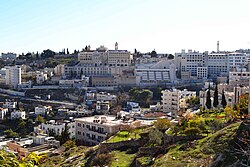
Bethlehem overlook
Bethlehem is a Palestinian city located in the central West Bank, about 10 kilometers south of Jerusalem.
The New Testament identifies Bethlehem as the birthplace of Jesus. The city is inhabited by one of the oldest Christian communities in the world[citation needed], although the size of the community has shrunk due to emigration.
.
* O Come Ye Faithful
https://www.youtube.com/watch?v=-JSF9Uz20PY
O come ye, O come ye to Bethlehem.
Sing all that hear in heaven God's holy word.
Give to our Father glory in the Highest;
All Hail! Lord, we greet Thee,
O Jesus! for evermore be Thy name adored.
.
* Australians say to Muslims "I'll ride with you"
http://www.bbc.com/news/blogs-trending-30479306
As a gunman holds people hostage in a cafe in Sydney, thousands of messages of support have been posted online for Muslims in Australia who are afraid of an Islamophobic backlash.

Thousands of people have now joined the spontaneous campaign, offering to meet Muslim people at their local stations and to ride with them on their journey.
.
Islamophobic = Islam + phobic
限會員,要發表迴響,請先登入


