* Etymology
arch- : order, chief, highest, most extreme
e.g., anarchy: a situation in which people are behaving in a way that ignores normal rules and laws, and are unable to be controlled
e.g., archbishop: a priest of the highest rank in some Christian churches who is responsible for all the churches in a particular area
spec- : to see or observe
e.g., spectacles: glasses that you wear to see
e.g., specimen: a small amount of blood, urine, or another liquid taken fromyour body so that it can be examined
audi- : to hear or relates to the sense of hearing
e.g., audience: a group of people who have come to a place to see or hear a film,performance, speech etc. The people who watch a sports match orother large event are usually called spectators or the crowd
.

God created 3 Archangels (Michael, Gabriel and Lucifer) to administer the government of God throughout the Angelic Realm. Each was perfectly crafted and were allowed to walk among the stones of fire and to enter any reality found among the Infinities.
God gave great power and authority to the three Archangels and they were created to reflect majesty and beauty. The one God created as the being of the greatest light and brilliance was Lucifer. Lucifer pleased God because Lucifer searched the Infinities diligently seeking the jewels of reality. God created all possibilities but until they are observed they are unmanifested. The Angels became Gods instruments of Awareness, peering into the infinite possibilities and manifesting realities. Many beautiful realities did Lucifer bring before the throne of the Eternal. His awareness was sharp and keen and Lucifer found many splendors hidden in the infinite possibilities God had set into motion.
Then came the time when God brought forth the greatest jewel of all. God created the Infinities containing the Physical Realm where the possibility of life existed. Thus began the Game of Angels. For it was in this new and beautiful expanse, we call the heavens, that God had placed a new and wonderful jewel. A world where life was growing and changing. The search for the Jewel of God had begun.
.
* Senior Play

畢業公演 ≠ graduation play
.
* Vocabulary
foul: very dirty, or smelling or tasting unpleasant
plot: LITERATURE a series of related events that make up the main story in a book, film etc. A second, less important story in the same book or film is called a subplot.
petrified: extremely frightened, especially so that you cannot move or decidewhat to do
bull's eye: The small central circle on a target.

stir up: to set in motion; instigate
.
* Plot


Deus ex machina in classical theatre: Euripides'Medea, performed in 2009 in Syracuse, Italy.
Deus ex machina from Latin deus, meaning "a god", ex, meaning "from", and machina, meaning "a device, a scaffolding, an artifice", is a calque from Greek ἀπὸ μηχανῆς θεός (apò mēkhanḗs theós), meaning "god from the machine". The term has evolved into a plot device whereby a seemingly unsolvable problem is suddenly and abruptly resolved by the contrived and unexpected intervention of some new event, character, ability or object. Depending on how it is done, it can be intended to move the story forward when the writer has "painted himself into a corner" and sees no other way out, to surprise the audience, to bring the tale to a happy ending, or as a comedic device.
.
* Catharsis
Catharsis is a term in dramatic art that describes the effect of tragedy (or comedy and quite possibly other artistic forms) principally on the audience (although some have speculated on characters in the drama as well). Nowhere does Aristotle explain the meaning of "catharsis" as he is using that term in the definition of tragedy in the Poetics (1449b21-28). G.F. Else argues that traditional, widely held interpretations of catharsis as "purification " or "purgation" have no basis in the text of the Poetics, but are derived from the use of catharsis in other Aristotelian and non-Aristotelian contexts," Leon Golden writes. For this reason, a number of diverse interpretations of the meaning of this term have arisen. D.W. Lucas (Aristotle: Poetics, Oxford, 1968) in an authoritative edition of the Poetics comprehensively covers the various nuances inherent in the meaning of the term in an Appendix devoted to "Pity, Fear, and Katharsis". Lucas (pp. 276–79) recognizes the possibility of catharsis bearing some aspect of the meaning of "purification, purgation, and 'intellectual clarification'" although his discussion of these terms is not always, or perhaps often, in the precise form with which other influential scholars have treated them. Lucas himself does not accept any one of these interpretations as his own but adopts a rather different one based on "the Greek doctrine of Humours" which has not received wide subsequent acceptance. Purgation and purification, used in previous centuries, as the common interpretations of catharsis are still in wide use today. More recently, in the twentieth century, the interpretation of catharsis as "intellectual clarification" has arisen as a rival to the older views in describing the effect of catharsis on members of the audience.
.
* Hamartia
In tragedy, hamartia is the protagonist’s error or flaw that leads to a chain of plot actions culminating in a reversal from his/her good fortune to bad. What qualifies as the error or flaw can include an error resulting from ignorance, an error of judgement, a flaw in character, or sin. The spectrum of meanings has invited debate among critics and scholars, and different interpretations among dramatists.
Hamartia is first described in the subject of literary criticism by Aristotle in his Poetics. The source of hamartia is at the juncture between Character and the character's actions or behaviors as outlined by Aristotle.
"Character in a play is that which reveals the moral purpose of the agents, i.e. the sort of thing they seek or avoid."
In his introduction to the S. H. Butcher translation of ″Poetics″, Francis Fergusson describes hamartia as the inner quality that initiates, in Dante's words, a ″movement of spirit″ within the protagonist to commit actions which drive the plot towards its tragic end, inspiring in the audience a build of pity and fear that leads to a purgation of those emotions, or Catharsis.
In Greek Tragedy, for a story to be ″of adequate magnitude″ it involves characters of high rank, prestige, or good fortune. If the protagonist is too worthy of esteem, or too wicked, his/her change of fortune will not evoke the ideal proportion of pity and fear necessary for catharsis. Here Aristotle describes hamartia as the quality of a tragic hero that generates that optimal balance.
"...the character between these two extremes - that of a man who is not eminently good and just, yet whose misfortune is brought about not by vice or depravity, but by some error or frailty."
.
In works of narrative (especially fictional), the literary element setting includes the historical moment in time and geographic location in which a story takes place, and helps initiate the main backdrop and mood for a story. Setting has been referred to as story world or milieu to include a context (especially society) beyond the immediate surroundings of the story. Elements of setting may include culture, historical period, geography, and hour. Along with the plot, character, theme, and style, setting is considered one of the fundamental components of fiction.
.
The classical unities, Aristotelian unities, or three unities are rules for drama derived from a passage in Aristotle's Poetics. In their neoclassicalform they are as follows:
- The unity of action: a play should have one main action that it follows, with no or few subplots.
- The unity of place: a play should cover a single physical space and should not attempt to compress geography, nor should the stage represent more than one place.
- The unity of time: the action in a play should take place over no more than 24 hours.
.
* Aristotle

Aristotle, whose name means "the best purpose", was born in 384 BCE in Stagira, Chalcidice, about 55 km (34 miles) east of modern-day Thessaloniki. Aristotle was a Greek philosopher and scientist. Although there is little information on Aristotle's childhood, he probably spent some time within the Macedonian palace, making his first connections with the Macedonian monarchy.
His most important treatises include Physics, Metaphysics, Nicomachean Ethics, Politics, De Anima (On the Soul) and Poetics.
.
* Chorus
A group of characters in Greek tragedy (and in later forms of drama), who comment on the action of a play without participation in it. Their leader is the choragos. Sophocles' Antigone and Oedipus the King both contain an explicit chorus with a choragos.
The chorus represents, on stage, the general population of the particular story, in sharp contrast with many of the themes of the ancient Greek plays which tended to be about individual heroes, gods, and goddesses. They were often the same sex as the main character. In Aeschylus' Agamemnon, the chorus comprises the elderly men of Argos, whereas in Euripides' The Bacchae, they are a group of eastern bacchantes, and in Sophocles' Electra, the chorus represents the women of Argos. The parts however were acted by males. In Aeschylus' The Eumenides, however, the chorus takes the part of a host of avenging Furies.
.
* Tragedy
Tragedy (from the Greek: τραγῳδία, tragōidia[a]) is a form of drama based on human suffering that invokes in its audience an accompanying catharsis or pleasure in the viewing.
In the wake of Aristotle's Poetics (335 BCE), tragedy has been used to make genre distinctions, whether at the scale of poetry in general (where the tragic divides against epic and lyric) or at the scale of the drama (where tragedy is opposed to comedy).
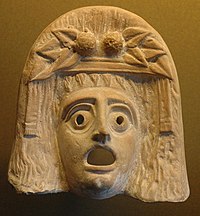
Mask of Dionysus. Greek, Myrina, 2nd century BCE.
Athenian tragedies were performed in late March/early April at an annual state religious festival in honor of Dionysus. The presentations took the form of a contest between three playwrights, who presented their works on three successive days. Each playwright offered a tetralogy consisting of three tragedies and a concluding comic piece called a satyr play.
.
* Dramatic irony
This type of irony is the device of giving the spectator an item of information that at least one of the characters in the narrative is unaware of (at least consciously), thus placing the spectator a step ahead of at least one of the characters. Dramatic irony produces dramatic conflict in what one character relies or appears to rely upon, the contrary of which is known by observers (especially the audience; sometimes to other characters within the drama) to be true. In summary, it means that the reader/watcher/listener knows something that one or more of the characters in the piece is not aware of. For example, in Oedipus the King, the audience knows that Oedipus himself is the murderer that he is seeking; Oedipus, Creon and Jocasta do not.
.
Aristotle shared his view of what makes a tragic hero in his Poetics. Aristotle suggests that a hero of a tragedy must evoke in the audience a sense of pity or fear, saying, “the change of fortune presented must not be the spectacle of a virtuous man brought from prosperity to adversity." In other words, the focus of the tragic hero should not be in the loss of his prosperity. He establishes the concept that the emotion of pity stems not from a person becoming better but when a person receives undeserved misfortune and fear comes when the misfortune befalls a man like us. This is why Aristotle points out the simple fact that, “The change of fortune should be not from bad to good, but, reversely, from good to bad.” According to Aristotle a tragic hero ought to be a man whose misfortune comes to him, not through vice or depravity but by some error of judgment. For example King Oedipus kills his father from impulse and marries his mother out of ignorance.
A great example of a tragic hero is Creon in the play Antigone by Sophcles. He dooms his family by making a law forbidding the bural of Polyneices, the former king. He and his brother were kings, and Polyneices wanted more power, so he left and assembled an army from a neighboring city. They attacked and the two brothers killed each other.
限會員,要發表迴響,請先登入


