* How to Take Great Notes
1. write down conclusion
2. use color pens
3. review
https://www.youtube.com/watch?v=UAhRf3U50lM#t=33

.
* Vocabulary
incest: sexual activity between people who are closely related, such as aparent and child or a brother and sister
simony: he buying or selling of a church office or ecclesiastical preferment
corruption: dishonest or illegal behaviour by officials or people in positions ofpower, especially when they accept money in exchange for doingthings for someone
treason: the crime of helping your country's enemies or of trying to destroy yourcountry's government
.
* Socrates
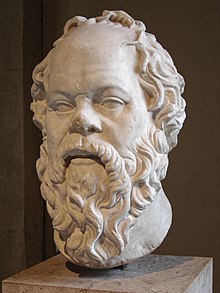
Socrates (/ˈsɒkrətiːz/; 470/469 – 399 BC) was a classical Greek (Athenian) philosopher credited as one of the founders of Western philosophy.
Socrates was never without critics. The comic poet Aristophanesridiculed him in The clouds, and when his pupil Alcibiades had committed high treason, Socrates' position became very difficult. He was forced to drink hemlock after a charge that he had corrupted the youth.

The Death of Socrates, by Jacques-Louis David(1787)
.
* 在律法裡講文明,從寬容中說歷史─導讀導讀馬里歐•普佐的《終極教父》
以下內容節錄自: http://doei.web2.nhcue.edu.tw/ezfiles/20/1020/img/342/140774950.doc
這種男長輩與女小輩的律法迷思辯證,可追溯到古遠的希臘時期:典自伊斯克萊斯的悲劇《奧萊斯提亞三部曲》(Aeschylus, The Oresteia)。這齣戲除了複述希臘人熟悉的耶楚斯(Atreus)家族三代涉及正義與報復的傳說,也記錄了希臘歷史上正義觀的沿革。話說歐瑞斯提茲(Orestes)之母為報其夫殺女Iphigeneia之仇,因而夥同也與耶楚斯家族有親人血債的情夫Aegisthus,亂刀做了剛從特洛依戰爭(The Trojan War)屠城歸來的老公亞格曼儂(Agamemnon)。當他們的兒女歐瑞斯提茲和Electra要血債血償,出面伸張以「血緣」為單一基礎的部族正義,來砍死這兩個不共戴天的殺父仇人同時,也冒瀆了最神聖的母子血緣。所以當西方司法史上首任陪審團,在新生代女神雅典娜(Athena)所設的法庭中,對為父弑母的歐瑞斯提茲作不起訴處分時,即象徵著希臘人的正義觀由部族組織的冤冤相報,過渡到社會制度的法庭仲裁。但是有些雅典娜女神的長輩包括她的爸爸天神宙斯(Zeus),著實不能認同這個「新新神類」悖逆既有傳統的行徑,惱羞成怒之餘,憤而詛咒那些即將盛行法庭仲裁制度的領域。所以西方人因此深信,時至今日人們仍然在公理、正義和天道的三角習題中,找不到個皆大歡喜的結論。
.
* Electra complex: is a girl’s psychosexual competition with her mother for possession of her father. Electra was the daughter of King Agamemnon and Queen Clytemnestra, and thus princess of Argos. She and her brother Orestes plotted revenge against their mother Clytemnestra and stepfather Aegisthus for the murder of their father, Agamemnon.
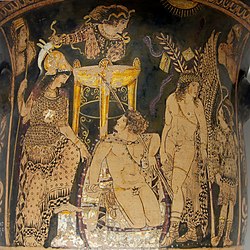
Orestes at Delphi flanked by Athena andPylades among the Erinyes and priestessesof the oracle, perhaps including Pythiabehind the tripod - Paestan red-figured bell-krater, c. 330 BC
* Oedipus complex: denotes the emotions and ideas that the mind keeps in the unconscious, via dynamic repression, that concentrates upon a child's desire to have sexual relations with the parent of the opposite sex (i.e. males attracted to their mothers, and females attracted to their fathers). Sigmund Freud, who coined the term "Oedipus complex" believed that the Oedipus complex is a desire for the parent in both males and females.
.
* Furies

Featured in ancient Greek literature, from poems to plays, the Erinyes form the Chorus and play a major role in the conclusion of Aeschylus's dramatic trilogy the Oresteia. In the first play, Agamemnon, King Agamemnon returns home from the Trojan War, where he is slain by his wife, Clytemnestra, who wants vengeance for her daughter Iphigenia, who was sacrificed by Agamemnon in order to obtain favorable winds to sail to Troy. In the second play, The Libation Bearers, their son Orestes has reached manhood and has been commanded by Apollo’s oracle to avenge his father‘s murder at his mother’s hand. Returning home and revealing himself to his sister Electra, Orestes pretends to be a messenger bringing the news of his own death to Clytemnestra. He then slays his mother and her lover Aegisthus. Although Orestes’ actions were what Apollo had commanded him to do, Orestes has still committed matricide, a grave sacrilege. Because of this, he is pursued and tormented by the terrible Erinyes, who demand yet further blood vengeance.
.
* Etymology
fore- : before, front, superior
e.g. foresight, forefather, foreman
.
* Foreshadowing
Foreshadowing or guessing ahead is a literary device by which an author hints what is to come. It is used to avoid disappointment, and sometimes used to arouse readers. A hint that is designed to mislead the audience is referred to as a red herring. A similar device is the flashforward (also known as prolepsis). However, foreshadowing only hints at a possible outcome within the confinement of a narrative. A flashforward is a scene that takes the narrative forward in time from the current point of the story in literature, film, television, and other media. Foreshadowing is sometimes employed through characters explicitly predicting the future.
In the novel and subsequent screen adaptation of The Lord of the Rings, Frodo considers it unfortunate that Bilbo pitied Gollum and was unable to kill him, but Gandalf feels that Gollum "has some part to play yet, for good or ill, before the end". This conversation foreshadows the fact that later in the story Frodo himself pities Gollum and is unable to kill him. Gollum then inadvertently makes it possible to destroy the Ring, which is the whole point of Frodo's and the rest of the central characters' quest.
.
* Goddess of Justice

Courthouses throughout America honor our Goddess of Justice with magnificent statues.
Justitia, a Roman goddess of justice symbolizes the fair and equal administration of the law, without corruption, avarice, prejudice, or favor; goddess of divine justice. Sculptors often portray her as evenly balancing both scales and a sword and wearing a blindfold (but often times without one). She sometimes holds the fasces (a bundle of rods around an ax) symbolizing judicial authority in one hand, and a flame in the other hand, symbolizing truth.
.
* Idiom
accuse someone of something: Her employers accused her of theft.
accuse someone of doing something: Are you accusing me of lying?
.
* Reveal (narrative)
is a plot device in narrative structure, and is the exposure to the reader or audience of a previously hidden key element of plot or of the performance.
≒ suggest
≠ conceal
.
* Haemon
According to Sophocles' play Antigone, Haemon /ˈhiːmɒn/ or Haimon (Greek: Αἵμων, Haimon "bloody"; gen.: Αἵμωνος), was the son of Creon and Eurydice.
限會員,要發表迴響,請先登入


