◎ attach: to fasten or join one thing to another
◎ detach: to remove a part from something
de-: down, away from
.
◎ dramatic irony
Dramatic irony has three stages—installation, exploitation, and resolution (often also called preparation, suspension, and resolution) —producing dramatic conflict in what one character relies or appears to rely upon, the contrary of which is known by observers (especially the audience; sometimes to other characters within the drama) to be true. In summary, it means that the reader/watcher/listener knows something that one or more of the characters in the piece is not aware of.
For example:
- In Oedipus the King, the audience knows that Oedipus himself is the murderer that he is seeking; Oedipus, Creon and Jocasta do not.
- In Romeo and Juliet, the audience knows that Juliet is already married to Romeo, but her family does not. Also, in the crypt, most of the other characters in the cast think Juliet is dead, but the audience knows she only took a sleeping potion. Romeo is also under the same misapprehension when he kills himself.
.
◎ fatal woman = femme fatale
A femme fatale is a stock character of a mysterious and seductive woman whose charms ensnare her lovers, often leading them into compromising, dangerous, and deadly situations. The phrase is French for "fatal woman". A femme fatale tries to achieve her hidden purpose by using feminine wiles such as beauty, charm, and sexual allure. She is an archetype of literature and art. Her ability to entrance and hypnotise her victim with a spell was in the earliest stories seen as being literally supernatural; hence, the femme fatale today is still often described as having a power akin to an enchantress, seductress, vampire, witch, or demon, having power over men.
For example:

Salome is often identified with the dancing woman from the New Testament (Mark 6:17-29 and Matthew 14:3-11, where, however, her name is not given). Christian traditions depict her as an icon of dangerous female seductiveness, notably in regard to the dance mentioned in the New Testament, which is thought to have had an erotic element to it, and in some later transformations it has further been iconized as the Dance of the Seven Veils. Other elements of Christian tradition concentrate on her lighthearted and cold foolishness that, according to the gospels, led to John the Baptist's death.
A similar motif was struck by Oscar Wilde in his Salome, in which she plays the role of femme fatale. This parallel representation of the Christian iconography, made even more memorable by Richard Strauss' opera based on Wilde's work, is as consistent with Josephus' account as the traditional Christian depiction.
.
◎ hubris
Hubris means extreme pride or self-confidence.
Hubris is usually perceived as a characteristic of an individual rather than a group, although the group the offender belongs to may suffer consequences from the wrongful act. Hubris often indicates a loss of contact with reality and an overestimation of one's own competence, accomplishments or capabilities, especially when the person exhibiting it is in a position of power.
Examples of hubris are often found in fiction, most famously in Paradise Lost, John Milton's depiction of the biblical Lucifer.

.
◎ The Riddle of the Sphinx

The Sphinx is said to have guarded the entrance to the Greek city of Thebes, and to have asked a riddle of travellers to allow them passage.
It was said in late lore that Hera or Ares sent the Sphinx from her Ethiopian homeland (the Greeks always remembered the foreign origin of the Sphinx) to Thebes in Greece where she asks all passersby the most famous riddle in history: "Which creature has one voice and yet becomes four-footed and two-footed and three-footed?" She strangled and devoured anyone unable to answer. Oedipus solved the riddle by answering: Man—who crawls on all fours as a baby, then walks on two feet as an adult, and then uses a walking stick in old age.
.
◎ Tragedy
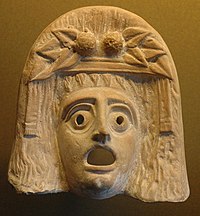
A form of drama based on human suffering that invokes in its audience an accompanying catharsis or pleasure in the viewing.
◎ Tragic flaw
The term hamartia derives from the Greek ἁμαρτία, from ἁμαρτάνειν hamartánein, which means “to miss the mark” or “to err”. It is most often associated with Greek tragedy. Hamartia as it pertains to dramatic literature was first used by Aristotle in his Poetics. In tragedy, hamartia is the protagonist’s error or flaw that leads to a chain of plot actions culminating in a reversal from his/her good fortune to bad. What qualifies as the error or flaw can include an error resulting from ignorance, an error of judgement, a flaw in character, or sin. The spectrum of meanings has invited debate among critics and scholars, and different interpretations among dramatists.
◎ Tragic hero
A tragic hero (or tragic heroine, if a woman) is the protagonist of a tragedy.
Aristotle shared his view of what makes a tragic hero in his Poetics. Aristotle suggests that a hero of a tragedy must evoke in the audience a sense of pity or fear, saying, “the change of fortune presented must not be the spectacle of a virtuous man brought from prosperity to adversity." In other words, the focus of the tragic hero should not be in the loss of his prosperity. He establishes the concept that the emotion of pity stems not from a person becoming better but when a person receives undeserved misfortune and fear comes when the misfortune befalls a man like us. This is why Aristotle points out the simple fact that, “The change of fortune should be not from bad to good, but, reversely, from good to bad.” According to Aristotle a tragic hero ought to be a man whose misfortune comes to him, not through vice or depravity but by some error of judgment. For example King Oedipus kills his father from impulse and marries his mother out of ignorance.
.
◎ Oedipus
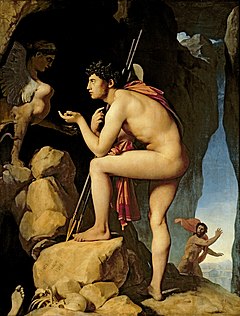
Oedipus (US /ˈɛdɨpəs/ or UK /ˈiːdɨpəs/; Ancient Greek: Οἰδίπους Oidípous meaning "swollen foot") was a mythical Greek king ofThebes. A tragic hero in Greek mythology, Oedipus accidentally fulfilled the prophecy, despite his efforts not to, that he would kill his father and marry his mother, and thereby bring disaster on his city and his family. When the truth is discovered, his wife hanged herself, and Oedipus gouged out his own eyes.
Oedipus was born to King Laius and Queen Jocasta. Laius wished to thwart a prophecy, which said that his child would grow up to murder his father and marry his mother. Thus, he fastened the infant's feet together with a large pin and left him to die on a mountainside. The baby was found on Kithairon by shepherds and raised by King Polybus and Queen Merope in the city of Corinth. Oedipus learned from the oracle at Delphi of the prophecy, but believing he was fated to murder Polybus and marry Merope, he left Corinth. Heading to Thebes, Oedipus met an older man in a chariot coming the other way on a narrow road. The two quarreled over who should give way, which resulted in Oedipus killing the stranger and continuing on to Thebes. He found that the king of the city (Laius) had been recently killed and that the city was at the mercy of the Sphinx. Oedipus answered the monster's riddle correctly, defeating it and winning the throne of the dead king and the hand in marriage of the king's widow, his mother, Jocasta.
Oedipus and Jocasta had two sons (Eteocles and Polynices) and two daughters (Antigone and Ismene). In his search to determine who killed Laius (and thus end a plague on Thebes), Oedipus discovered it was he who had killed the late king (his father). Jocasta, upon realizing that she had married her own son and Laius's murderer, hanged herself. Oedipus then seized two pins from her dress and blinded himself with them. Oedipus was driven into exile, accompanied by Antigone and Ismene. After years of wandering, he arrived in Athens, where he found refuge in a grove of trees called Colonus. By this time, warring factions in Thebes wished him to return to that city, believing that his body would bring it luck. However, Oedipus died at Colonus, and the presence of his grave there was said to bring good fortune to Athens.
.
◎ narrative poem
Narrative poetry is a form of poetry that tells a story, often making use of the voices of a narrator and characters as well; the entire story is usually written in metred verse. The poems that make up this genre may be short or long, and the story it relates to may be complex. It is usually dramatic, with objectives, diverse characters, and metre. Narrative poems include epics, ballads, idylls, and lays.
◎ lyric poetry
Lyric poetry is a form of poetry which expresses personal emotions or feelings, typically spoken in the first person. The term derives from a form of Ancient Greek literature, the lyric, which was defined by its musical accompaniment, usually on a stringed instrument known as a lyre. The term owes its importance in literary theory to the division developed by Aristotlebetween three broad categories of poetry: lyrical, dramatic and epic.
.
◎ on a par with
of the same quality as or at the same level as
Profits should be on a par with last year.
.
◎fate: a power that some people believe controls everythingthat happens in their lives 無法控制
destiny/destination: the things that you will do, or thetype of person that you will become, in the future 可以選擇
fatal destiny
.
◎ stock character
A stock character is a stereotypical person whom audiences readily recognize from frequent recurrences in a particular literary tradition. Stock characters are archetypalcharacters distinguished by their flatness; as a result, they tend to be easy targets for parody and to be criticized as clichés. The presence of a particular array of stock characters is a key component of many genres.
.
◎ catharsis
Catharsis is the purification and purgation of emotions—especially pity and fear—through art or any extreme change in emotion that results in renewal and restoration. It is a metaphor originally used by Aristotle in the Poetics to describe the effects of tragedy on the spectator.
.
◎ 神話:內在的旅程,英雄的冒險,愛情的故事


限會員,要發表迴響,請先登入


