* Ulysses

Ulysses is derived from Ulixes, the Latin name for Odysseus, a character in ancient Greek literature.
* Ulysses (novel)
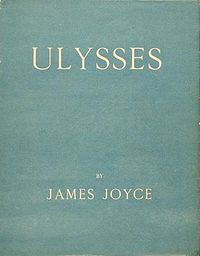
Ulysses is a modernist novel by Irish writer James Joyce. Ulysses is the Latinised name of Odysseus, the hero of Homer's epic poem Odyssey, and the novel establishes a series of parallels between its characters and events and those of the poem (e.g., the correspondence of Leopold Bloom to Odysseus, Molly Bloom to Penelope, and Stephen Dedalus to Telemachus).
* Motif
In narrative, a motif is any recurring element that has symbolic significance in a story. Through its repetition, a motif can help produce other narrative (or literary) aspects such as theme or mood.
* 五段論證法
(由 莎莎老師 整理)

* 一神論
Monotheism
Monotheism characterizes the traditions of Atenism, Babism, the Bahá'í Faith, Cao Dai (Caodaiism), Cheondoism (Cheondogyo), Christianity, Deism, Eckankar, Islam, Judaism, the Mormon Community of Christ, Rastafari, Ravidassia religion, Seicho no Ie, Shaivism, Sikhism, Tenrikyo (Tenriism), Vaishnavism, and Zoroastrianism and elements of the belief are discernible in numerous other religions.
* 寡頭政治
Oligarchy (from Greek ὀλιγαρχία (oligarkhía); from ὀλίγος (olígos), meaning "few", and ἄρχω (arkho), meaning "to rule or to command") is a form of power structure in which power effectively rests with a small number of people. These people could be distinguished by royalty, wealth, family ties, education, corporate, religious or military control.
* 亞歷山大的帝王學 (Fortune favors the bolod)
https://www.youtube.com/watch?v=YK4s2Fjefn8
* Religion
Christian: a person who believes in the teachings of Jesus Christ
Catholic: of or relating to the Roman Catholic Church
Protestant: a member of any of several church denominations denying the universal authority of the Pope and affirming the Reformation principles of justification by faith alone, the priesthood of all believers, and the primacy of the Bible as the only source of revealed truth
Elizabeth (1998)
https://www.youtube.com/watch?v=DyGBwrtIamw

* Aristotle's unities (三一律)
Aristotle dealt with the unity of action in some detail, under the general subject of "definition of tragedy", where he wrote:
Now, according to our definition, Tragedy is an imitation of an action that is
complete, and whole, and of a certain magnitude … As therefore, in the other
imitative arts, the imitation is one when the object imitated is one, so the plot,
being an imitation of an action, must imitate one action and that a whole, the
structural union of the parts being such that, if any one of them is displaced or
removed, the whole will be disjointed and disturbed. For a thing whose
presence or absence makes no visible difference, is not an organic part of the whole.
His only reference to the time in the fictive world is in a distinction between the epic and tragic forms:
Epic poetry agrees with Tragedy in so far as it is an imitation in verse of
characters of a higher type. They differ, in that Epic poetry admits but one kind of metre, and is narrative in form. They differ, again, in their length: for
Tragedy endeavours, asfar as possible, to confine itself to a single revolution of
the sun, or but slightly to exceed this limit; whereas the Epic action has no
limits of time.
Unlike his prescriptive attitude regarding the plot (unity of action), Aristotle here merely remarks on the typical duration of a tragedy's action, and does not suggest any kind of imperative that it always ought to be so. He was writing after the golden age of Greek drama, and many Greek playwrights wrote plays that do not fit within these conventions.
Aristotle does not actually mention the neoclassical unity of place at all. However, the prevalent interpretation of his Poetics during the Middle Ages inclined toward interpreting his comment on time as another "unity".
* Secularity
Secularity (adjective form secular, from Latin saecularis meaning "worldly" or "temporal") is the state of being separate from religion, or not being exclusively allied with or against any particular religion.
A religion is an organized collection of beliefs, cultural systems, and world views that relate humanity to an order of existence. Many religions have narratives, symbols, and sacred histories that are intended to explain the meaning of life and/or to explain the origin of life or the Universe. From their beliefs about the cosmos and human nature, people derive morality, ethics, religious laws or a preferred lifestyle. According to some estimates, there are roughly 4,200 religions in the world.
* Vocabulary
rival: 可敬的對手
enemy: 敵人
* Satan: His pride(hubris) is considered a reason why he would not bow to God as all other angels did, but sought to rule heaven himself.
限會員,要發表迴響,請先登入


