* In medias res
In medias res (Latin "in the midst of things") is the literary and artistic narrative technique of relating a story from the midpoint(從中間開始), rather than the beginning. In an in medias res narrative, the story opens with dramatic action rather than exposition setting up the characters and situation.
In medias res often, though not always, entails subsequent use of flashback and nonlinear narrative for exposition of earlier events in order to fill in the backstory. For example, in Homer's Odyssey, we first learn about Odysseus' journey when he is held captive on Calypso's island. We then find out, in Books IX through XII, that the greater part of Odysseus' journey precedes that moment in the narrative. On the other hand, Homer's Iliad has relatively few flashbacks, although it opens in the thick of the Trojan War.
* invocation
An invocation (from the Latin verb invocare "to call on, invoke, to give") may take the form of: Supplication, prayer or spell.
吟唱英雄詩歌總是以祈願(invocation)破題,呼請記憶女神(Mnemosyne)的女兒Calliope,即掌管史詩的謬思,求賜詩藝靈感。 ─新編西洋文學概論:上古迄文藝復興/呂健忠 p.16
* foreshadowing (伏筆)
Foreshadowing or guessing ahead is a literary device by which an author hints what is to come. It is used to avoid disappointment, and sometimes used to arouse readers.
* flashback (倒敘)
A flashback or analepsis is an interjected scene that takes the narrative back in time from the current point in the story. Flashbacks are often used to recount events that happened before the story's primary sequence of events to fill in crucial backstory.
* epic poetry
An epic (from the Ancient Greek adjective ἐπικός (epikos), from ἔπος (epos) "word, story, poem") is a lengthy narrative poem, ordinarily concerning a serious subject containing details of heroic deeds and events significant to a culture or nation.
The first epics were products of preliterate societies and oral poetic traditions.
* motif (文學、藝術作品的)主題,中心思想
In narrative, a motif is any recurring element that has symbolic significance in a story. Through its repetition, a motif can help produce other narrative (or literary) aspects such as theme or mood.
--------------------------------------------------------------------------------------
* Sappho

Sappho’s poems focus on women more than men, and on feelings more than actions. Aphrodite, goddess of love and sex, seems more important to Sappho than Zeus, the father of the gods. -from The Norton Anthology of western Literature p.595
* Metamorphoses(變形記)

A Latin narrative poem by the Roman poet Ovid.
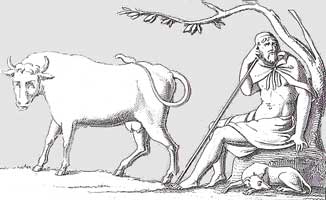
* Io (/ˈaɪ.oʊ/; Ancient Greek: Ἰώ [iːɔ̌ː]) was, in Greek mythology, a nymph(美麗的少女) who was seduced by Zeus, who changed her into a heifer to escape detection. Another of the myths is told most anecdotally by Ovid, in Metamorphoses. According to Ovid, one day, Zeus noticed the maiden and lusted after her. As Io tells her own story in Aeschylus' Prometheus Bound, she rejected his whispered nighttime advances until the oracles caused her own father to drive her out into the fields of Lerna. There, Zeus covered her with clouds to hide her from the eyes of his jealous wife, Hera, who nonetheless came to investigate. In a vain attempt to hide his crimes, Zeus turned himself into a white cloud and transformed Io into a beautiful white heifer. Hera was not fooled. She demanded the heifer as a present, and Zeus could not refuse her without arousing suspicion.
Hera tethered Io to the olive-tree in the temenos of her cult-site, the Heraion, and placed her in the charge of many-eyed Argus Panoptes to keep her separated from Zeus. Zeus commanded Hermes to kill Argus ; Ovid added the detail that he lulled all hundred eyes to sleep, ultimately with the story of Pan and Syrinx. Hera then forced Io to wander the earth without rest, plagued by a gadfly (Οἶστρος or oestrus: see etymology of "estrus") to sting her into madness. Io eventually crossed the path between the Propontis and the Black Sea, which thus acquired the name Bosporus (meaning ox passage), where she met Prometheus.
限會員,要發表迴響,請先登入


