Zemer Nuge
(Israel)

Song Title: Zemer Nugeh (also known as: HaTishma Koli, Hebrew: התשמע קולי)
Lyricist: Rachel Bluwstein Sela
Composer: Shmulik Kraus
Vocalist: The High Windows (Hebrew: החלונות הגבוה / HaChalonot HaGvoim), 1967 (Note: The original hit album was released in 1967)
Dance Title: Zemer Nugeh
Choreographer: Yankele Levy, 1977
Chinese Dance Title: 情話綿綿
Folk Dance Music Source: The 5th Asian Folk Dance Camp
Starting Formation: Circle dance, single circle facing center, holding hands with neighbors, arms hanging naturally down in V-position.
This is a profound and sorrowful love song that Teacher Frog deeply cherishes. The lyrics are moving, and the melody pierces the heart. However, the dance sequence has long puzzled Teacher Frog: Why is it that, in the entire global folk dance community, only Teacher Frog strictly adheres to the original choreographers authentic sequence? As usual, please take a seat and listen to Teacher Frogs detailed explanation.

The dance shares its title with the song, transliterated as Zemer Nugeh, which translates to "Sad Melody" or "Melancholic Song." The song is also widely known by its subtitle, which is the opening line of the lyrics: HaTishma Koli, meaning "Can You Hear My Voice?" It is a tragic love song. The lyrics are adapted from a poem written by Rachel Bluwstein, one of Israels most revered poets, and were published in her 1927 poetry collection titled Safiah (ספיח).
Rachel Bluwstein was born on September 20, 1890, in Saratov, Tsarist Russia, and began writing poetry at the age of 15. Although she lived a brief life of only 41 years (1890–1931), the exquisite poetry she left behind for the Israeli people resembles a brilliant display of summer fireworks-fleeting, yet permanently imprinted on the hearts of every Israeli.
Rachel Bluwstein in her youth: 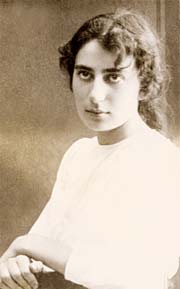
Image source: English Wikipedia
Rachel during her Kibbutz era (Degania Alef Kibbutz, 1919–1921): 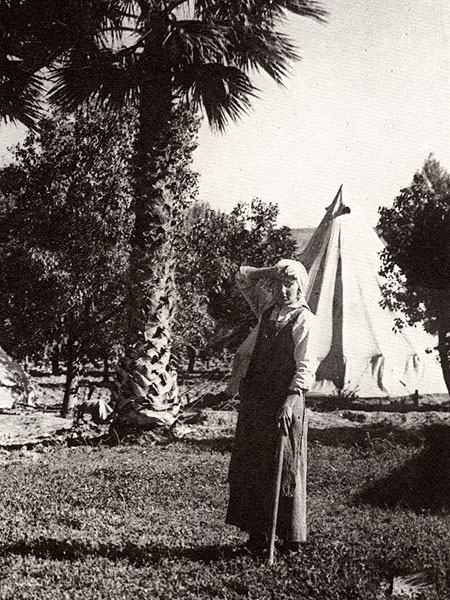
Image source: English Wikipedia
Rachel Bluwstein: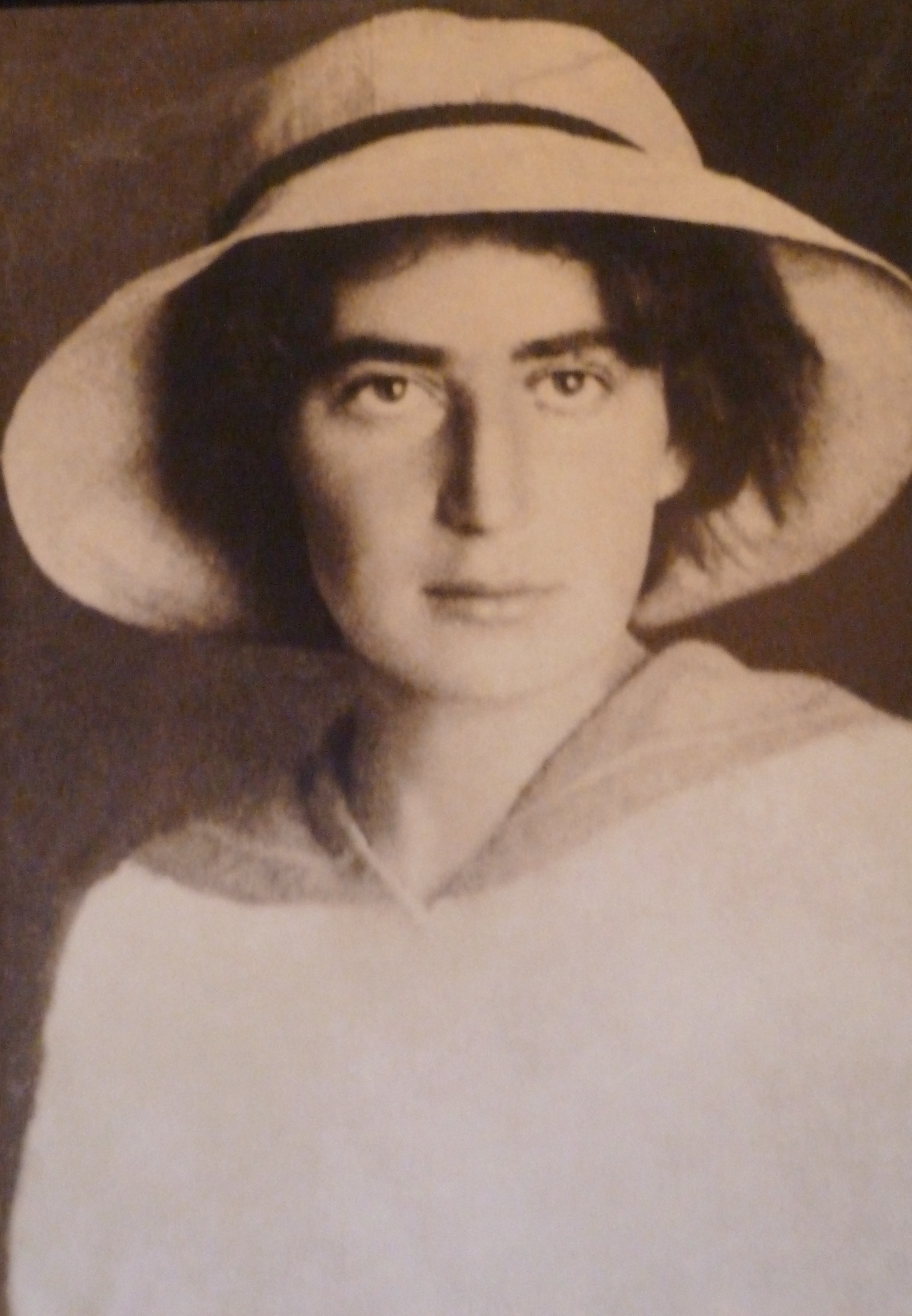
Image source: Wikimedia Commons
Rachel Bluwstein remains one of the most beloved national poets of Israel. In her honor, her portrait is officially featured on the Israeli 20-shekel banknote.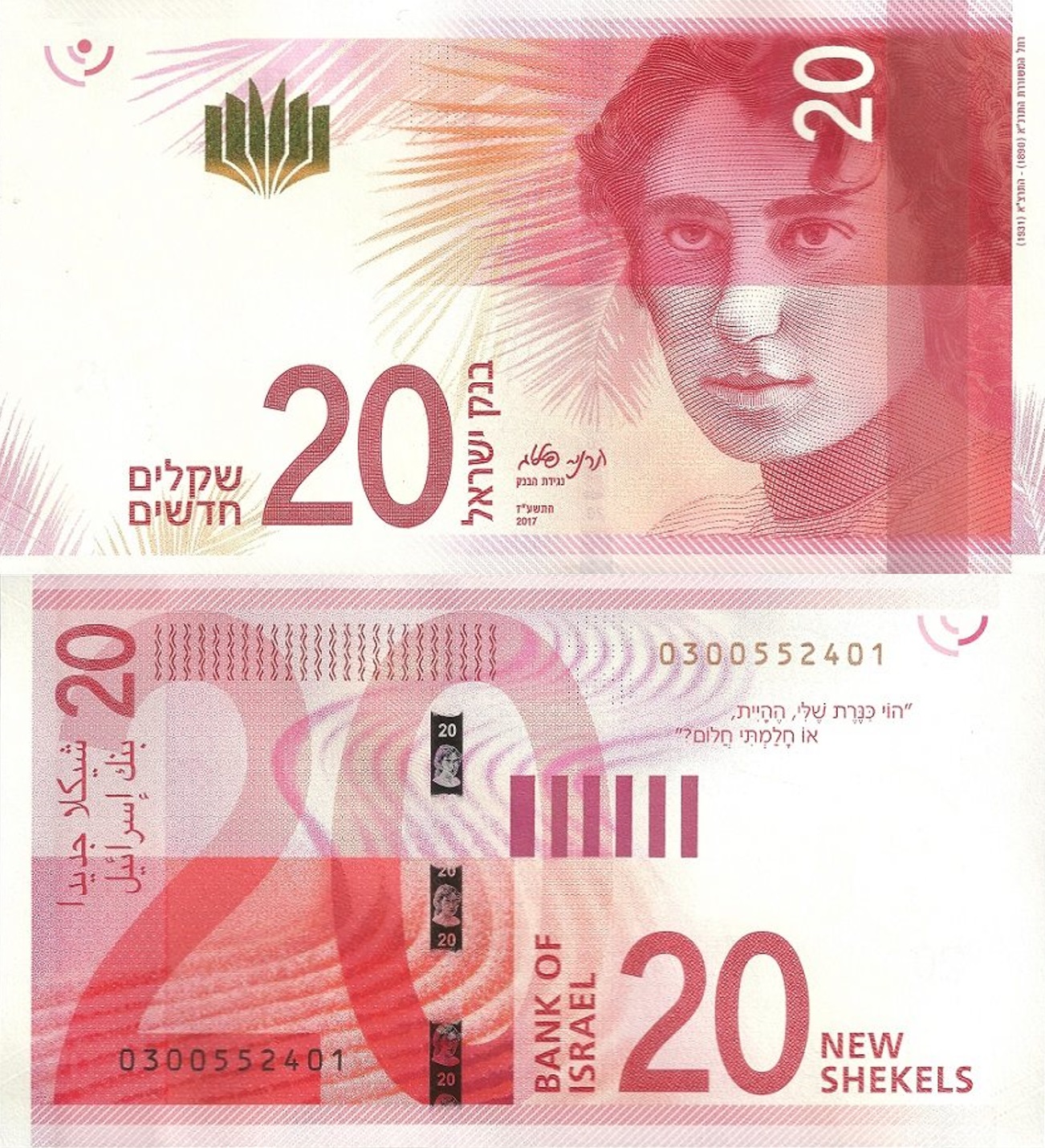
Rachel Bluwsteins tombstone: (Rachel is buried in the historic Kinneret Cemetery on the shores of the Sea of Galilee, resting alongside Naomi Shemer, revered as the "First Lady of Israeli Song and Poetry.")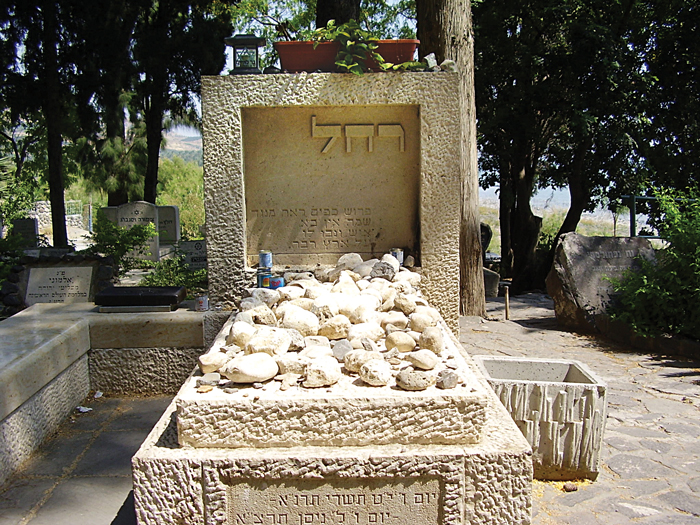
(Teacher Frog’s Cultural Note: Have you noticed the small pile of stones placed on top of the gravestone? According to ancient Jewish tradition and mourning customs, instead of leaving flowers, visitors place a small stone on the grave as a token of respect and to show that the deceased has been visited and remembered. For a deeper look into this tradition, please refer to Teacher Frogs introduction to the dance "Od Lo Ahavti Dai" at https://blog.udn.com/frankflin01/131109676)
Hebrew Lyrics:
1.
הֲתִשְׁמַע קוֹלִי, רְחוֹקִי שֶׁלִּי,
הֲתִשְׁמַע קוֹלִי, בַּאֲשֶׁר הִנְּךָ –
קוֹל קוֹרֵא בְּעֹז, קוֹל בּוֹכֶה בִּדְמִי
וּמֵעַל לַזְּמַן מְצַוֶּה בְּרָכָה?
2.
תֵּבֵל זוֹ רַבָּה וּדְרָכִים בָּה רָב.
נִפְגָּשׁוֹת לְדַק, נִפְרָדוֹת לָעַד.
מְבַקֵּשׁ אָדָם, אַךְ כּוֹשְׁלוֹת רַגְלָיו,
לֹא יוּכַל לִמְצֹא אֶת אֲשֶׁר אָבַד.
3.
אַחֲרוֹן יָמַי כְּבָר קָרוֹב אוּלַי,
כְּבָר קָרוֹב הַיּוֹם שֶׁל דִּמְעוֹת פְּרִידָה,
אֲחַכֶּה לְךָ עַד יִכְבּוּ חַיַּי,
כְּחַכּוֹת רָחֵל לְדוֹדָהּ.
Lyrics (Transliterated):
1.
Hatishma koli rechoki sheli,
Hatishma koli baasher hincha?
Kol kore beOz,
Kol boche bidmi,
Umeal hazman metzave brakha.
2.
Eretz zo raba uDrachim ba rav.
Nifgashot leDak, nifradot laad.
Mevakesh adam, ach koshlot raglav,
Lo yuchal limtzo, et asher avad.
3.
Acharon yamai kvar karov ulai.
Kvar karov haYom shel dimot preda.
Achake lecha ad yichbu chayay
kechakot Rachel
Ledoda.
Lyrics (English Translation):
1.
Will you hear my voice my far-away one
Will you hear my voice where-ever you are
A voice calling with strength, crying in my blood.
Over time it sends a blessing.
2.
Planet/land so big and has many roads
we meet for a moment, separate forever.
A man asks, but his legs fail,
He can never find that which he has lost.
3.
The last of my days is already/so close perhaps
Already/so near is the day of goodbye tears.
I will wait for you until my life will end ,
like Rachels wait for her lover.
Lyrics (Traditional Chinese Translation):
1.
在遠方的你聽得到我的聲音嗎?
不論你在哪裡,你聽得到我的聲音嗎?
來自內心哭泣的聲音
以及一直不斷捎來的祝福祈禱
2.
這個國家很漂亮,馬路既大又寬
我們短暫相聚,卻又長久分離
有一個人在乞討,他的腳不良於行
他永遠不會知道他失去了什麼
3.
我的來日無多了
接近大家流下good-bye眼淚的日子了.
我會一直等著你,直到我的生命結束
就像拉荷兒一直等著她的愛一樣
This legendary song originates from the self-titled debut album of the iconic Israeli trio, HaChalonot HaGvoim (internationally known as The High Windows). The three defining members of this historic trio are Arik Einstein, Shmulik Kraus, and Josie Katz. This exquisite melody was directly inspired by the profound poetry of Rachel Bluwstein. It was Arik’s wife, Alona Einstein, who discovered the sheer beauty of Rachels verses; deeply moved, she envisioned it as a song and encouraged Shmulik Kraus, the talented composer of the trio, to set the poem to music. Performed by The High Windows, the track was permanently captured as the second song on Side B of their monumental debut album. Released in April 1967-merely six weeks prior to the outbreak of the historic Six-Day War-the album garnered widespread critical acclaim, with "Zemer Nugeh" standing out as an absolute masterpiece that captured the hearts of an entire nation.
However, due to various reasons, The High Windows trio disbanded shortly after their debut, making their self-titled album their sole release. Nevertheless, the album left an indelible mark on Israels music history. A digital remastered reissue was released in 2007, achieving phenomenal sales and earning platinum certification that same year-but that is a story for another time.
The High Windows 1967 self-titled album cover: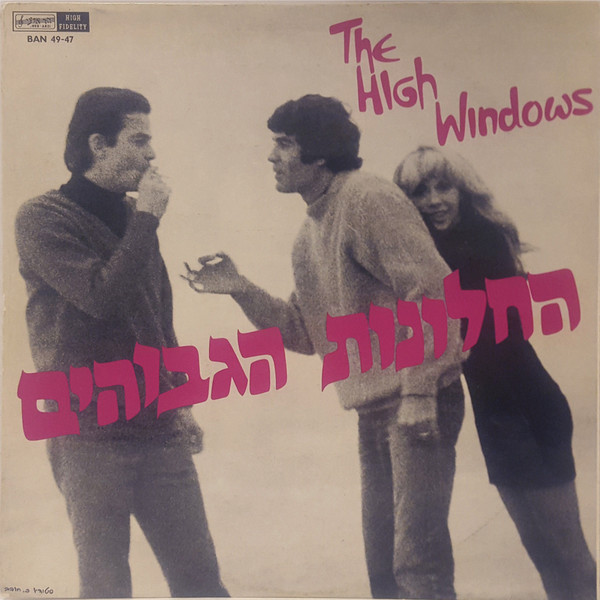
The High Windows 1967 self-titled album back cover: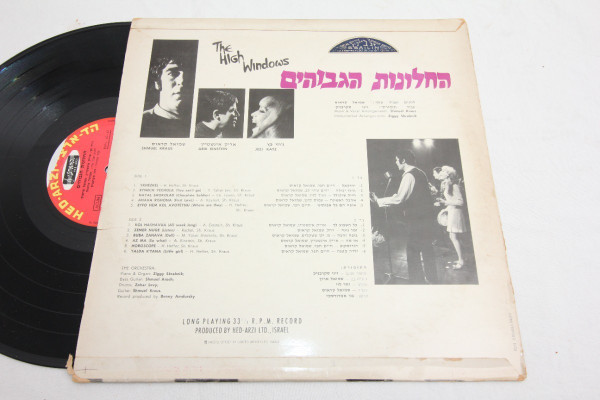
The High Windows 1967 self-titled album - Side A: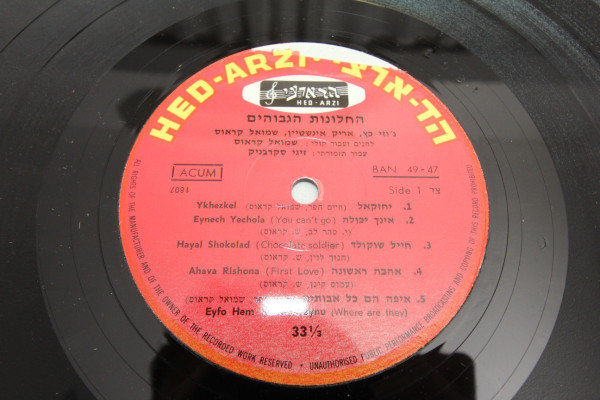
The High Windows 1967 self-titled album - Side B: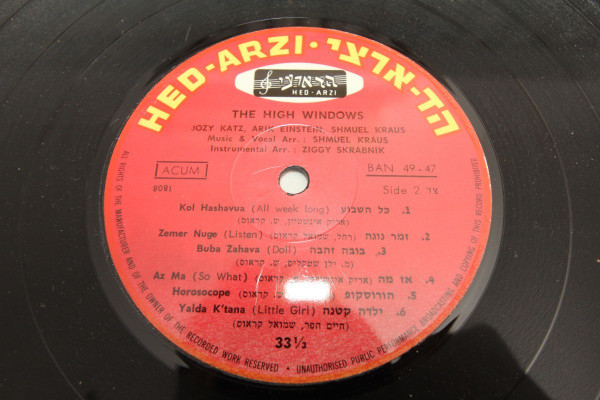
Original version :
"Teacher Frog Invites You to a Folk Dance" - Teacher Frogs Favorite Live Performance Version:
Behind this melancholic love song lies an even more tragic and poignant story, intertwined with a historic mission aboard NASA’s Space Shuttle Columbia. On January 16, 2003, Columbia lifted off for its 28th space mission, designated as "STS-107." Among the seven courageous crew members was Colonel Ilan Ramon, the very first Israeli astronaut. Colonel Ramon was an exceptional payload specialist and an elite combat pilot who had logged thousands of flight hours in advanced fighter jets, including the F-16. As a highly experienced flight instructor, he was 48 years old at the time, making him the oldest crew member on this fateful mission.
Israeli astronaut Colonel Ilan Ramon:
During space shuttle missions, the crew was divided into Red and Blue teams to work around-the-clock shifts. To maintain their schedule, NASA utilized a traditional "Wake-up Call" service-much like a morning call at a hotel. For each shift, a specific song chosen by an astronauts family, friends, or Mission Control would be broadcast to wake the sleeping crew members. For Colonel Ilan Ramon, his wife, Rona Ramon, lovingly chose this very song, Zemer Nugeh, to wake him for his shift. This marked the historic moment when the first Israeli song was ever played in outer space.
The first Israeli song played in space (highlighted in red):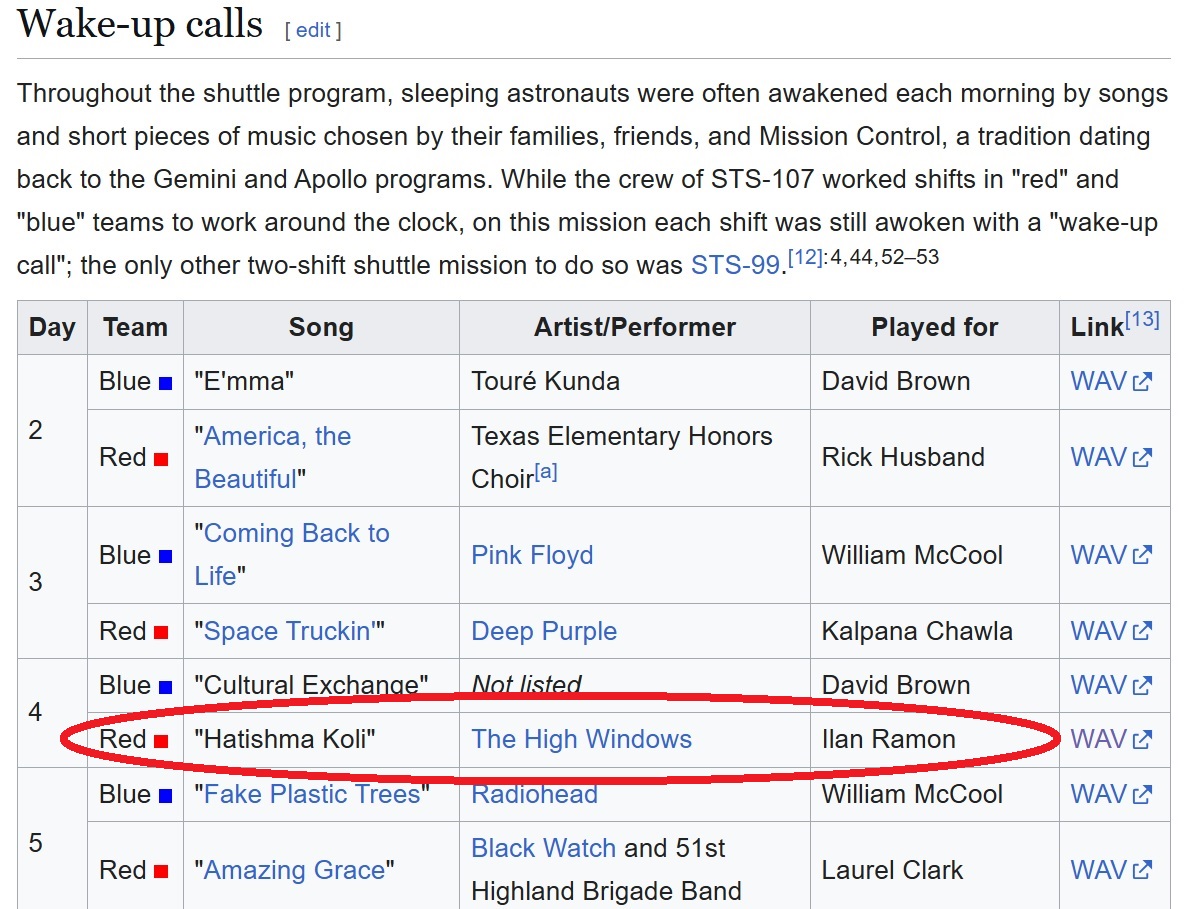
Image source: English Wikipedia
However, do you recall what we discussed earlier? This song is fundamentally a tragic love song, depicting lovers separated by immense distances, or perhaps destined never to meet again. Given that this mission took place in the distant void of space rather than somewhere on Earth, did the haunting lyrics subtly foreshadow an ominous fate?
Live footage of the Space Shuttle Columbia launch on January 16, 2003:
Sharp-eyed observers might have noticed a critical incident that occurred just moments after liftoff. A piece of insulating foam broke away from the shuttles External Tank (ET)-the massive structure housing the liquid hydrogen fuel and liquid oxygen oxidizer-due to intense aerodynamic forces. Tragically, this detached fragment struck the leading edge of Columbias left wing, severely damaging the Thermal Protection System (TPS) tiles designed to shield the spacecraft from the scorching heat of atmospheric reentry.
STS-107 mission launch:
While the Space Shuttle Columbia was in orbit, several ground control engineers discovered that the Thermal Protection System on the shuttles left wing had been compromised. This fatal flaw would prevent the spacecraft from withstanding the intense atmospheric heat generated during reentry, placing both the orbiter and the lives of the entire crew in extreme peril. However, for reasons still debated, mission management dismissed the engineers concerns, blocking further thermal imaging inspections and halting any potential corrective action. Two weeks later, on February 1, 2003, as Columbia was returning to Earth after completing its STS-107 mission, the disaster unfolded precisely as feared. Upon plunging into the Earths atmosphere, superheated gases penetrated the damaged left wing, breaching its internal structure. The shuttle rapidly disintegrated in mid-air, scattering the remains of the seven brave astronauts and debris across a vast expanse of Texas, Louisiana, and Arkansas.
Space Shuttle Columbia STS-107 Mission Insignia:
Who could have foreseen that such a beautiful Israeli song carried such an ominous premonition? The poignant verses of the poem inadvertently mirrored this catastrophic event. This brings to mind another exquisite Israeli dance, Bein Harei Chevron, which similarly features a gorgeous melody but conceals a tragic, yet inspiring story of national revival and pioneering nation-building. (For a brief introduction to the Bein Harei Chevron dance, please refer to Teacher Frogs corresponding article at: https:/blog.udn.com/frankflin01/22329037).
Space Shuttle Columbia STS-107 Mission Crew:
From left to right:
David M. Brown, U.S. Navy Captain: Pilot and Flight Surgeon
Rick D. Husband, U.S. Air Force Colonel: Commander and Mechanical Engineer
Laurel B. Clark, U.S. Navy Captain: Flight Surgeon and Mission Specialist
Kalpana Chawla: Indian-American Aerospace Engineer and Mission Specialist
Michael P. Anderson, U.S. Air Force Lieutenant Colonel: Payload Commander and Physicist in charge of scientific missions
William C. McCool, U.S. Navy Commander: Pilot
Ilan Ramon, Israeli Air Force Colonel: Payload Specialist and Israel’s First Astronaut (with the Israeli flag proudly embroidered on his left sleeve)
Having shared the profound history behind the song, Teacher Frog will now focus on the dance itself. The core technical puzzle of this dance revolves around the upbeat. In music theory, an upbeat is formally known as an anacrusis. This concept is also frequently utilized in the notation of Labanotation (Laban dance score). An anacrusis refers to the unaccented beat or notes that precede the first downbeat of a measure, serving to prepare the body for the subsequent primary movement. Just as many musical compositions begin with an anacrusis, numerous dances incorporate an upbeat movement to fluidly transition into the main choreography-such as the knee flexion (plié) prior to a jump, or the arm swing before a throw. In Labanotation, these upbeat movements are meticulously recorded right before the preparatory stance and the actual first downbeat. (Regarding upbeat and anacrusis in Labanotation, Teacher Frog has briefly explained these concepts in several previous dance introductions; dance enthusiasts are encouraged to Google them for further reading.).
Next, Teacher Frog will present the original Israeli dance notation side-by-side with the Chinese version, along with the sheet music for this dance. Please examine and compare them carefully to see the discrepancies, which will reveal why Teacher Frog previously emphasized that only Teacher Frog initiates the dance strictly according to the original choreographic sequence, and why other dancers mistakenly start on a completely different beat.
The original dance notation: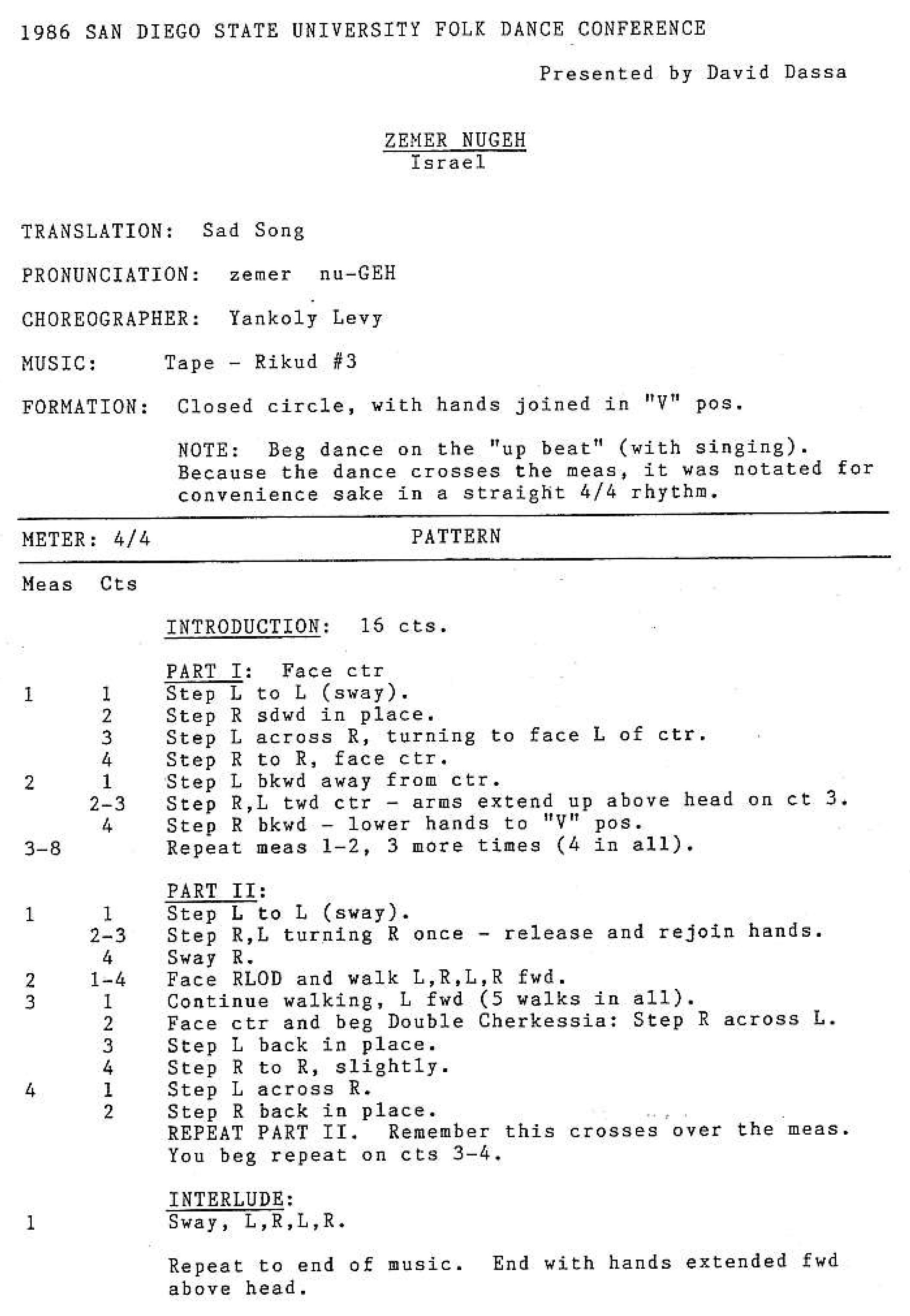
The Chinese dance notation: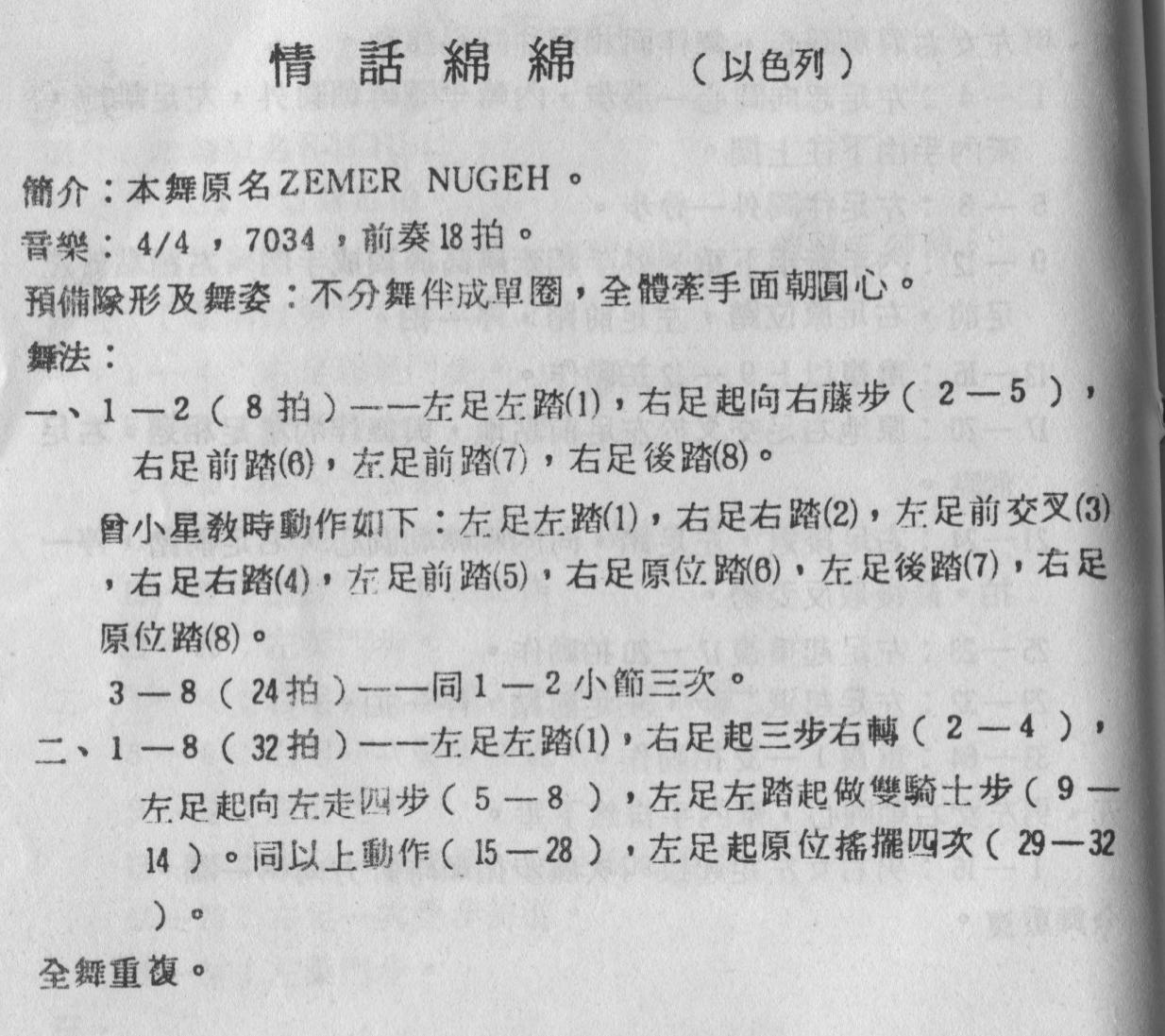
Dancers, have you noticed the discrepancy in the introduction section? The Chinese dance notation states an 18-beat introduction pause, whereas the original Israeli notation specifies 16 beats. This reveals a significant discrepancy in the materials brought back by Teacher Zeng Xiaoxing from the 5th Asian Folk Dance Camp.
The original notation describes a 16-beat pause for the introduction: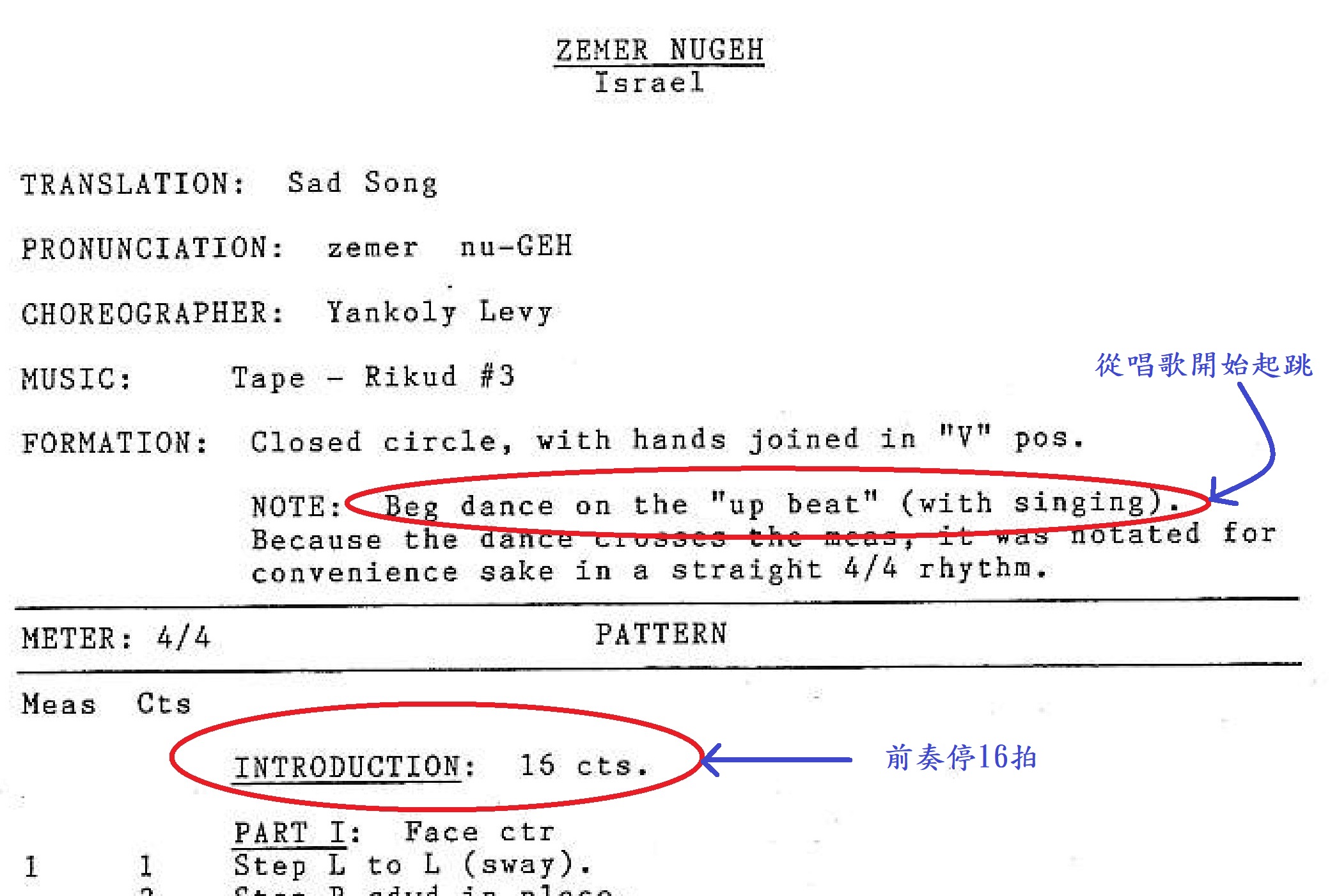
The Chinese notation describes an 18-beat pause for the introduction: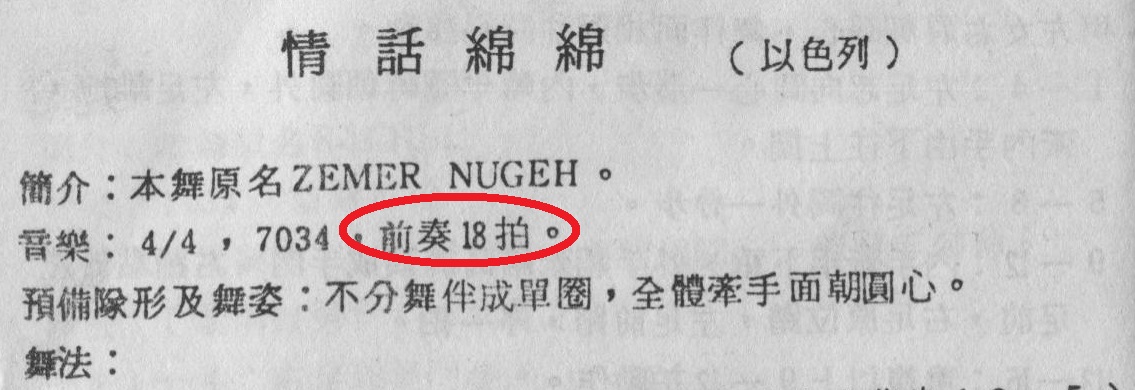
Here, Teacher Frog will point out a crucial detail in the original dance notes that many dancers might have overlooked: the upbeat.
In the "Note" section of the original Israeli notation, it explicitly states: "Beg dance on the up beat (with singing)." The word "Beg" here is not a plea; it is the standard abbreviation for "Begin." Teacher Frog has already thoroughly explained the concept of an "upbeat" previously, so I will not repeat it here. Following the "Note," the parentheses (with singing) indicate that the dance movements must commence simultaneously with the onset of the vocals.
However, whether it is the original Israeli dance notes, the Chinese translation, or versions in any other language, it is practically impossible to provide a full musical score to every dancer. Furthermore, the vast majority of folk dancers are not formally trained in advanced music theory. Consequently, even a fundamental concept like an anacrusis (upbeat/weak beat) gradually caused widespread confusion among dancers across different regions. The ultimate result left Teacher Frog completely speechless-and perhaps even the original choreographer, Yankele Levy, could never have anticipated that folk dancers all over the world would collectively make the exact same mistake!
Teacher Frog has tracked down the complete musical score for this song so that dancers can visualize the structural relationship between the various vocal parts and instruments:
Zemer Nugeh – Full Score – Cover Page: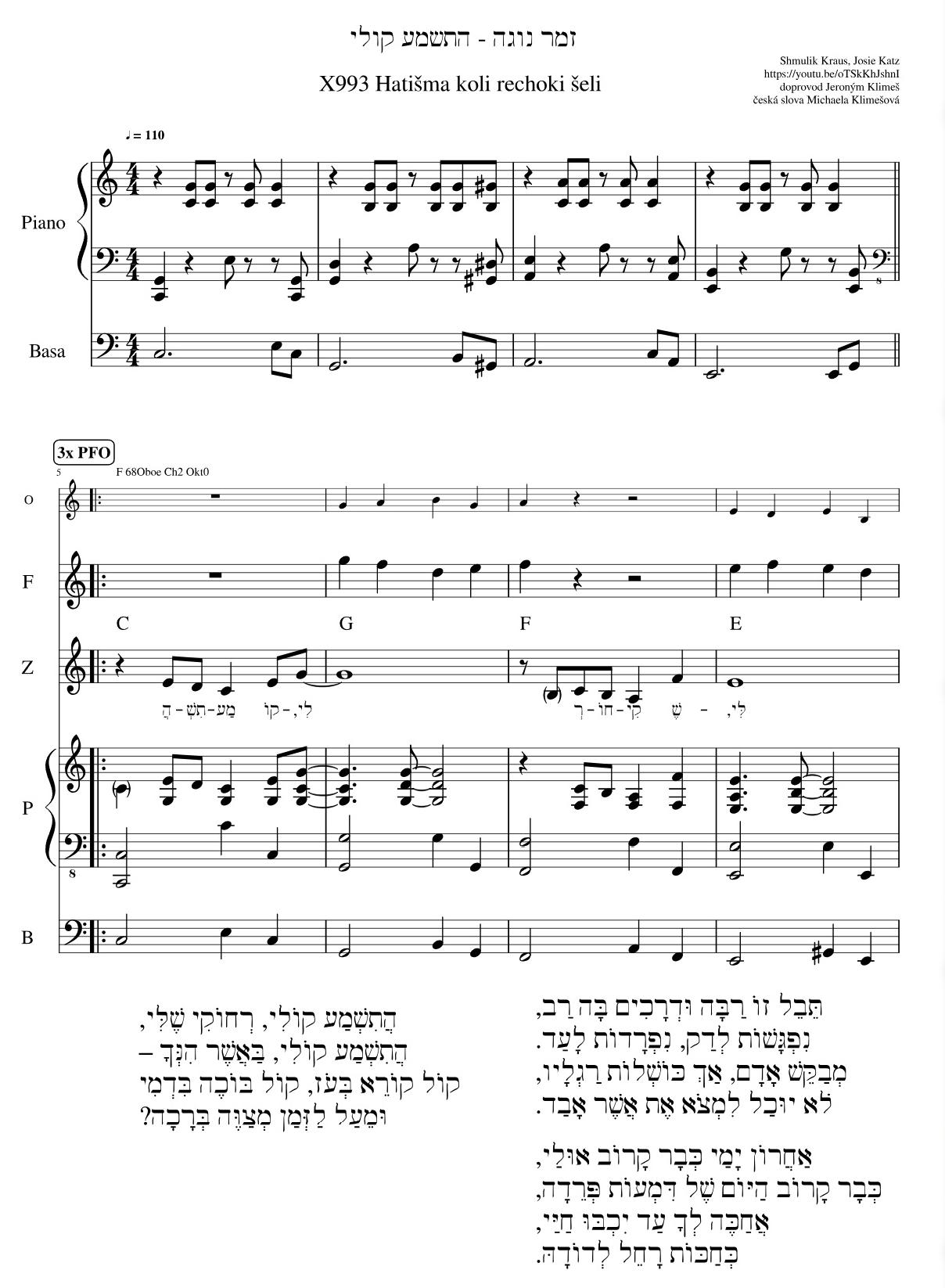
Source: Czech Website: https://klimes.mysteria.cz/
The score above displays all parts and instrumentation, including the piano and flute. At first glance, dancers might find it overwhelming to locate the starting point. Therefore, Teacher Frog has isolated the vocal part from the score below to make it much easier to analyze:
Zemer Nugeh – Vocal Score: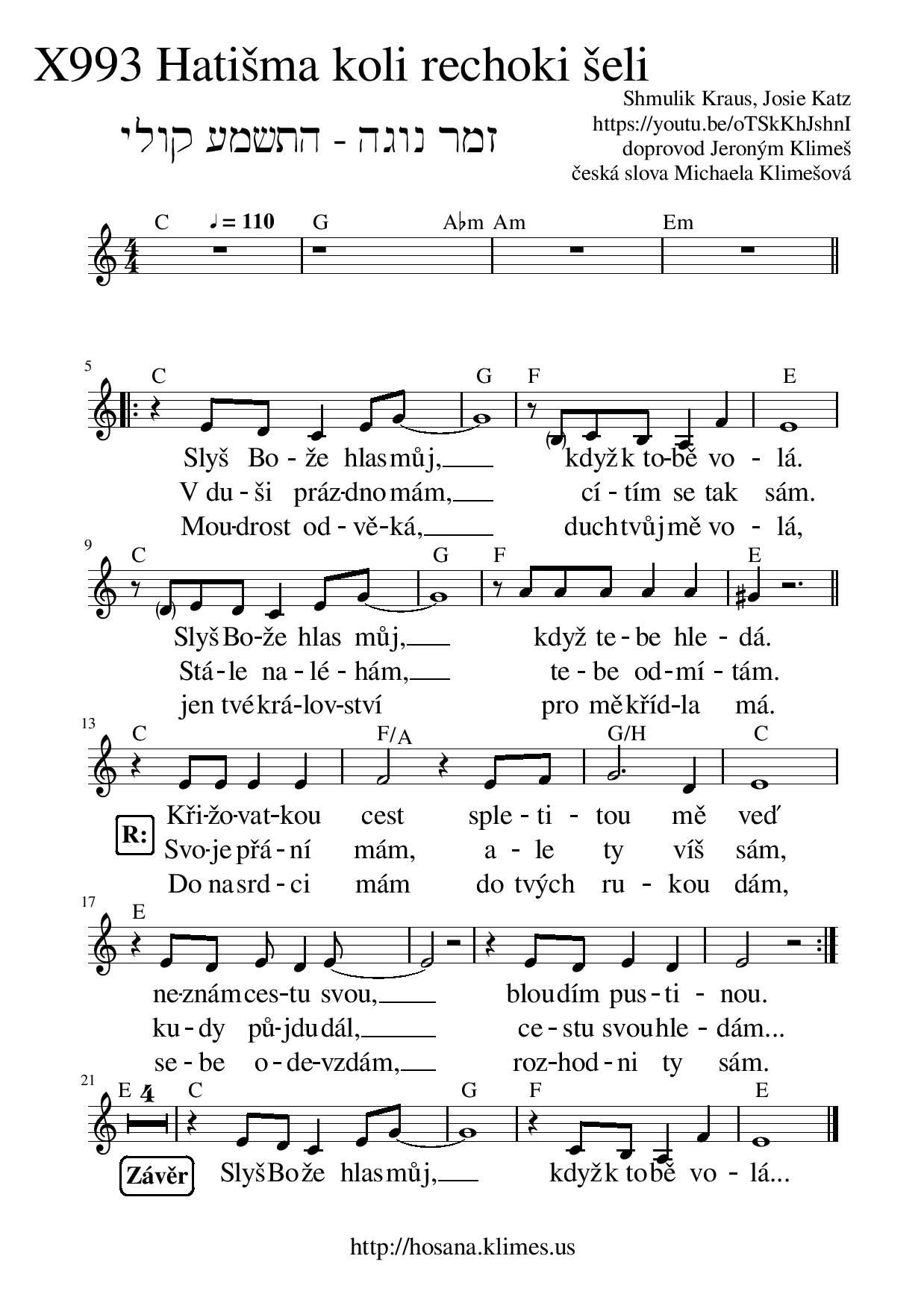
Source: Czech Website: https://klimes.mysteria.cz/
(Teacher Frog’s Note: The lyrics printed in this specific score are a Czech translation, not the original Hebrew or transliterated lyrics).
Teacher Frog’s Music Theory Guide: The (4/4) time signature marked next to the treble clef indicates that this piece is written in common time (four beats per measure). The solid black rectangular blocks resting below the staff lines in the first four measures are whole rests (semibreve rests), which indicate that the entire measure is silent. (Teacher Frog explains: A whole rest means that regardless of the performers internal timing, if a measure has two beats, you rest for two; if it has three, you rest for three; and if it has four, you rest for four-the entire measure remains silent). Since the introduction contains four consecutive whole rests across four measures, the music rests for four four-beat intervals, totaling exactly 16 beats.
Then, the musical structure shifts. The first beat of the fifth measure begins with a quarter rest (crotchet rest), making this starting measure an incomplete measure (also formally known as an anacrusis, which is precisely what the choreographer noted as the "upbeat"). Normally, if dancers attempt to take their first step as they usually do on a downbeat, they will find their foot awkwardly jammed in mid-air before the vocal melody actually lands, making the start quite clumsy.
Accounting for that quarter rest on the very first beat of this measure, dancers have technically waited a total of 17 beats across the introduction before the singing officially begins on the 18th beat. However, because this 18th beat is an anacrusis (weak beat), it disrupts the instinctive routine of most dancers. It becomes incredibly difficult for them to identify their starting foot and lock into the rhythm, even though the choreographers notes declare that the dance has begun!
As a result, dancers worldwide implicitly united to wait for the next strong downbeat-which lands on the 19th beat. This collective adjustment is the exact origin of the "18-beat introduction pause" documented in the Chinese dance sequence. Although this workaround completely deviated from the original choreographer’s artistic intention, it could not stop the global dance community from changing the rules to suit their comfort.
However, this academic precision strictly brought unexpected hardships to Teacher Frog. Whether conducting regular classes or leading recreational dance parties, Teacher Frog always remains completely faithful to the original choreographers authentic sequence, initiating the dance movements precisely when the vocals begin. Consequently, whenever his students attended general folk dance parties, they would invariably step out one beat earlier than everyone else, resulting in chaotic bumps and collisions with neighboring dancers. Later, these students returned and complained, "Teacher Frog, you taught us the wrong way!"
But what is the absolute truth? Did Teacher Frog truly teach it incorrectly? At that moment, it was incredibly difficult for Teacher Frog to explain such complex musical and choreographic theory to the students on the spot. Now, by laying out the music theory, the dance choreography, and the entire historical context for all dance enthusiasts to read and analyze, everyone can finally understand the intricate details-and hopefully, stop misunderstanding that Teacher Frog made a mistake! In the end, as an academic-minded, institutional school-of-thought instructor who treats folk dance as a rigorous scholarly research project, Teacher Frog often finds that high-brow songs find few singers. It is truly lonely at the top! Ah! My tongue slipped-allow me to correct myself: Teacher Frog is merely a humble frog living at the bottom of a pond, looking up at the sky from the well. Not high at all, not high at all! Haha!
If dance enthusiasts ask Teacher Frog, "Now that we know the original choreographers true sequence, should we risk colliding with our neighbors at recreational parties just to dance the historically correct version?" Well... Teacher Frogs ultimate answer is: Let nature take its course! (Let it be!) 
Nevertheless, Teacher Frog himself will personally continue to adhere strictly to the original choreographers sequence... albeit privately when dancing entirely alone. Starting the movements on the choreographers intended upbeat right as the singing commences changes everything. Do not underestimate the subtle difference of a single beat; with that one single beat, the entire flavor, essence, and artistic conception of the dance are completely transformed. It allows you to deeply connect with and get the cross-century dialogue between the choreographer and the original poet, Rachel, evoking a far more profound emotional impact. Teacher Frog guarantees that if you play the music and try dancing it by yourself in the dead of night, the sensation will be entirely different.
Here, Teacher Frog would like to treat everyone to an additional Hebrew-transliterated sheet music as a bonus. The tonality of this score differs from the full orchestra score featured above; it is written in E-flat major with three flats. Furthermore, it does not record the music from the introduction. However, because it contains the crucial Hebrew-transliterated lyrics, it is placed here at the very end solely for dance enthusiasts reference, and was not included in the primary research discussion above:
Zemer Nugeh Sheet Music in E-flat major with Hebrew-transliterated lyrics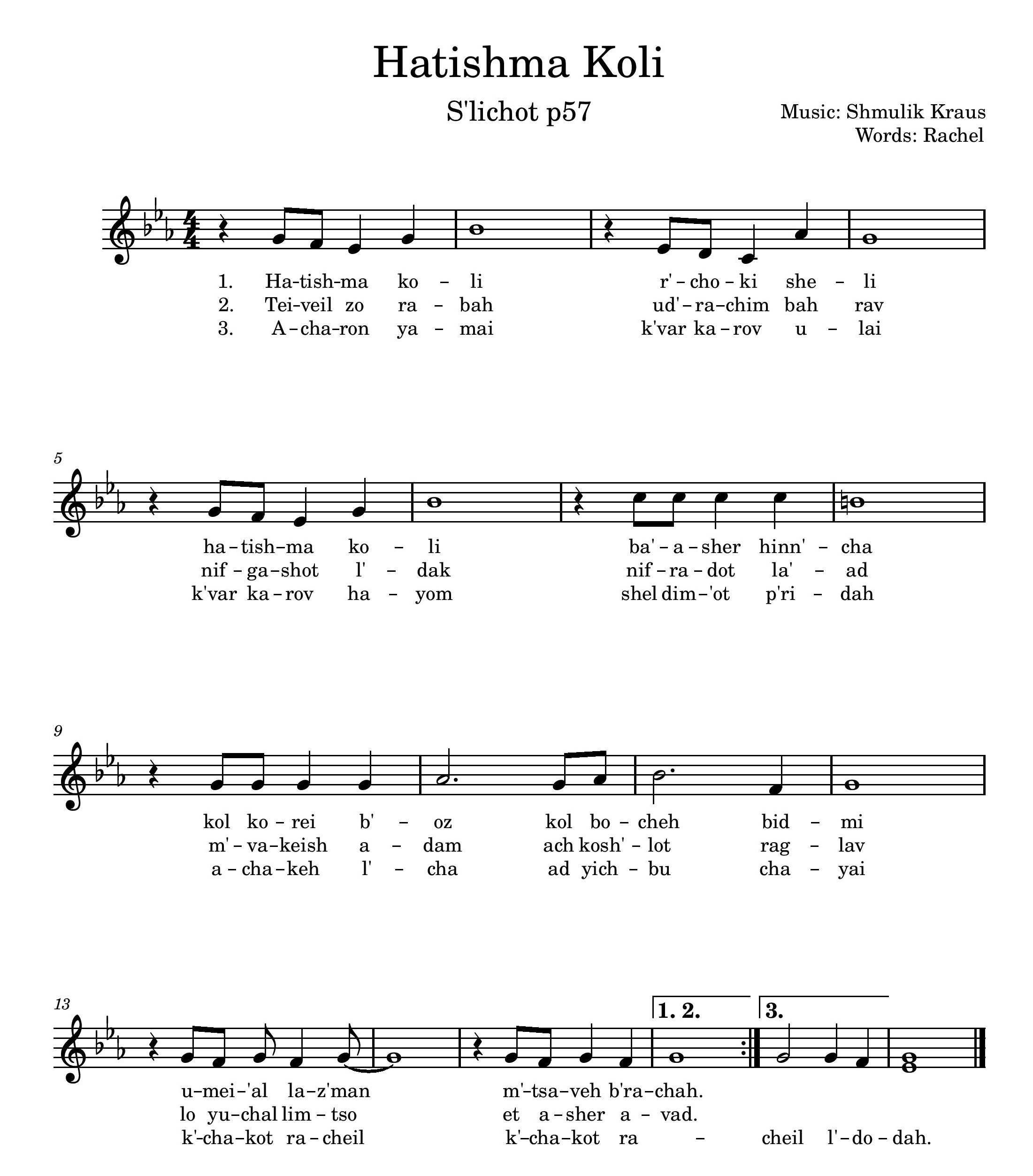
Finally, Teacher Frog has compiled several reference demonstration videos from various folk dance societies around the world for your study and comparison:
Rokdim Folk Dance Society (Israel): Reference instructional and demonstration video.
Bonding Folk Dance Club (Hong Kong): Led by Teacher Johnny.
Teacher Zhou Shiyang (Oshasha) from National Tsing Hua University: Reference demonstration.
Henry (Israeli Folk Dancer): Reference video.
Israel-Europe Folk Dance Class: Demonstrated by Teacher Zhan Biying.
(Teacher Frog’s Final Request: Please carefully count the beats in these videos, everyone. Arent the folk dancers from all over the world invariably starting their very first step precisely on the 19th beat?)
References:
1.Wikimedia Commons
2.Hebrew Wikipedia
3.Hebrew Songs Database
4.Jacob Richmans Home Page
5.Hebrew Lyrics Repository
6.National Academy for Educational Research Dictionary (Taiwan)
7.Czech Musical Scores Archival Website


