․ Allusion
Allusion is a figure of speech, in which one refers covertly or indirectly to an object or circumstance from an external context. It is left to the audience to make the connection; where the connection is directly and explicitly stated (as opposed to indirectly imply) by the author, an allusion is instead usually termed a reference.
p Three different forms of allusions
According to Dr. Naseeb Shaheen, Shakespeare, in writing
his plays, "seldom borrows biblical references from his sources, even when those sources contain many references."
- Literary:
Literary allusion is closely related to parody and pastiche,
which are also "text-linking" literary devices.
- Classical:
An indirect although not accidental reference to a Greek or
Roman legend. This form of writing is often used in poetry. It is used repeatedly in Romeo and Juliet as well.
․ Genre
Genre (from French genre, "kind" or "sort", from Latin genus (stem gener-)) is any category of literature, music, or other forms of art or entertainment, whether written or spoken, audio or visual, based on some set of stylistic criteria. The literary type of genre is like poetry and drama.
․ Fiction
An imaginary story, whether in prose, poetry, or drama. For example, The_Help is a fiction, which is written by Kathryn Stockett, and the characters in the book are all imaginary. Fiction thrived in the middle class when it first published.
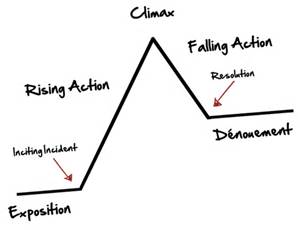
․ Structure of story
․ Plot
A brief story that teaches a lesson often ethical or spiritual, which refers to the sequence of events inside a story which affect other events through the principle of cause and effect.
․ Conflict
A struggle between opposing forces in a story or play, usually resolved by the end of the work. The conflict may occur within a character as well as between characters.
․ Prose
Prose is a form of language that exhibits a grammatical structure and a natural flow of speech, rather than a rhythmic structure as in traditional poetry.
․ Romance
As a literary genre of high culture, romance or chivalric romance is a type of prose and verse narrative that was popular in the aristocratic circles of High Medieval and Early Modern Europe.
․ Subgenre
A subgenre is a subordinate within a genre. Two stories being the same genre can still sometimes differ in subgenre.
ð Poetry :
- Narrative: epic, Ballad
- Lyrical: Ghazal g The ghazal is a form of poetry. In classic form, the ghazal has from five to fifteen rhyming couplets that share a refrain at the end of the second line. The ghazal often reflects on a theme of unattainable love or divinity.
․ The difference between Simile and Metaphor
|
Simile |
Simile explicitly use connecting words (such as like, as, so, than, or various verbs such as resemble), though these specific words are not always necessary. |
|
Metaphor |
A metaphor directly equates them, and does not use "like" or "as" as does a simile |
Shall I compare thee to a summer’s day?
By William Shakespeare, 1564-1616
Shall I compare thee to a summer’s day?
Thou art more lovely and more temperate:
Rough winds do shake the darling buds of May,
And summer’s lease hath all too short a date;
Sometime too hot the eye of heaven shines,
And often is his gold complexion dimm'd;
And every fair from fair sometime declines,
By chance or nature’s changing course untrimm'd;
But thy eternal summer shall not fade,
Nor lose possession of that fair thou ow’st;
Nor shall death brag thou wander’st in his shade,
When in eternal lines to time thou grow’st:
So long as men can breathe or eyes can see,
So long lives this, and this gives life to thee.
ð Sonnet is composed of three quatrains (question) and one couplet(answer).
․ Vocabulary
- glossary (n.)
A list of technical or special words, especially those in a particular text, explaining their meanings
- text (n.)
The main printed part of a book or magazine, not the notes, pictures, etc.
- renovate (v.)
to repair and paint an old building, a piece of furniture, etc. so that it is in good condition again.
- trim (v.)
to make something neater, smaller, better, etc., by cutting parts from it
- sonnet (n.)
a poem that has 14 lines, each containing 10 syllables, and a fixed pattern of rhyme


