★ Charles Dickens

Charles John Huffam Dickens (February 1812 – 9 June 1870) was an English writer and social critic. He created some of the world's best-known fictional characters and is regarded as the greatest novelist of the Victorian era. His works enjoyed unprecedented popularity during his lifetime, and by the twentieth century critics and scholars had recognized him as a literary genius. His novels and short stories enjoy lasting popularity.
Dickens's literary success began with the 1836 serial publication of The Pickwick Papers. Within a few years he had become an international literary celebrity, famous for his humor, satire, and keen observation of character and society. His novels, most published in monthly or weekly instalments, pioneered the serial publication of narrative fiction, which became the dominant Victorian mode for novel publication. The instalment format allowed Dickens to evaluate his audience's reaction, and he often modified his plot and character development based on such feedback. For example, when his wife's chiropodist expressed distress at the way Miss Mowcher in David Copperfield seemed to reflect her disabilities, Dickens improved the character with positive features. His plots were carefully constructed, and he often wove elements from topical events into his narratives. Masses of the illiterate poor chipped in ha'pennies to have each new monthly episode read to them, opening up and inspiring a new class of readers.
★ A Christmas Carol

A Christmas Carol in Prose, Being a Ghost-Story of Christmas, commonly known as A Christmas Carol, is a novella by Charles Dickens, first published in London by Chapman & Hall on 19 December 1843. The novella met with instant success and critical acclaim. A Christmas Carol tells the story of a bitter old miser named Ebenezer Scrooge and his transformation into a gentler, kindlier man after visitations by the ghost of his former business partner Jacob Marley and the Ghosts of Christmas Past, Present and Yet to Come.
The book was written at a time when the British were examining and exploring Christmas traditions from the past as well as new customs such as Christmas cards and Christmas trees. Carol singing took a new lease on life during this time. Dickens's sources for the tale appear to be many and varied, but are, principally, the humiliating experiences of his childhood, his sympathy for the poor, and various Christmas stories and fairy tales.
A Christmas Carol remains popular—having never been out of print—and has been adapted many times to film, stage, opera, and other media.
Ê scrooge (n.) -A scrooge is a miserly person.

★ David Copperfield
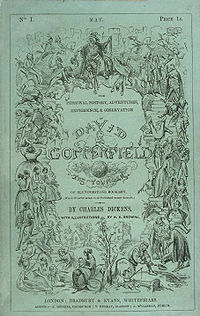
David Copperfield, (full title: The Personal History, Adventures, Experience and Observation of David Copperfield the Younger of Blunder stone Rookery (Which He Never Meant to Publish on Any Account)) is the eighth novel by Charles Dickens. It was first published as a serial in 1849–50, and as a book in 1850. Many elements of the novel follow events in Dickens' own life, and it is probably the most autobiographical of his novels. In the preface to the 1867 edition, Dickens wrote, "like many fond parents, I have in my heart of hearts a favorite child. And his name is David Copperfield

★ 英文名其來有自~
(1.) 希臘 / 羅馬 神祇的名字
For example: Athena、Jupiter…
(2.) 英文經典名作、典籍或聖經
For example: Abraham、Phoebe…
(3.) 曾經的國王
For example: David、Charles
★ Acts of the Apostles

The Acts of the Apostles, often referred to simply as Acts, is the fifth book of the New Testament; it tells of the founding of the Christian church and the spread of its message to the Roman Empire.
Acts and the Gospel of Luke make up a two-part work, Luke–Acts, by the same anonymous author, usually dated to around 80-90 AD. The first part, the Gospel of Luke, tells how God fulfilled his plan for the world's salvation through the life, death and resurrection of Jesus of Nazareth, the promised Messiah. Acts continues the story of Christianity in the 1st century, beginning with Jesus' Ascension to Heaven. The early chapters, set in Jerusalem, describe the Day of Pentecost (the coming of the Holy Spirit) and the growth of the church in Jerusalem. Initially the Jews are receptive to the Christian message, but soon they turn against the followers of Jesus. Rejected by the Jews, under the guidance of the Apostle Peter the message is taken to the Gentiles. The later chapters tell of Paul's conversion, his mission in Asia Minor and the Aegean, and finally his imprisonment in Rome, where, as the book ends, he awaits trial.

★ Last supper
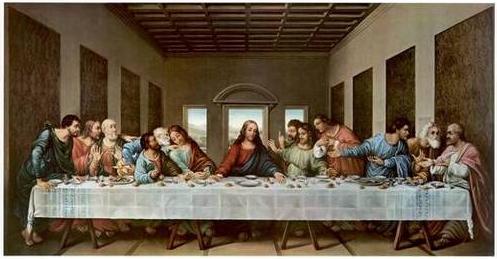
The Last Supper is the final meal that, in the Gospel accounts, Jesus shared with his Apostles in Jerusalem before his crucifixion. The Last Supper is commemorated by Christians especially on Maundy Thursday. Moreover, the Last Supper provides the scriptural basis for the Eucharist, also known as "Holy Communion" or "The Lord's Supper".
The First Epistle to the Corinthians contains the earliest known mention of the Last Supper. The four canonical Gospels all state that the Last Supper took place towards the end of the week, after Jesus' triumphal entry into Jerusalem and that Jesus and his Apostles shared a meal shortly before Jesus was crucified at the end of that week. During the meal Jesus predicts his betrayal by one of the Apostles present, and foretells that before the next morning, Peter will deny knowing him.
The three Synoptic Gospels and the First Epistle to the Corinthians include the account of the institution of the Eucharist in which Jesus takes bread, breaks it and gives it to the Apostles, saying: "This is my body which is given for you". The Gospel of John does not include this episode, but tells of Jesus washing the feet of the Apostles, giving the new commandment "to love one another as I have loved you", and has a detailed farewell discourse by Jesus, calling the Apostles who follow his teachings "friends and not servants", as he prepares them for his departure.
Scholars have looked to the Last Supper as the source of early Christian Eucharist traditions. Others see the account of the Last Supper as derived from 1st-century Eucharistic practice as described by Paul in the mid-50s.
The Last Supper served the dual purpose of venerating Passover, the escape of the Jews from slavery in Egypt, and the establishment of a new tradition, Christianity.

♫ Have yourself a merry little Christmas (Sam Smith)

★ Original sin
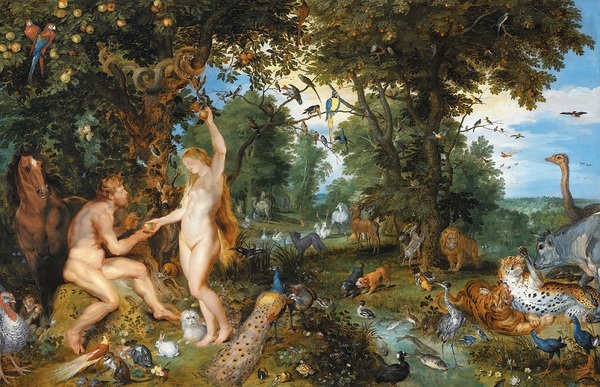
Original sin, also called ancestral sin, is the Christian doctrine of humanity's state of sin resulting from the fall of man, namely the sin of consuming from the tree of knowledge of good and evil, stemming from Adam's rebellion in Eden. This condition has been characterized in many ways, ranging from something as insignificant as a slight deficiency, or a tendency toward sin yet without collective guilt, referred to as a "sin nature", to something as drastic as total depravity or automatic guilt of all humans through collective guilt.
The concept of original sin was first alluded to in the 2nd century by Irenaeus, Bishop of Lyons in his controversy with certain dualist Gnostics. Other church fathers such as Augustine also developed the doctrine, seeing it as based on the New Testament teaching of Paul the Apostle (Romans 5:12–21 and 1 Corinthians 15:22) and the Old Testament verse of Psalm 51:5. Tertullian, Cyprian, Ambrose and Ambrosiaster considered that humanity shares in Adam's sin, transmitted by human generation. Augustine's formulation of original sin was popular among Protestant reformers, such as Martin Luther and John Calvin, who equated original sin with concupiscence, affirming that it persisted even after baptism and completely destroyed freedom. The Jansenist movement, which the Catholic Church declared to be heretical, also maintained that original sin destroyed freedom of will.
 Original sin

★ Adam and Eve

Adam and Eve, according to the creation myths of the Abrahamic religions, were the first man and woman. The story of Adam and Eve is central to the belief that God created human beings to live in a paradise on earth, although they fell away from that state and formed the present world full of suffering and injustice. It provides the basis for the belief that humanity is in essence a single family, with everyone descended from a single pair of original ancestors. It also provides much of the scriptural basis for the doctrines of the fall of man and original Sin, important beliefs in Christianity, although not generally shared by Judaism or Islam.
In the Book of Genesis of the Hebrew Bible, chapter one through five, there are two creation narratives with two distinct perspectives. In the first, Adam and Eve are not referenced by name. Instead, God created humankind in God's image and instructed them to multiply and to be stewards over everything else that God had made. In the second narrative, God fashions Adam from dust and places him in the Garden of Eden. Adam is told that he can till the ground and eat freely of all the trees in the garden, except for a tree of the knowledge of good and evil, of which he is prohibited from eating. Subsequently, Eve is created from one of Adam's ribs to be Adam's companion. However, a serpent tricks Eve into eating fruit from the forbidden tree, and she gives some of the fruit to Adam. God curses the serpent and the ground. God prophetically tells the woman and the man what will be the consequences of their sin of disobeying God. Then he banishes 'the man' from the Garden of Eden.
The story underwent extensive elaboration in later Abrahamic traditions, and it has been extensively analyzed by modern biblical scholars. Interpretations and beliefs regarding Adam and Eve and the story revolving around them vary across religions and sects. The story of Adam and Eve is often depicted in religious art, and it has had an important influence in literature and poetry.
Ê The rib, which God had taken from man, made he a woman. (from bible)
“I had a string tied here under my left rib where my heart is.”
“Sometimes I have the strongest feeling about you. Especially when you are near me as you are now. It feels as though I had a string tied here under my left rib where mt heart is, tightly knotted to you in a similar fashion. And when you go to Ireland, with all that distance between us, I am afraid that this cord will be snapped, and I shall bleed inwardly.”

★ The Use Of Three In The Bible
It should be noted at the outset that the biblical authors’ use of the number three is abundantly attested. Indeed, the number three or its compounds occurs hundreds of times. Most of these display a conventional use such as to mark quantity whether in enumerating persons, things, or activities. For example, Noah had three sons and Job had three daughters; The Ark of the Covenant contained three sacred objects ‘The gold jar of manna, Aaron’s staff that had budded, and the stone tablets of the covenant”. Solomon’s Palace of the Forest of Lebanon was designed with windows “placed high in sets of three facing each other. All the doorways had rectangular frames; they were in the front part in sets of three, facing each other”. 21 Likewise, in John’s vision a triple entrance way marked all four sides of the city of the New Jerusalem. David “bowed down before Jonathan three times, with his face to the ground” and Daniel regularly prayed three times a day giving thanks to God. Israelite men were required to appear before the Lord three times in a year: “Three times a year all your men must appear before the LORD your God at the place he will choose: at the Feast of Unleavened Bread, the Feast of Weeks and the Feast of Tabernacles”. Jesus answered Satan’s threefold temptation by citing three scriptural passages Matt 4:1-11). Paul experienced three shipwrecks and prayed three times to the Lord for the removal of his “thorn in the flesh”
★ Jesus' nativity
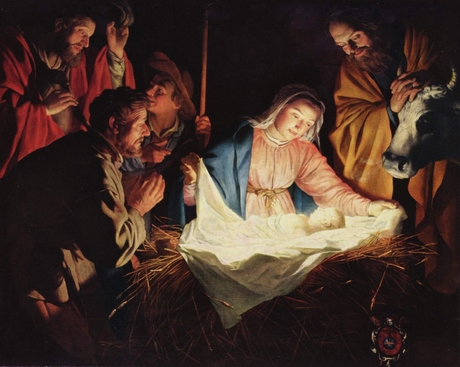
Matthew and Luke each offer a genealogy of Jesus. Matthew traces Jesus' ancestry to Abraham through David. Luke traces Jesus' ancestry through Adam to God.
Matthew and Luke each describe Jesus' nativity (or birth), especially that Jesus was born of a virgin in Bethlehem in fulfillment of prophecy. Luke's account emphasizes events before the birth of Jesus and centers on Mary, while Matthew's mostly covers those after the birth and centers on Joseph. Both accounts state that Jesus was born to Joseph and Mary, his betrothed, in Bethlehem, and both support the doctrine of the virgin birth, according to which Jesus was miraculously conceived by the Holy Spirit in Mary's womb when she was still a virgin. The virgin birth has been a consistent tenet of orthodox Christian belief, although a number of liberal theologians have questioned it in the last 150 years. Matthew repeatedly cites the Old Testament to show that Jesus is the Jews' promised Messiah.
In Matthew, Joseph is troubled because Mary, his betrothed, is pregnant (Matthew 1:19–20), but in the first of Joseph's three dreams an angel assures him not to be afraid to take Mary as his wife, because her child was conceived by the Holy Spirit. In Matthew 2:1–12, wise men or Magi from the East bring gifts to the young Jesus as the King of the Jews. Herod hears of Jesus' birth and, wanting him killed, orders the murders of male infants in Bethlehem. But an angel warns Joseph in his second dream, and the family flees to Egypt—later to return and settle in Nazareth.
In Luke 1:31–38 Mary learns from the angel Gabriel that she will conceive and bear a child called Jesus through the action of the Holy Spirit. When Mary is due to give birth, she and Joseph travel from Nazareth to Joseph's ancestral home in Bethlehem to register in the census ordered by Caesar Augustus. While there Mary gives birth to Jesus, and as they have found no room in the inn, she places the newborn in a manger (Luke 2:1–7). An angel announces the birth to some shepherds, who go to Bethlehem to see Jesus, and subsequently spread the news abroad (Luke 2:8–20). After the presentation of Jesus at the Temple, Joseph, Mary and Jesus return to Nazareth.
Biblical Magi
Ê Biblical Magi
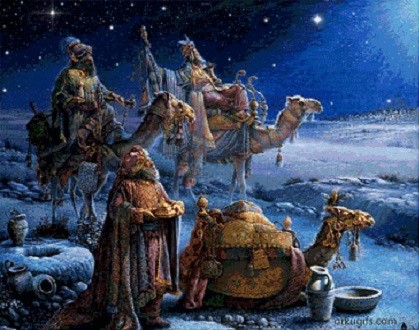
The Magi, also referred to as the (Three) Wise Men or (Three) Kings, were, in the Gospel of Matthew and Christian tradition, a group of distinguished foreigners who visited Jesus after his birth, bearing gifts of gold, frankincense and myrrh. They are regular figures in traditional accounts of the nativity celebrations of Christmas and are an important part of Christian tradition.
According to Matthew, the only one of the four Canonical gospels to mention the Magi, they came "from the east" to worship the "king of the Jews". Although the account does not mention the number of Magi, the three gifts has led to the widespread assumption that there were three men. In Eastern Christianity, especially the Syriac churches, the Magi often number twelve. Their identification as kings in later Christian writings is probably linked to Psalms 72:11, "May all kings fall down before him".
★ Saint Peter

Saint Peter, also known as Simon Peter, Simeon, or Simōn, according to the New Testament, was one of the Twelve Apostles of Jesus Christ, leaders of the early Christian Church. The Roman Catholic Church considers him to be the first Pope, ordained by Jesus in the "Rock of My Church" dialogue in Matthew 16:18. The ancient Christian churches all venerate Peter as a major saint and associate him with founding the Church of Antioch and later the Church in Rome, but differ about the authority of his various successors in present-day Christianity.
According to Christian tradition, Peter was crucified in Rome under Emperor Nero Augustus Caesar. It is traditionally held that he was crucified upside down at his own request, since he saw himself unworthy to be crucified in the same way as Jesus. Tradition holds that he was crucified at the site of the Clementine Chapel. His remains are said to be those contained in the underground Confessio of St. Peter's Basilica, where Pope Paul VI announced in 1968 the excavated discovery of a first-century Roman cemetery. Every June 29 since 1736, a statue of Saint Peter in St. Peter's Basilica is adorned with papal tiara, ring of the fisherman, and papal vestments, as part of the celebration of the Feast of Saints Peter and Paul. According to Catholic doctrine, the direct papal successor to Saint Peter is Pope Francis.
★ St. Peter's Basilica

The Papal Basilica of St. Peter in the Vatican, or simply St. Peter's Basilica (Latin: Basilica Sancti Petri; Italian: Basilica Papale di San Pietro in Vaticano), is an Italian Renaissance church in Vatican City, the papal enclave within the city of Rome.
Designed principally by Donato Bramante, Michelangelo, Carlo Maderno and Gian Lorenzo Bernini, St. Peter's is the most renowned work of Renaissance architecture and one of the largest churches in the world. While it is neither the mother church of the Catholic Church nor the cathedral of the Diocese of Rome, St. Peter's is regarded as one of the holiest Catholic shrines. It has been described as "holding a unique position in the Christian world" and as "the greatest of all churches of Christendom".
Ê fresco (n.) -A method of wall painting in water colors on fresh plaster.
★ Binding of Isaac
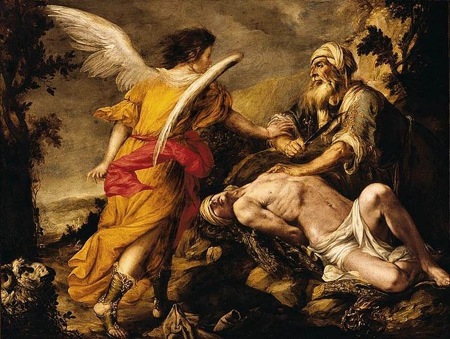
The Binding of Isaac (in Hebrew the עֲקֵידַת יִצְחַק, Akedát Yitzḥák, also known as "The Binding" הָ)עֲקֵידָה), the Akedah or Aqedah, is a story from the Hebrew Bible in which God asks Abraham to sacrifice his son, Isaac, on Mount Moriah. The account states that Abraham "bound Isaac, his son" before placing him on the altar.
According to the Hebrew Bible, God commands Abraham to offer his son Isaac as a sacrifice. After Isaac is bound to an altar, the angel of God stops Abraham at the last minute, saying "now I know you fear God." At this point, Abraham sees a ram caught in some nearby bushes and sacrifices the ram instead of Isaac.
The Book of Genesis does not tell the age of Isaac at the time. The Talmudic sages teach that Isaac was thirty-seven, likely based on the next biblical story, which is of Sarah's death at 127[Genesis 23:1], being 90 when Isaac was born.
Genesis 22:14 states that the event occurred at "the mount of the LORD". 2 Chronicles 3:1; Psalm 24:3; Isaiah 2:3 & 30:29; and Zechariah 8:3, identify the location of this event as the hill on which Solomon was said to later build the Temple, now believed to be the Temple Mount in Jerusalem.


