
★ Seven points of underlining the notes on textbooks
When we see the punctuations below, boldface words and italics words in sentences, most of which are the key points.
Underline it !!!

(1.) Colon :
(2.) Double question mark “ ”
(3.) Shell brackets []
(4.) Brackets ( )
(5.) Hyphen
(6.) Boldface For example: A ➜ A
(7.) Italics For example: A ➜ A
★ How to take great notes (video)
1. facts Ð conclusion ¢
2. lecture + evidence + colour pen $
3. review notes + try teaching others
------------------------------------------------------------------------------------------------------------------
★ Lysistrata
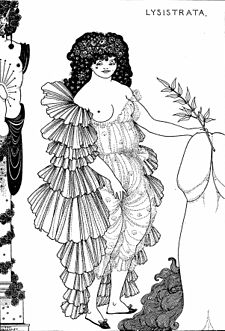
Lysistrata (/laɪˈsɪstrətə/ or /ˌlɪsəˈstrɑːtə/; Attic Greek: Λυσιστράτη, "Army Disbander") is a comedy by Aristophanes. Originally performed in classical Athens in 411 BC, it is a comic account of one woman's extraordinary mission to end the Peloponnesian War. Lysistrata persuades the women of Greece to withhold sexual privileges from their husbands and lovers as a means of forcing the men to negotiate peace—a strategy, however, that inflames the battle between the sexes. The play is notable for being an early exposé of sexual relations in a male-dominated society. Additionally, its dramatic structure represents a shift from the conventions of Old Comedy, a trend typical of the author's career. It was produced in the same year as the Thesmophoriazusae, another play with a focus on gender-based issues, just two years after Athens' catastrophic defeat in the Sicilian Expedition.
★ Platonic Academy

The Academy was founded by Plato (428/427 BC – 348/347 BC) in ca. 387 BC in Athens. Aristotle (384 BC – 322 BC) studied there for twenty years (367 BC – 347 BC) before founding his own school, the Lyceum. The Academy persisted throughout the Hellenistic period as a skeptical school, until coming to an end after the death of Philo of Larissa in 83 BC. Although philosophers continued to teach Plato's philosophy in Athens during the Roman era, it was not until AD 410 that a revived Academy was established as a center for Neoplatonism, persisting until 529 AD when it was finally closed by Justinian I.
The Platonic Academy has been cited by historians as the first higher learning institution in the Western world.
★ Plato
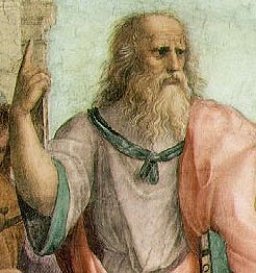
Plato in Classical Attic; 428/427 or 424/423 – 348/347 BC) was a philosopher and mathematician in Classical Greece, and the founder of the Academy in Athens, the first institution of higher learning in the Western world. He is widely considered the most pivotal figure in the development of philosophy, especially the Western tradition. Unlike nearly all of his philosophical contemporaries, Plato's entire œuvre is believed to have survived intact for over 2,400 years.
★ Mimesis
Mimesis, from μιμεῖσθαι (mīmeisthai), "to imitate," from μῖμος (mimos), "imitator, actor") is a critical and philosophical term that carries a wide range of meanings, which include imitation, representation, mimicry, imitatio, receptivity, nonsensuous similarity, the act of resembling, the act of expression, and the presentation of the self.
In ancient Greece, mimesis was an idea that governed the creation of works of art, in particular, with correspondence to the physical world understood as a model for beauty, truth, and the good. Plato contrasted mimesis, or imitation, with diegesis, or narrative. After Plato, the meaning of mimesis eventually shifted toward a specifically literary function in ancient Greek society, and its use has changed and been reinterpreted many times since then.
One of the best-known modern studies of mimesis, understood as a form of realism in literature, is Erich Auerbach's Mimesis: The Representation of Reality in Western Literature, which opens with a famous comparison between the way the world is represented in Homer's Odyssey and the way it appears in the Bible. From these two seminal Western texts, Auerbach builds the foundation for a unified theory of representation that spans the entire history of Western literature, including the Modernist novels being written at the time Auerbach began his study. In art history, "mimesis", "realism" and "naturalism" are used, often interchangeably, as terms for the accurate, even "illusionistic", representation of the visual appearance of things.
★ Socrates
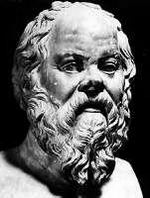
Socrates (470/469 – 399 BC) was a classical Greek (Athenian) philosopher credited as one of the founders of Western philosophy. He is an enigmatic figure known chiefly through the accounts of classical writers, especially the writings of his students Plato and Xenophon and the plays of his contemporary Aristophanes. Plato's dialogues are among the most comprehensive accounts of Socrates to survive from antiquity, though it is unclear the degree to which Socrates he is "hidden behind his 'best disciple', Plato".
★ Aristotle

Aristotle (384 – 322 BC) was a Greek philosopher and scientist born in the city of Stagira, Chalkidice, on the northern periphery of Classical Greece. His father, Nicomachus, died when Aristotle was a child, where after Proxenus of Atarneus became his guardian. At eighteen, he joined Plato's Academy in Athens and remained there until the age of thirty-seven (c. 347 BC). His writings cover many subjects – including physics, biology, zoology, metaphysics, logic, ethics, aesthetics, poetry, theater, music, rhetoric, linguistics, politics and government – and constitute the first comprehensive system of Western philosophy. Shortly after Plato died, Aristotle left Athens and, at the request of Philip of Macedon, tutored Alexander the great starting from 343 BC.


