★ ab- (分離、離開)
✎ abandon
(v.t.)
(1.) To give up entirely. 離棄。
➜ The captain decided to abandon the ship.
(2.) To desert; forsake. 放棄;捨棄。
➜ The exhibition is postponed, not abandoned.
➜ She abandoned her son to his fate.
(3.) To yield (oneself) without restraint, as to an emotion or impulse.
放縱;縱情;恣意;耽溺;沉湎於...;恣情縱慾。
➜ She abandoned herself to despair.
(n.)
(1.) Freedom of manner; dash; complete surrender to natural impulses.
放浪不羈;放縱;恣情縱慾;放任;無拘無束。
❀ phrases
․ with abandon 狂放不羈地;放肆地;放縱地。
✎ aboriginal
(adj.)
(1.) Original; first; existing from the beginning. 原始的;最初的;土著的。
(n.)
(1.) Inhabitant, plant, etc. that has been in a place from the earliest times.
土著;原住民;土生動植物。
✎ abuse
(v.t.)
(1.) To use improperly; misuse. 妄用;濫用。
(2.) To maltreat; treat rudely or wrongfully. 苛待;虐待。
➜ What have I done and why do you abuse me?
(3.) To use violent or insult language toward; upbraid. 辱罵。
➜ The abused each other.
(4.) To violate or ravish. 非禮;姦污。
(5.) Deceive. 欺騙。
(n.)
(1.) Mistreatment; improper or excessive use. 虐待;妄用;濫用。
(2.) Violent or insulting speech. 謾罵;辱罵。
➜ The two parties, after exchanging a good deal of abuse, came to blows.
(3.) A corrupt practice or vicious habit. 腐敗之行為;惡習。
★ characteristic
(adj.)
(1.) Pertaining to, or displaying, the moral nature of; typical.
屬於(或顯)本性的;有特色的;特徵的;典型的。
➜ The remark is characteristic of the man.
(n.)
(1.) A distinguishing mark or quality; essential nature. 特徵;本色。
★ condemn
(v.t.)
(1.) To pronounce or judge guilty. 宣告有罪;定罪。
➜ He was condemned to death.
(2.) To blame; censure. 譴責;非難。
➜ I condemn such measures.
(3.) To declare to be forfeited. 沒收;充公。
➜ The captured ship and her cargo were condemned.
(4.) To pronounce to be unfit for use. 查封。
➜ The city government condemned the old building because it was falling down.
★ The Face That Launch'd A Thousand Ships ★
by Christopher Marow
Was this the face that launch'd a thousand ships,
And burnt the topless towers of Ilium?
Sweet Helen, make me immortal with a kiss.
Her lips suck forth my soul: see where it flies!
Come, Helen, come, give me my soul again.
Here will I dwell, for heaven is in these lips,
And all is dross that is not Helena.
I will be Paris, and for love of thee,
Instead of Troy, shall Wittenberg be sack'd;
And I will combat with weak Menelaus,
And wear thy colours on my plumed crest;
Yea, I will wound Achilles in the heel,
And then return to Helen for a kiss.
O, thou art fairer than the evening air
Clad in the beauty of a thousand stars;
Brighter art thou than flaming Jupiter
When he appear'd to hapless Semele;
More lovely than the monarch of the sky
In wanton Arethusa's azur'd arms;
➥ Helen of Troy (formerly of Sparta) was so beautiful that Greek men went to Troy and fought the Trojan War to win Helen back from Paris. The thousand ships refer to the Greek troops that set sail from Aulis to Troy where the Trojan prince Paris had taken Menelaus' wife, Helen. Helen had been abducted before she married Menelaus, so Menelaus knew it could happen again. Before Helen of Sparta married Menelaus, all the Greek suitors, and she had had quite a few, swore an oath to aid Menelaus should he ever need their help retrieving his wife. Those suitors or their sons brought their own troops and ships to Troy. The Trojan War may have actually happened. The stories about it, best known from the author known as Homer, say it lasted 10 years. At the end of the Trojan War, the belly of the Trojan Horse (from which we get the expression "beware of Greeks bearing gifts") sneakily transported Greeks into Troy where they set fire to the city, killed the Trojan men, and took many of the Trojan women as concubines.
★ Irony
Irony, meaning "dissimulation, feigned ignorance"), in its broadest sense, is a rhetorical device, literary technique, or event in which what appears, on the surface, to be the case, differs radically from what is actually the case. Irony may be divided into categories such as verbal, dramatic, and situational.
Verbal, dramatic, and situational irony are often used for emphasis in the assertion of a truth. The ironic form of simile, used in sarcasm, and some forms of litotes can emphasize one's meaning by the deliberate use of language which states the opposite of the truth, denies the contrary of the truth, or drastically and obviously understates a factual connection.
☸ Verbal irony
Verbal irony is a statement in which the meaning that a speaker employs is sharply different from the meaning that is ostensibly expressed. The ironic statement usually involves the explicit expression of one attitude or evaluation, but with indications in the overall speech-situation that the speaker intends a very different, and often opposite, attitude or evaluation
☸ Dramatic irony
This type of irony is the device of giving the spectator an item of information that at least one of the characters in the narrative is unaware of (at least consciously), thus placing the spectator a step ahead of at least one of the characters.
☸ Situational irony
This is a relatively modern use of the term, and describes a sharp discrepancy between the expected result and actual results in a certain situation.
★ Hubris
Hubris means, in a modern context, extreme pride or self-confidence; in its ancient Greek context, it typically describes violent and excessive behavior rather than an attitude. When it offends the gods of ancient Greece, it is usually punished. The adjectival form of the noun hubris is "hubristic".
Hubris is usually perceived as a characteristic of an individual rather than a group, although the group the offender belongs to may suffer consequences from the wrongful act. Hubris often indicates a loss of contact with reality and an overestimation of one's own competence, accomplishments or capabilities, especially when the person exhibiting it is in a position of power.
★ Orestes
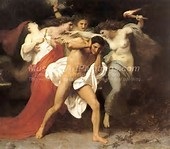
In Greek mythology, Orestes was the son of Clytemnestra and Agamemnon. He is the subject of several Ancient Greek plays and of various myths connected with his madness and purification, which retain obscure threads of much older ones.
➥ In Homer
In the Homeric telling of the story, Orestes is a member of the doomed house of Atreus which is descended from Tantalus and Niobe. Orestes is absent from Mycenae when his father, Agamemnon, returns from the Trojan War with the Trojan princess Cassandra as his concubine, and thus not present for Agamemnon's murder by his wife Clytemnestra's lover, Aegisthus. Seven years later, Orestes returns from Athens and avenges his father's death by slaying both Aegisthus and his own mother Clytemnestra.
In the Odyssey, Orestes is held up as a favorable example to Telemachus, whose mother Penelope is plagued by suitors.

★ Chrismon

A chrismon is a Christian symbol representing Jesus Christ. As in the case of Christogram, the term chrismon comes from the Latin phrase "Christi monogramma", meaning "monogram of Christ".
Since early Christianity, the term chrismon has traditionally referred to any symbol or figure reminiscent of the name of Christ, by contrast with the basic christogram consisting of plain letters typically implying the presence of some kind of calligraphic ornamentation.
In the 20th century the term also started to be used in a wider sense to refer to ornaments that are "symbols for Christ or some part of Christ's ministry"; these are often used during Advent and Christmas, to decorate a Chrismon tree (or a Christmas tree), and include "the crow, descending down, fish, Celtic cross, Jerusalem cross, shepherd's crook, chalice, shell, and others".
★ Othello

Othello (The Tragedy of Othello, the Moor of Venice) is a tragedy by William Shakespeare, believed to have been written in 1603. It is based on the story Un Capitano Moro ("A Moorish Captain") by Cinthio, a disciple of Boccaccio, first published in 1565. This tightly constructed work revolves around four central characters: Othello, a Moorish general in the Venetian army; his beloved wife, Desdemona; his loyal lieutenant, Cassio; and his trusted but ultimately unfaithful ensign, Iago. Given its varied and enduring themes of racism, love, jealousy, betrayal, revenge and repentance, Othello is still often performed in professional and community theatre alike, and has been the source for numerous operatic, film, and literary adaptations.


★ The Sphinx

The sphinx is a mythical creature with, as a minimum, the head of a human and the body of a lion.
In Greek tradition, it has the head of a human, the haunches of a lion, and sometimes the wings of a bird. It is mythicized as treacherous and merciless. Those who cannot answer its riddle suffer a fate typical in such mythological stories, as they are killed and eaten by this ravenous monster. This deadly version of a sphinx appears in the myth and drama of Oedipus. Unlike the Greek sphinx, which was a woman, the Egyptian sphinx is typically shown as a man (an androsphinx). In addition, the Egyptian sphinx was viewed as benevolent, but having a ferocious strength similar to the malevolent Greek version and both were thought of as guardians often flanking the entrances to temples.
★ Tragic Flaw
Aristotle mentions hamartia in Poetics. He argues that is a powerful device to have a story begin with a rich and powerful hero, neither exceptionally virtuous nor villainous, who then falls into misfortune by a mistake or error (harmartia). Discussion among scholars centers mainly on the degree to which hamartia is defined as tragic flaw or tragic error.
➥ Critical Argument for flaw
Poetic justice describes the obligation of the dramatic poet, along with philosophers and priests, to see that their work promotes moral behavior. 18th century French dramatic style honored that obligation with the use of hamartia as a vice to be punished Phèdre, Racine's adaptation of Euripides' Hippolytus, is an example of French Neoclassical use of hamartia as a means of punishing vice. Jean Racine says in his Preface to Phèdre, as translated by R.C. Knight:
″The failings of love are treated as real failings. The passions are offered to view only to show all the ravage they create. And vice is everywhere painted in such hues, that its hideous face may be recognized and loathed.″
The play is a tragic story about a royal family. The main characters respective vices; rage, lust and envy lead them to their tragic downfall.
★ Blue Blood / Purple Robes
Comes from the medieval belief that aristocratic blood was blue. Usually used talking about nobility and royal family members.


