★ -ics (框線起、有範疇的學問)
✎ economics (n.)
(1.) The science that treats of the production and use of wealth. 經濟學。
(2.) Financial feasibility. 經濟上的可行性。
✎ physics (n.)
(1.) The science which treats of matter and energy, including the study of mechanics, heat, light, sound, electricity, etc. 物理學。
✎ acoustics (n.)
(1.) The science of sound. 聲學;音響學。
(2.) The qualities of a hall that determine how well sound be heard in it.
(禮堂、音樂廳等的)傳音性;音響效果(狀態)。
✎ mathematics (n.)
(1.) The science that treats of quantities and magnitudes, by the use of symbols, and the measuring, relations, and properties of such quantities and magnitudes.數學。
✎ statistics (n.)
(1.) Numerical facts, collected and classified, relating to a large body of people, as a nation or state, or to some special industry, interest, or the like. 統計。
(2.) The art or science of collecting and arranging such facts. 統計學。
✎ politics (n.)
(1.) The science or art of government. 政治學。
(2.) One's opinions as to government and party. 政論;政見。
(3.) Party management or control. 政黨;黨治。
(4.) Intrigue used to gain one's ends. 陰謀;策略。
➜ play politics 玩弄政策。
✎ athletics (n.)
(1.) Any system of training by gymnastic exercises or athletic sports.
運動;體育;競技。
(2.) Athletic sports collectively. 各種運動;各項體育賽。
★ Contr-
✎ controversial (adj.)
(1.) Pertaining to, or like, a dispute; likely to cause controversy.
爭辯好的;好爭論的;引起爭議的。
✎ control
(n.)
(1.) The power to control, command, influence, direct or restrain.
控制(力);命令;支配;指揮;抑制;克制。
➜ She has no control over herself.
(2.) Superintendence; authority. 監督權;管理權。
(3.) A means of controlling. (常用複數)控制、管理的方法。
(4.) The apparatus regulating the movement of an airplane. 飛機上之操縱裝置。
(5.) Means of comparison, as for verifying. 對照標準;對照物(如用以證明)。
(6.) A person who checks or verifies. 檢驗員。
(7.) In spiritualism, the dead person who guides a medium.招魂術中驅使靈媒的靈。
(8.) A place or station from which a machine, activity, system, etc. is controlled.
控制室;檢修站。
❀ phrases
- beyond control 無法控制。
- bring [get] under control 鎮壓;控制;使平服。
- in control 握有控制權;控制。
- in the control of 在...控制下。
- out of control 無法控制。
- under control 被管制;情況良好。
(v.t.)
(1.) To restrain; govern. 抑制;管理;控制。
(2.) To regulate. 調節。
➜ The pressure of steam in the engine is controlled by this button.
(3.) To make sure of the correctness of (figures, accounts, etc).
檢查;核對(帳目、數字等)。
✎ contrive
(v.t.)
(1.) To devise cleverly; invent; plan. 巧計;發明;計畫。
➜ He contrived a new machine.
(v.i.)
(1.) To make schemes. 設計。
★ -fid
✎ confidence (n.)
(1.) Belief; reliance; trust. 相信;信任;信託。
➜ He enjoys his master's confidence.
(2.) Self-reliance; boldness. 自信;大膽。
➜ He has confidence in his own ability.
(3.) A secret. 秘密。
❀ phrases
․ enjoy [have] (sb's) confidence 深受(某人的)信賴。
․ give one's confidence to 信任;信賴。
(=have [place, repose, show] confidence in)
․ in (strike) confidence 秘密地。
․ in the confidence of (a)受...信任。(b)參與...的機密。
․ make a confidence [confidences] to (sb) (對某人 )吐露秘密。
(=take (sb) into one's confidence)
✎ fidelity (n.)
(1.) Integrity; faithfulness; honesty; loyalty; reliability.
正直;忠實;誠實;忠心;可靠。
(2.) Exactness. 精準;確實。
(3.) Ability with which an electronic device accurately reproduces sound. 傳真性。
☂ Fido Dido

Fido Dido is a cartoon character created by Joanna Ferrone and Sue Rose. Rose first developed the character in 1985, on a napkin in a restaurant. They later stenciled Fido on T-shirts with the credo: "Fido is for Fido, Fido is against no one". These T-shirts became very popular in New York.
Fido Dido was licensed to PepsiCo in 1987, but the character did not receive much attention or popularity until the early 1990s, when he appeared on numerous products, particularly stationery. Later, he was replaced with Cool Spot as the brand mascot.
★ contemporary
(adj.)
(1.) Existing or occurring at the same time. 同時存在的;同時發生的。
(2.) Belonging to the same time; coeval. 同時的;同年代的。
(n.)
(1.) A person or thing existing at the same time as another. 同時代之人或物。
➜ a contemporary of Newton
★ turmoil (n.)
(1.) Confused movement; disturbance; agitation. 騷擾;騷動;煽動。
➜ The presidential election throws the country for several months into a state of
turmoil.
★ iambic
(adj.)
(1.) Having a verse from in which each foot consists of a short or unaccented syllable followed by a long or accented syllable. 抑揚格的。
(n.)
(1.) A metrical foot having a long one. 抑揚格。
(2.) A satirical poem in verse composed of such metrical feet. 抑揚格的諷刺詩。
★ lament
(v.t.) & (v.i.)
(1.) To express sorrow. 悲痛。
➜ He lamented the death of his friend.
(n.)
(1.) An expression of sorrow. 悲傷;悔恨。
(2.) A song or piece of music expressing sorrow, esp. for the death of somebody. 【樂】哀歌;輓歌。
★ assembly (n.)
(1.) A company of persons brought together for a common objects; a meeting; congregation. 集合;集會。
(2.) A legislative body. 議會;【美】(州議會)下議院。
(3.) A bugle call to bring troops together. 【軍】集合號。
(4.) Putting together, as parts. (機件等的)裝配;組合。
(5.) Parts forming a self-contained unit. 【機】零件;元件。
❀ phrases
․ assembly hall 議場;會場。
․ assembly line 裝配線。
․ assembly room 會議室。
․ assembly language 組合語言。(= assembler language)
★ Deus ex machina

Deus ex machina is a Latin calque from Greek ἀπὸ μηχανῆς θεός (apò mēkhanês theós), meaning "god from the machine". The term has evolved to mean a plot device whereby a seemingly unsolvable problem is suddenly and abruptly resolved by the contrived and unexpected intervention of some new event, character, ability or object. Depending on how it is done, it can be intended to move the story forward when the writer has "painted himself into a corner" and sees no other way out, to surprise the audience, to bring the tale to a happy ending, or as a comedic device.
The term was coined from the conventions of Greek tragedy, where a machine is used to bring actors playing gods onto the stage. The machine could be either a crane (mechane) used to lower actors from above or a riser that brought actors up through a trapdoor. Preparation to pick up the actors was done behind the skene. The idea was introduced by Aeschylus and was used often to resolve the conflict and conclude the drama. Although the device is associated mostly with Greek tragedy, it also appeared in comedies.
★ Medea

Medea is an ancient Greek tragedy written by Euripides, based upon the myth of Jason and Medea and first produced in 431 BCE. The plot centers on the actions of Medea, a barbarian and the wife of Jason; she finds her position in the Greek world threatened as Jason leaves her for a Greek princess of Corinth. Medea takes vengeance on Jason by killing Jason's new wife as well as her own children with him, after which she escapes to Athens to start a new life.
Considered shocking to his contemporaries, Medea and the suite of plays that it accompanied in the City Dionysia festival came last in the festival that year. Nonetheless the play remained part of the tragic repertoire, and experienced renewed interest with the emergence of the feminist movement, because of its nuanced and sympathetic portrayal of Medea's struggle to take charge of her own life in a male-dominated world. The play has remained the most frequently performed Greek tragedy through the 20th century.
★ Medea

In Greek mythology, Medea is a sorceress who was the daughter of King Aeëtes of Colchis, niece of Circe, granddaughter of the sun god Helios, and later wife to the hero Jason, with whom she had two children, Mermeros and Pheres. In Euripides's play Medea, Jason leaves Medea when Creon, king of Corinth, offers him his daughter, Glauce. The play tells of Medea avenging her husband's betrayal by killing their children.
★ Jason

Jason was an ancient Greek mythological hero who was famous for his role as the leader of the Argonauts and their quest for the Golden Fleece. He was the son of Aeson, the rightful king of Iolcos. He was married to the sorceress Medea. Because he belongs to mythology, he may have existed before the Greek Dark Ages (1100–800 BC.) The people who wrote about Jason lived around 300 BC.
★ Aeson

In Greek mythology, Aeson (Greek: Αἴσων Aísōn) was the son of Cretheus and Tyro. He had two other brothers Pheres and Amythaon. Aeson was the father of Jason and Promachus with Polymele, the daughter of Autolycus. Other sources say the mother of his children was Alcimede or Amphinome. Aeson's mother Tyro had two other sons, Neleus and Pelias, with the sea god Poseidon.
★ Argo
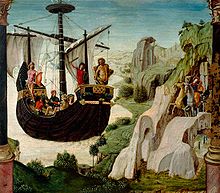
In Greek mythology, Argo (/ˈɑrɡoʊ/; in Greek: Ἀργώ, meaning 'swift') was the ship on which Jason and the Argonauts sailed from Iolcos to retrieve the Golden Fleece. She was named after her builder, Argus.
Argo was constructed by the shipwright Argus, and its crew were specially protected by the goddess Hera. The best source for the myth is the Argonautica by Apollonius Rhodius. According to a variety of sources of the legend, Argo was said to have been planned or constructed with the help of Athena. According to other legends she contained in her prow a magical piece of timber from the sacred forest of Dodona, which could speak and render prophecies. After the successful journey, Argo was consecrated to Poseidon in the Isthmus of Corinth. She was then translated into the sky and turned into the constellation of Argo Navis.
★ Golden Fleece

In Greek mythology, the Golden Fleece is the fleece of the gold-hair winged ram, which was held in Colchis. The fleece is a symbol of authority and kingship. It figures in the tale of the hero Jason and his band of Argonauts, who set out on a quest for the fleece by order of King Pelias, in order to place Jason rightfully on the throne of Iolcus in Thessaly. Through the help of Medea, they acquire the Golden Fleece. The story is of great antiquity and was current in the time of Homer (eighth century BC). It survives in various forms, among which the details vary.
★ Colchis
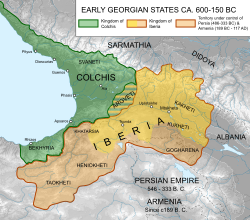
In Greco-Roman geography, Colchis was the name for a region in the Southern Caucasus. Colchis was located on the eastern coast of the Black Sea, centered on present-day western Georgia. Around the 1st centuries BC and AD the land south of the Greater Caucasus and north of the Lesser Caucasus was divided between Kolchis in the west, Caucasian Iberia in the center and Caucasian Albania in the east. To the southwest was Armenia and to the southeast Atropatene. Colchis is also an important land in Greco-Roman mythology, most notably as the kingdom of Medea and the Golden-fleece, destination of the Argonauts.
 Medea
Medea


