✎ abduct
(v.t.)
(1) To carry off by stealth or force; kidnap. 誘拐;劫持;綁架。
✎ hubris
(n.)
(1) Overbearing pride. 傲慢;自大。
✎ paellas
(n.)
(1) One of the many small planets or asteroids whose orbits lie between Jupiter and Mars. 火星和木星之軌道間之小行星。
(2) A name often prefixed to that of Athena, the goddess of wisdom.
【神話】雅典娜(智慧女神)之名。
(3) Largest of the asteroids.
火星及木星之間小行星中之最大星。
✎ pledge
(n.)
(1) Anything placed as a security or guarantee. 抵押品;擔保物。
(2) A pawn. 典當品。
(3) The state of being held as a security or guarantee. 抵押;質押;典當。
(4) A drinking of a health as an expression of food will or a promise.
祝飲(以表善意或承諾);乾杯。
(5) An agreement or promise to do or not to do something. 誓約。
(6) A token of good will. (表示善意之)紀念物;信物。
(7) Person tentatively accepted for membership, as in a fraternity, pending formal approval. 預備會員(為正式入會前接受考核的人)。
(v.t.)
(1) To give as security or guarantee.以...做擔保。
(2) To put in pawn. 典;當。
➜He pledged his watch.
(3) To bind by a promise. 使發誓;以誓言約束。
➜I am pledged to secrecy.
(4) To promise the performance of by a pledge. 誓言;保證。
➜I pledge allegiance to my country.
(5) To drink to the health of. 祝飲;舉杯祝福。
✎ fate
(n.)
(1) The power that determines events; destiny. 天命;命運。
(2) One's predestined lot. 運氣;注定的命運。
(3) The unalterable future. 不能變更的將來。
(4) Final outcome. 結果。
(5) The expected result of normal development. (正常發展的)預期結果。
✎ destiny (n.)(可控制的)命運。
★ Dic
✎dictionary
(n.)
(1) A book explaining the words of a language arranged alphabetically; a lexicon; vocabulary. 字典;辭典;字彙。
✎predict
(v.t.)
(1) To tell or make known beforehand; foretell. 預測;預言。
➜You cannot predict my future.
✎dictator
(n.)
(1) One who tells another what to write. 口述的人。
(2) One invested with absolute powers of government. 獨裁者。
✎verify
(v.t.)
(1) To prove the correctness of; examine so as to prove. 證明;證實。
➜Later findings verified the scientist's theory.
(2) To confirm or substantiate, as a statement. 確認;證明確實。
(3) To authenticate or give legal authority to.【法律】證實。
(4) To affirm by affidavit. 由口供證明。
★ Iris

In Greek mythology, Iris is the personification of the rainbow and messenger of the gods. She is also known as one of the goddesses of the sea and the sky. Iris links the gods to humanity. She travels with the speed of wind from one end of the world to the other, and into the depths of the sea and the underworld.
★ Cleopatra

Cleopatra VII Philopator, known to history simply as Cleopatra, was the last active pharaoh of Ptolemaic Egypt, shortly survived as pharaoh by her son Caesarion. After her reign, Egypt became a province of the then-recently established Roman Empire.
★Augustus
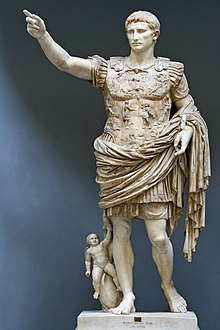
Augustus was the founder of the Roman Empire and its first Emperor, ruling from 27 BC until his death in 14 AD. He was born Gaius Octavius into an old and wealthy equestrian branch of the plebeian Octavii family. Following the assassination of his maternal great-uncle Julius Caesar in 44 BC, Octavian was named in Caesar's will as his adopted son and heir. Together with Mark Antony and Marcus Lepidus, he formed the Second Triumvirate to defeat the assassins of Caesar. Following their victory at Philippi, the Triumvirate divided the Roman Republic among themselves and ruled as military dictators. The Triumvirate was eventually torn apart under the competing ambitions of its members: Lepidus was driven into exile and stripped of his position, and Antony committed suicide following his defeat at the Battle of Actium by Octavian in 31 BC.
After the demise of the Second Triumvirate, Augustus restored the outward facade of the free Republic, with governmental power vested in the Roman Senate, the executive magistrates, and the legislative assemblies. In reality, however, he retained his autocratic power over the Republic as a military dictator. By law, Augustus held a collection of powers granted to him for life by the Senate, including supreme military command, and those of tribune and censor. It took several years for Augustus to develop the framework within which a formally republican state could be led under his sole rule. He rejected monarchical titles, and instead called himself Princeps Civitatis ("First Citizen of the State"). The resulting constitutional framework became known as the Principate, the first phase of the Roman Empire.The reign of Augustus initiated an era of relative peace known as the Pax Romana (The Roman Peace). Despite continuous wars of imperial expansion on the Empire's frontiers and one year-long civil war over the imperial succession, the Roman world was largely free from large-scale conflict for more than two centuries. Augustus dramatically enlarged the Empire, annexing Egypt, Dalmatia, Pannonia, Noricum, and Raetia, expanded possessions in Africa, expanded into Germania, and completed the conquest of Hispania.
★Caesar

Gaius Julius Caesar was a Roman statesman, general and notable author of Latin prose. He played a critical role in the events that led to the demise of the Roman Republic and the rise of the Roman Empire. In 60 BC, Caesar, Crassus, and Pompey formed a political alliance that was to dominate Roman politics for several years. Their attempts to amass power through populist tactics were opposed by the conservative ruling class within the Roman Senate, among them Cato the Younger with the frequent support of Cicero. Caesar's victories in the Gallic Wars, completed by 51 BC, extended Rome's territory to the English Channel and the Rhine. Caesar became the first Roman general to cross both when he built a bridge across the Rhine and conducted the first invasion of Britain.
These achievements granted him unmatched military power and threatened to eclipse the standing of Pompey, who had realigned himself with the Senate after the death of Crassus in 53 BC. With the Gallic Wars concluded, the Senate ordered Caesar to step down from his military command and return to Rome. Caesar refused the order, and instead marked his defiance in 49 BC by crossing the Rubicon with a legion, leaving his province and illegally entering Roman Italy under arms. Civil war resulted, and Caesar's victory in the war put him in an unrivaled position of power and influence.
After assuming control of government, Caesar began a programme of social and governmental reforms, including the creation of the Julian calendar. He centralised the bureaucracy of the Republic and was eventually proclaimed "dictator in perpetuity", giving him additional authority. But the underlying political conflicts had not been resolved, and on the Ides of March (15 March) 44 BC, Caesar was assassinated by a group of rebellious senators led by Marcus Junius Brutus. A new series of civil wars broke out, and the constitutional government of the Republic was never fully restored. Caesar's adopted heir Octavius, later known as Augustus, rose to sole power after defeating his opponents in the civil war. Octavius set about solidifying his power, and the era of the Roman Empire began.
Much of Caesar's life is known from his own accounts of his military campaigns, and from other contemporary sources, mainly the letters and speeches of Cicero and the historical writings of Sallust. The later biographies of Caesar by Suetonius and Plutarch are also major sources. Caesar is considered by many historians to be one of the greatest military commanders in history.


