★ Penelope’s weaving
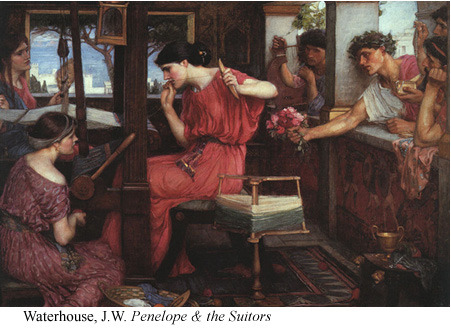
Penelope is the faithful wife of the She only has one son by Odysseus, Telemachus, who was born just before Odysseus was called to fight in the Trojan War. She waits twenty years for the final return of her husband, during which she devises various strategies to delay marrying one of the 108 suitors. She weaved her design for a shroud by day, but unraveled it again at night, to keep her suitors from claiming her during the long years while Odysseus was away. She has devised tricks to delay her suitors, one of which is to pretend to be weaving a burial shroud for Odysseus's elderly father Laertes and claiming that she will choose a suitor when she has finished. She undoes part of the shroud, until one of twelve unfaithful serving women discovers her chicanery and reveals it to the suitors.
★ Suitors of Penelope
The Suitors of Penelope are one of the main subjects of Homer's Odyssey. Penelope's husband Odysseus, king of Ithaca, goes off to fight in the 10-year Trojan War. While most survivors return relatively soon, it takes Odysseus another ten years to return home, and in this time the suitors court Penelope, whom they believe (or hope) has become a widow.
★ archery contest
Penelope announces that whoever can string Odysseus's rigid bow and shoot an arrow through twelve axe heads may have her hand. When the contest of the bow begins, none of the suitors are able to string the bow, but Odysseus does, and wins the contest. Having done so, he proceeds to slaughter the suitors—beginning with Antinous whom he finds drinking from Odysseus' cup—with help from Telemachus, Athena and two servants. Odysseus has now revealed himself in all his glory; yet Penelope cannot believe that her husband has really returned—she fears that it is perhaps some god in disguise, and tests him by ordering her servant to move the bed in their bridal-chamber. Odysseus protests that this cannot be done since he made the bed himself and knows that one of its legs is a living olive tree. Penelope finally accepts that he truly is her husband
★ mentor
A mentor is a more experienced or more knowledgeable person helps to guide a less experienced or less knowledgeable person.
★ Io
Io was, in Greek mythology, one of the mortal lovers of Zeus. Io was a priestess of the Goddess Hera in Argos, whose cult her father Inachus was supposed to have introduced to Argos. Zeus noticed Io, a mortal woman, and lusted after her. Zeus then turned Io into a heifer in order to hide her from his wife, Hera. In the version of the story in which Zeus transformed Io, the deception failed, and Hera begged Zeus to give her the heifer as a present, which, having no reason to refuse, he did. Hera then sent Argus Panoptes, who had 100 eyes, to watch Io and prevent Zeus from visiting her, and so Zeus sent Hermes to distract and eventually slay Argus. In order to extract her revenge, Hera sent a gadfly to sting Io continuously, driving her to wander the world without rest. Io escaped across the Ionian Sea to Egypt, where she was restored to human form by Zeus. She later married Egyptian king Telegonus.


★ Argos
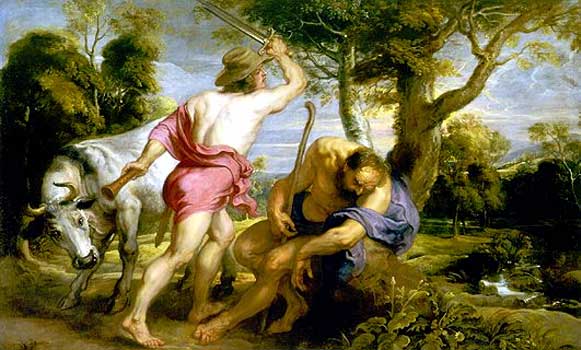
Argos is a 100-eyed giant in Greek mythology. Argus was Hera's servant. His great service to the Olympian pantheon was to slay the chthonic serpent-legged monster Echidna as she slept in her cave. Hera's defining task for Argus was to guard the white heifer Io from Zeus, keeping her chained to the sacred olive tree at the Argive Heraion. To free Io, Zeus had Argus slain by Hermes. The messenger of the Olympian gods, disguised as a shepherd, first put all of Argus' eyes asleep with spoken charms, then slew him by hitting him with a stone, the first stain of bloodshed among the new generation of gods. According to Ovid, to commemorate her faithful watchman, Hera had the hundred eyes of Argus preserved forever, in a peacock's tail.
★ Hermes
Hermes is an Olympian god in Greek religion and mythology, the son of Zeus and the Pleiad Maia. He is the second youngest of the Olympian gods. Hermes is considered a god of transitions and boundaries. He is described as quick and cunning, moving freely between the worlds of the mortal and divine. He is als portrayed as an emissary and messenger of the gods:] an intercessor between mortals and the divine, and conductor of souls into the afterlife. He has been viewed as the protector and patron of herdsmen, thieves, oratory and wit, literature and poetry, athletics and sports, invention and trade, roads, boundaries and travelers.

★ Siren
In Greek mythology, the Sirens were dangerous yet beautiful creatures, who lured nearby sailors with their enchanting music and voices to shipwreck on the rocky coast of their island.
➜ A siren can be also described as a loud noise making device.

★ Mephistopheles
Mephistopheles is a demon featured in German folklore. He originally appeared in literature as the demon in the Faust legend, and he has since appeared in other works as a stock character.

★ Cassandra
Cassandra, the daughter of King Priam and Queen Hecuba of Troy, was a prophetess. A common version of her story is that Apollo gave her the power of prophecy in order to seduce her, but when she refused, he spat into her mouth cursing her never to be believed. In an alternative version, she fell asleep in a temple, and snakes licked (or whispered in) her ears so that she was able to hear the future. Snakes as a source of knowledge is a recurring theme in Greek mythology, although sometimes the snake brings understanding of the language of animals rather than an ability to know the future. Cassandra is a figure of epic tradition and of tragedy.

★ Clytemnestra
Clytemnestra was the wife of Agamemnon, ruler of the Ancient Greek kingdom of Mycenae or Argos. The Trojan War lasted ten years. During this period of Agamemnon's long absence, Clytemnestra began a love affair with Aegisthus, her husband's cousin. Whether Clytemnestra was seduced into the affair or entered into it independently differs according to the respective author of the myth.Nevertheless, Clytemnestra and Aegisthus began plotting Agamemnon's demise. Clytemnestra was enraged by Iphigenia's murder (and presumably the earlier murder of her first husband by Agamemnon, and her subsequent rape and forced marriage). Aegisthus saw his father Thyestes betrayed by Agamemnon's father Atreus (Aegisthus was conceived specifically to take revenge on that branch of the family). Agammemnon, having arrived at his palace with his concubine, the Trojan princess Cassandra, in tow and being greeted by his wife, entered the palace for a banquet while Cassandra remained in the chariot. Clytemnestra waited until he was in the bath, and then entangled him in a cloth net and stabbed him. Trapped in the web, Agamemnon could neither escape nor resist his murderer.Meanwhile, Cassandra saw a vision of herself and Agamemnon being murdered. Her attempts to elicit help failed (she had been cursed by Apollo that no one would believe her prophecies). She realized she was fated to die, and resolutely walked into the palace to receive her death.After the murders, Aegisthus replaced Agamemnon as king and ruled for seven years with Clytemnestra as his queen. In some traditions they have three children: a son Aletes, and daughters Erigone and Helen. Clytemnestra was eventually killed by her and Agamemnon's son Orestes.

★ Oedipus
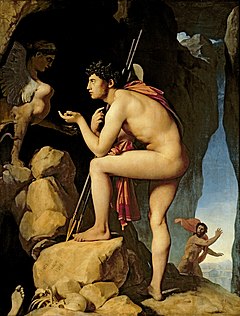
Oedipus was a mythical Greek king of Thebes, the son and killer of Laius, son and consort of Jocasta, and father and sibling of Polynices, Eteocles, Antigone, and Ismene. A tragic hero in Greek mythology, Oedipus accidentally fulfilled the prophecy, despite his efforts not to that he would end up killing his father and marrying his mother, thereby bringing disaster to his city and family. When the truth was discovered, his wife-mother hanged herself, and Oedipus gouged out his own eyes.
★ Oedipus complex
The term Oedipus complex (or, less commonly, Oedipal complex) explains the emotions and ideas that the mind keeps in the unconscious, via dynamic repression, that concentrates upon a child's desire to have sexual relations with the parent of the opposite sex
★ Electra
In Greek mythology, Electra was the daughter of King Agamemnon and Queen Clytemnestra, and thus princess of Argos. She and her brother Orestes plotted revenge against their mother Clytemnestra and stepfather Aegisthus for the murder of their father, Agamemnon.
Electra is one of the most popular mythological characters in tragedies. She is the main character in two Greek tragedies, Electra by Sophocles and Electra by Euripides.

★ Electra complex
The Electra complex is a girl's psychosexual competition with her mother for possession of her father. In the course of her psychosexual development, the complex is the girl's phallic stage; formation of a discrete sexual identity, a boy's analogous experience is the Oedipus complex. In classical psychoanalytic theory, the child's identification with the same-sex parent is the successful resolution of the Electra complex and of the Oedipus complex; his and her key psychological experience to developing a mature sexual role and identity.


