1.
Aesop's Fables- or the Aesopica is a collection of fables credited to Aesop, a slave and storyteller believed to have lived in ancient Greece between 620 and 564 BCE. Of diverse origins, the stories associated with his name have descended to modern times through a number of sources and continue to be reinterpreted in different verbal registers and in popular as well as artistic media. The fables originally belonged to the oral tradition and were not collected for some three centuries after Aesop’s death. By that time a variety of other stories, jokes and proverbs were being ascribed to him, although some of that material was from sources earlier than him or came from beyond the Greek cultural sphere. The process of inclusion has continued until the present, with some of the fables unrecorded before the later Middle Ages and others arriving from outside Europe. The process is continuous and new stories are still being added to the Aesop corpus, even when they are demonstrably more recent work and sometimes from known authors.
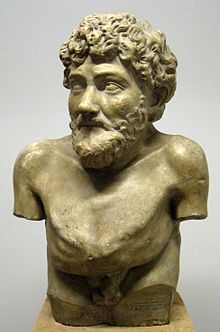
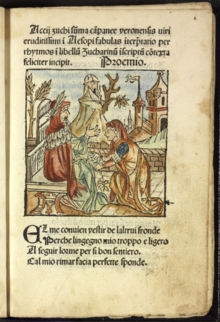
Aesop- was an Ancient Greek fabulist or story teller credited with a number of fables now collectively known as Aesop's Fables. Although his existence remains uncertain and no writings by him survive, numerous tales credited to him were gathered across the centuries and in many languages in a storytelling tradition that continues to this day. Many of the tales are characterized by animals and inanimate objects that speak, solve problems, and generally have human characteristics.
2.
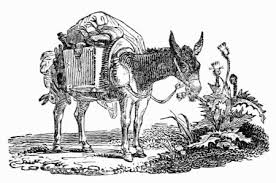
(1) ''One man's meat is another man's poison''
-something that one person likes may be distasteful to someone else.
fable:'' An Ass Eating Thistles''
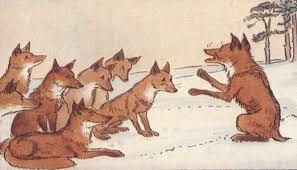
(2) ''Misery loves company.''
-something that you say which means that people who are feeling sad usually want the
people they are with to also feel sad.
fable: '' The Fox Without a Tail''
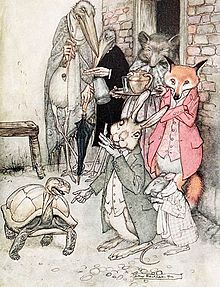
(3) fable '' The Tortoise and The Hare''
- is one of Aesop's Fables and is numbered 226 in the Perry Index. The account of a race between unequal partners has attracted conflicting interpretations. It is itself a variant of a common folktale theme in which ingenuity and trickery (rather than doggedness) are employed to overcome a stronger opponent.
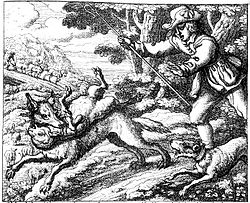
(4) fable '' The Boy Who Cried Wolf ''
- is one of Aesop's Fables, numbered 210 in the Perry Index. From it is derived the English idiom "to cry wolf", defined as "to give a false alarm" in Brewer's Dictionary of Phrase and Fable and glossed by the Oxford English Dictionary as meaning to make false claims, with the result that subsequent true claims are disbelieved.
(5) fable ''The Farmer and His sons ''
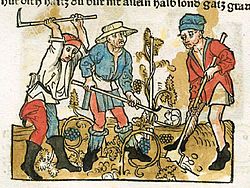
- is a story of Greek origin that is included among Aesop's Fables and is listed as 42 in the Perry Index. It illustrates both the value of hard work and the need to temper parental advice with practicality.
3.
(1)
folklore- is the body of expressive culture shared by a particular group of people; it encompasses the traditions common to that culture, subculture or group. These include oral traditions such as tales, proverbs and jokes. They include material culture, ranging from traditional building styles to handmade toys common to the group. Folklore also includes customary lore, the forms and rituals of celebrations like Christmas and weddings, folk dances and initiation rites. Each one of these, either singly or in combination, is considered a folklore artifact. Just as essential as the form, folklore also encompasses the transmission of these artifacts from one region to another or from one generation to the next.
(2)
myth- is any traditional story consisting of events that are ostensibly historical, though often supernatural, explaining the origins of a cultural practice or natural phenomenon. Mythology can refer either to the study of myths, or to a body or collection of myths. Myth can mean 'sacred story', 'traditional narrative' or 'tale of the gods'. A myth also can be a story to explain why something exists.
metaphor- is a figure of speech that refers, for rhetorical effect, to one thing by mentioning another thing. It may provide clarity or identify hidden similarities between two ideas. Where a simile compares two items, a metaphor directly equates them, and does not use "like" or "as" as does a simile. One of the most commonly cited examples of a metaphor in English literature is the "All the world's a stage" monologue from As You Like It:
(3)
legend- is a narrative of human actions that are perceived both by teller and listeners to take place within human history and demonstrating human values, and which possesses certain qualities that give the tale verisimilitude. Legend, for its active and passive participants, includes no happenings that are outside the realm of "possibility", but may include miracles. Legends may be transformed over time, in order to keep them fresh and vital, and realistic. Many legends operate within the realm of uncertainty, never being entirely believed by the participants, but also never being resolutely doubted.
4.
Bildingsroman- in literary criticism, a Bildungsroman, novel of formation, novel of education, or coming-of-age story is a literary genre that focuses on the psychological and moral growth of the protagonist from youth to adulthood (coming of age), in which character change is extremely important.
Didacticism- is a philosophy that emphasizes instructional and informative qualities in literature and other types of art.
5. Term Explanation and Vocabulary
(1) carpe diem- is a Latin aphorism, usually translated "seize the day", taken from book 1 of the Roman poet Horace's work Odes (23 BC).
(2) mor, mort- death
mortician- An undertaker.
mortuary park- A room or building in which dead bodies are kept, for hygienic storage or for examination, until burial or cremation.
morgue- A mortuary.
mortify- Cause (someone) to feel very embarrassed or ashamed.
(3) ad- to, toward
advanced (course)- Far on or ahead in development or progress
advocate- A person who publicly supports or recommends a particular cause or policy.
(4)
assembly(集合)- The action of gathering together as a group for a common purpose.
attention(立正)- A position assumed by a soldier, standing very straight with the feet together and the arms straight down the sides of the body.
at ease(稍息)- a position of rest in which soldiers may relax butmay not leave their
places or talk.
dismiss(解散)- to direct (an assembly of persons) to disperse or go.
6. Video
John Denver- Today