1.
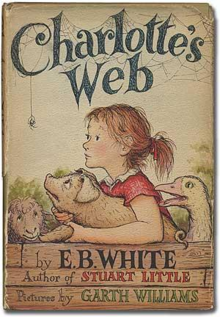
Charlotte’s Web- is a children's novel by American author E. B. White and illustrated by Garth Williams. The novel tells the story of a pig named Wilbur and his friendship with a barn spider named Charlotte. When Wilbur is in danger of being slaughtered by the farmer, Charlotte writes messages praising Wilbur (such as "Some Pig") in her web in order to persuade the farmer to let him live. Written in White's dry, low-key manner, Charlotte's Web is considered a classic of children's literature, enjoyable to adults as well as children. The description of the experience of swinging on a rope swing at the farm is an often cited example of rhythm in writing, as the pace of the sentences reflects the motion of the swing.
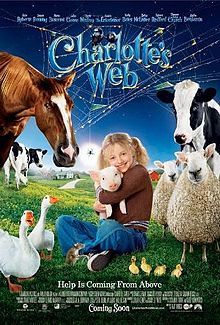
Charlotte’s Web (2006 film) - is a 2006 American live-action feature film based on the book of the same name by E. B. White. It was directed by Gary Winick and produced by Paramount Pictures, Walden Media, The K Entertainment Company, and Nickelodeon Movies. The screenplay is by Susannah Grant and Karey Kirkpatrick, based on White's book.
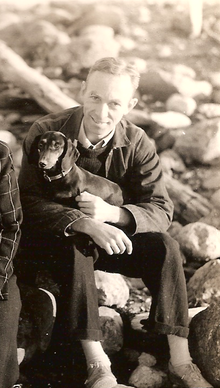
The Author of Charlotte’s Web- E. B. White
-was an American writer. He was a contributor to The New Yorker magazine and a co-author of the English language style guide The Elements of Style, which is commonly known as "Strunk & White". He also wrote books for children, including Stuart Little (1945), Charlotte's Web (1952), and The Trumpet of the Swan (1970). Charlotte's Web was voted the top children's novel in a 2012 survey of School Library Journal readers, an accomplishment repeated from earlier surveys.
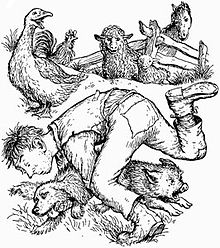
The Illustrator of Charlotte’s Web- Garth Williams
-was an American artist who came to prominence in the American postwar era as an illustrator of children's books. Many of the books he illustrated have become classics of American children's literature.
2. Notes of Charlotte’s Web
Three points of naming (p.182):
“How about me?”asked the third spider. “Will you just pick out a nice sensible name for me-something not too long, not too fancy, and not too dumb?”
Quotation (p.164):
“You have been my friend, “replied Charlotte. “That in itself is a tremendous thing. I wove my webs for you because I liked you. After all, what’s a life, anyway? We’re born, we live a little while, and we die. A spider’s life can’t help being something of a mess, with all this trapping and eating flies. By helping you, perhaps I was trying to loft up my life a trifle. Heaven knows anyone’s life can stand a little for that.”
3.
1978: A special citation to E. B. White for his letters, essays and the full body of his work.
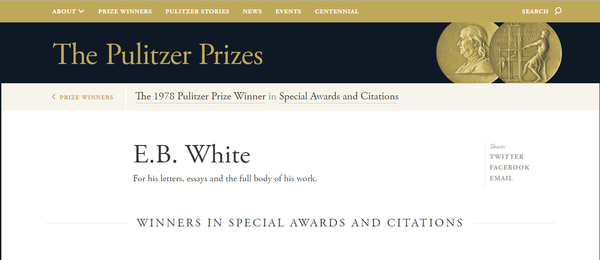
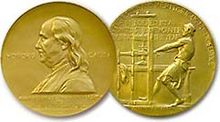
Pulitzer Price- is an award for achievements in newspaper, magazine and online journalism, literature, and musical composition in the United States. It was established in 1917 by provisions in the will of American (Hungarian-born) Joseph Pulitzer who had made his fortune as a newspaper publisher, and is administered by Columbia University in New York City. Prizes are awarded yearly in twenty-one categories.In twenty of the categories, each winner receives a certificate and a US$10,000 cash award. The winner in the public service category of the journalism competition is awarded a gold medal.
4. Term Explanation and Vocabulary
(1) Mock (v.)- tease or laugh at in a scornful or contemptuous manner. (Are you mocking me?)
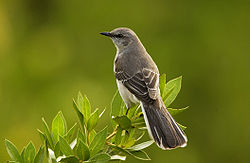
Mockingbird(反舌鳥)- a group of New World passerine birds from the Mimidae family. They are best known for the habit of some species mimicking the songs of other birds and the sounds of insects and amphibians, often loudly and in rapid succession.
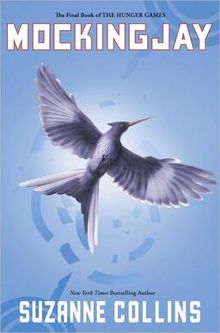
Mockingjay- is a 2010 science fiction novel by American author Suzanne Collins. It is the last installment of The Hunger Games, following 2008's The Hunger Games and 2009's Catching Fire. The book continues the story of Katniss Everdeen, who agrees to unify the districts of Panem in a rebellion against the tyrannical Capitol. The hardcover and audiobook editions of Mockingjay were published by Scholastic on August 24, 2010, six days after the ebook edition went on sale. It received a generally positive reaction from critics.
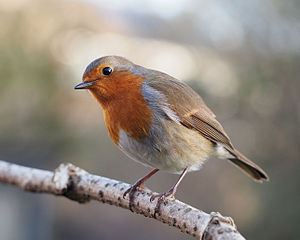
Robin(知更鳥)- is a small insectivorous passerine bird, specifically a chat that was formerly classified as a member of the thrush family(Turdidae) but is now considered to be an Old World flycatcher. It is found across Europe, east to Western Siberia and south to North Africa; it is sedentary in most of its range except the far north.
(2) astro-, astr- study of the star.
Astrology- is the study of the movements and relative positions of celestial objects as a means for divining information about human affairs and terrestrial events. Astrology has been dated to at least the 2nd millennium BCE, and has its roots in calendrical systems used to predict seasonal shifts and to interpret celestial cycles as signs of divine communications. Many cultures have attached importance to astronomical events, and some – such as the Indians, Chinese, and Maya – developed elaborate systems for predicting terrestrial events from celestial observations.
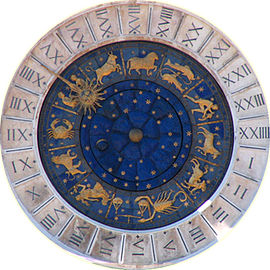
Astronomy- is a natural science that studies celestial objects and phenomena. It applies mathematics, physics, and chemistry, in an effort to explain the origin of those objects and phenomena and their evolution. The objects of interest include planets, moons, stars, galaxies, and comets; while the phenomena include supernovae explosions, gamma ray bursts, and cosmic microwave background radiation. More generally all astronomical phenomena that originate outside Earth's atmosphere is within the preview of astronomy.
Asterisk- is a typographical symbol or glyph. It is so called because it resembles a conventional image of a star.