1.
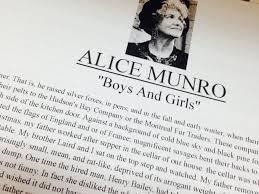
Alice Munro- is a Canadian short story writer and Nobel Prize winner. Munro's work has been described as having revolutionized the architecture of short stories, especially in its tendency to move forward and backward in time. Her stories have been said to "embed more than announce, reveal more than parade." Munro's fiction is most often set in her native Huron County in southwestern Ontario. Her stories explore human complexities in an uncomplicated prose style.
''Boys and Girls''- is a short story by Alice Munro, the Canadian winner of the Nobel Prize in Literature in 2013 which deals with the making of gender roles. The narrator remembers that by the time she was eleven years old she was faced with more and more expectations of what a girl should be like and what she should do or not do. Her role in the family began to change, and the narrator concludes with telling the story of an event in which she behaved according to her intuition, is squealed on by her younger brother and subsequently is being assigned the new gender role by her father. The narrator's last comment reads: ″Maybe it was true.″
2.
point of view- narrative point of view or narrative perspective describes the position of the narrator, that is, the character of the storyteller, in relation to the story being told. It can be thought of as a camera mounted on the narrator's shoulder that can also look back inside the narrator's mind. There are five kinds of point of view, first person, second person, third person, hybrids, and alternating person. The point of view of first person, for examples ''A Rose for Emily'' by William Faulkner.
character- is a person in a narrative work of art. Character, particularly when enacted by an actor in the theatre or cinema, involves ''the illusion of being a human person.'' In literature, characters guide readers through their stories, helping them to understand plots and ponder them. The types of character divided into round and flat character, flat character are two dimensional, they are relatively uncomplicated. By contrast, round characters are complex figures with many different characteristic and undergo development, sometimes sufficiently to surprise the reader. There is another type of character divided into dynamic and static character, dynamic characters are the ones who change over the course of the story, while static characters remain the same throughout.
3.
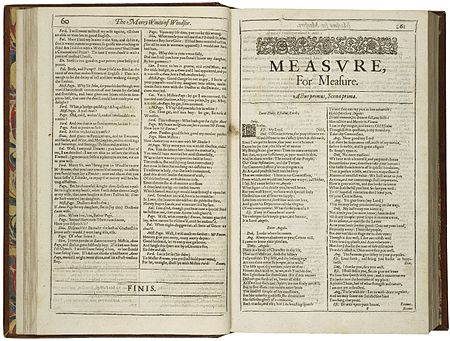
<Measure for Measure>
- is a play by William Shakespeare, believed to have been written in 1603 or 1604. Originally published in the First Folio of 1623, where it was listed as a comedy, the play's first recorded performance occurred in 1604. The play's main themes include justice, "mortality and mercy in Vienna," and the dichotomy between corruption and purity: "some rise by sin, and some by virtue fall." Mercy and virtue predominate, since the play does not end tragically. Measure for Measure is often called one of Shakespeare's problem plays. It was, and continues to be classified as comedy, though its tone and setting defy those expectations.
4.
''Danny Boy''- is a ballad written by English songwriter Frederic Weatherly and usually set to the Irish tune of the "Londonderry Air". It is most closely associated with Irish communities. There are various theories as to the true meaning of "Danny Boy". Some have interpreted the song to be a message from a parent to a son going off to war or leaving as part of the Irish Diaspora.
5.
Vocabulary and Term Explanation
(1)
didactic- intended to instruct, morally instructive or inclined to teach or moralize excessively
didacticism- is a philosophy that emphasizes instructional and informative qualities in literature and other types of art.
(2)
Ode- is a type of lyrical stanza. A classic ode is structured in three major parts: the strophe, the antistrophe, and the epode. Different forms such as the homostrophic ode and the irregular ode also exist. It is an elaborately structured poem praising or glorifying an event or individual, describing nature intellectually as well as emotionally.
Ave- is a Latin word, used by the Romans as a salutation and greeting, meaning "hail". It is the singular imperative form of the verb avēre, which meant "to be well"; thus one could translate it literally as "be well" or "farewell".
(3)
Mimesis- is a critical and philosophical term that carries a wide range of meanings, which include imitation, representation, mimicry, imitatio, receptivity, nonsensuous similarity, the act of resembling, the act of expression, and the presentation of the self. In ancient Greece, mimesis was an idea that governed the creation of works of art, in particular, with correspondence to the physical world understood as a model for beauty, truth, and the good. Plato contrasted mimesis, or imitation, with diegesis, or narrative.
Catharsis- is the purification and purgation of emotions—especially pity and fear—through art or any extreme change in emotion that results in renewal and restoration. It is a metaphor originally used by Aristotle in the Poetics, comparing the effects of tragedy on the mind of spectator to the effect of a cathartic on the body.
humanities- are academic disciplines that study human culture. In the Middle Ages, the term contrasted with divinity and referred to what is now called classics, the main area of secular study in universities at the time. Today, the humanities are more frequently contrasted with natural, physical and sometimes social sciences as well as professional training.
(4)obs-
obstacle- something that stands in the way of or holds up progress.
(5)pri-, prim-main
prime time- is the block of broadcast programming taking place during the middle of the evening for television programming. The term prime time is often defined in terms of a fixed time period – for example (in the United States), from 19:00 to 22:00 (Central and Mountain Time) or 20:00 to 23:00 (Eastern and Pacific Time).
In Taiwan, prime time starts at 20:00 in the evening. Taiwanese drama series played then are called 8 o'clock series and are expected to have high viewer ratings.