Pearl drilling looks simple until a workshop has to produce dozens or hundreds of pieces with matching hole positions, clean openings, and minimal damage. A hand-held drill may be adequate for occasional repairs, but production work demands much tighter control. A well-adjusted pearl drilling machine can turn a variable manual operation into a repeatable process, provided that the operator pays attention to setup, tooling, alignment, and material handling.
The first factor is pearl positioning. Natural and cultured pearls rarely have perfectly uniform surfaces, so holding every piece in exactly the same way can be challenging. A suitable fixture should support the pearl without crushing it while keeping the intended drilling point stable. Before starting a batch, operators should check the fixture for wear and remove any residue that could cause the pearl to shift.
Drill selection has a direct effect on consistency. A dull bit generates unnecessary pressure and heat, increasing the possibility of chipped edges or poorly formed holes. Small-diameter drills should be inspected frequently because even minor wear can affect hole diameter. Replacing a tool before it becomes severely worn is generally more economical than trying to compensate for its condition by changing feed pressure.
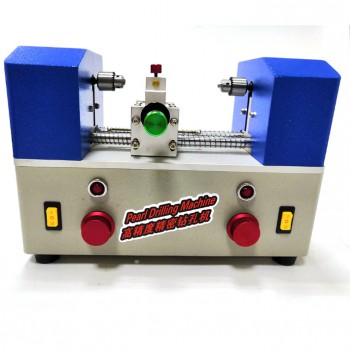
Machine speed should match the pearl material, drill diameter, and drilling depth. Excessive speed can create heat, while insufficient speed may produce rough cutting and encourage the operator to apply too much force. Coolant or water-based lubrication can help control temperature and carry away fine particles, but the delivery method must be controlled so that liquid does not reach electrical components.
Depth control is another important consideration, particularly when producing half-drilled pearls for jewelry settings. A mechanical stop or calibrated depth system allows operators to reproduce the same drilling depth from one piece to the next. This is much more reliable than judging depth by eye, especially during long production runs when fatigue can gradually affect hand control.
Cleaning between batches also contributes to uniform results. Pearl dust and drilling debris can collect around the fixture, spindle, or work area. If this material changes the seating position of a pearl, even a well-calibrated machine can produce inconsistent holes. Regular cleaning takes little time but prevents accumulated debris from becoming a hidden source of dimensional variation.
Operator technique should be standardized as well. A simple procedure covering pearl inspection, orientation, clamping, drilling speed, lubrication, depth verification, and final inspection gives different operators the same working reference. Periodic checks with sample pieces can reveal drift before an entire batch is affected.
Finally, production records can be surprisingly useful. Recording drill changes, machine settings, material types, and common defects helps identify patterns over time. If chipped holes repeatedly appear after a certain number of pieces, for example, the problem may point to tool wear rather than operator technique.
Consistency in pearl drilling comes from controlling small variables that are easy to overlook. With stable fixturing, sharp tooling, controlled depth, appropriate speed, clean equipment, and repeatable operating procedures, a pearl drilling machine can deliver cleaner holes and more predictable results while reducing material loss and rework.
下一則: The Importance of Temperature Control in Automatic Jewelry Casting Systems
- How Automatic Casting Machines Enhance Precision in Jewelry Manufacturing
- The Benefits of Digital Inside Ring Engraving Machines
- Pneumatic Jewelry Engravers and Modern Jewelry Production
- The Evolution of Pearl Drilling Technology in Jewelry Making
- High-Speed vs. Low-Speed Drilling in Pearl Processing
- Keeping Your Pneumatic Jewelry Engraver Running Smoothly
限會員,要發表迴響,請先登入


