Cutting sapphire and ruby has never been a forgiving task. Both stones belong to the corundum family, ranking just below diamond in hardness. For decades, gem cutters relied almost entirely on hand-controlled faceting machines, steady eyesight, and patience that bordered on obsession. Automatic gem faceting machines have started to change that balance, especially in workshops handling calibrated stones or repeated designs.
The biggest advantage of automation is consistency. Natural sapphire and ruby often contain color zoning, silk inclusions, or uneven crystal growth. A traditional cutter may spend hours adjusting angles to compensate for these irregularities. Automatic systems, especially CNC-assisted models, reduce much of that repetitive alignment work. Once the parameters are programmed, the machine can reproduce identical facet angles across multiple stones with remarkable precision.
That precision matters more than many buyers realize. A ruby with slightly uneven pavilion facets can lose brightness immediately. Light leakage dulls the stone, making even vivid material appear sleepy. Automatic faceting equipment helps maintain symmetry across every tier of the cut, improving brilliance without constant manual correction.
Another reason these machines are becoming more common is production efficiency. Jewelry manufacturers working with matched sapphire pairs or calibrated melee stones need repeatable results. Hand faceting remains valuable for rare collector gems, but commercial production demands speed. An automatic faceting setup can process stones continuously while reducing operator fatigue. In larger workshops, one technician may oversee several machines at once instead of concentrating on a single stone for an entire day.
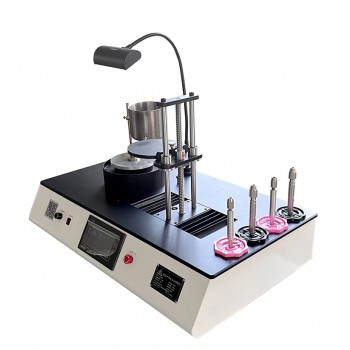
Modern systems also allow highly detailed digital planning. Before cutting begins, operators can map proportions based on the rough crystal shape. This is especially useful for expensive ruby rough, where material loss directly impacts profit. A few extra percentage points of yield can represent hundreds or even thousands of dollars depending on the quality of the rough.
Still, automation is not magic. Sapphire and ruby remain unpredictable materials. Internal fractures, hidden inclusions, and heat-treatment variations can create problems no software fully anticipates. Skilled operators are still essential for evaluating rough orientation and deciding whether maximum weight or maximum brilliance should take priority. In many cases, the machine performs the repetitive precision work while human judgment guides the overall strategy.
There is also an interesting shift happening among small independent gem cutters. Compact automatic faceting machines have become more accessible than they were ten years ago. Hobbyists and boutique lapidary studios now experiment with hybrid workflows, combining digital controls with traditional polishing techniques. Some cutters intentionally leave final polishing by hand to preserve a personal touch that purely automated stones sometimes lack.
In the end, automatic gem faceting machines are best viewed as advanced tools rather than replacements for craftsmanship. Sapphire and ruby cutting still depends on experience, patience, and a strong understanding of light behavior inside the stone. Automation simply allows cutters to spend less time correcting mechanical inconsistencies and more time focusing on the beauty hidden inside the rough crystal.
Related articles: https://blog.seniorennet.nl/jewelerstoolsmall/archief.php?ID=109849
下一則: The Role of Filtration Technology in Jewelry Dust Collectors
- The Future of Small Induction Melting Furnaces in Jewelry Manufacturing
- Creating Textured Metal Sheets Using a Jewelry Rolling Mill Machine
- Preventing Cracks and Thermal Shock in Ceramic Melting Crucibles
- How Inside Ring Engraving Machines Support Small Jewelry Businesses
- The Evolution of Pearl Drilling Technology in Jewelry Making
- Cleaning and Maintenance of Clay Graphite Crucibles
限會員,要發表迴響,請先登入


