Class Notes
1. What Is Poetry?
(1) poetry: one of the three major genres of imaginative literature, which has its orgins in music and oral performanceand is characterized by controlled patterns of rhythm and syntax( often use meter and rhyme); compression and compactness and an allowance for ambiguity; a particularly concentrated empahsis on the sensual, especially visual and aural, qualities and effects of words and word order; especially vivid, often figurative language. " Auld Lang Syne" is a poem by Robert Burns.
(2) rhythm: the modulation of stressed and unstressed elements in the flow of speech. In most poetry written before 20th, rhythm was often expressed in meter; in prose and free verse, rhythm is present but in a much less predictable and regular manner.
(3)meter: the more or less regular pattern of stressed and unstressed syllables in a line of poetry. This is determined by the kind of foot( iambic or dactylic) and by the number of feet per line( five feet = pentameter).
(4)rhyme: repetition or correspondence of the terminal sounds of words. The most common type, end rhyme, occurs when the last words in two or more lines of a poem rhyme with each other.
(5)alliteration: the repetition of usually initial consonant sounds through a sequence of words-- for example, " While I nodded, nearly napping" in Edgar Allan Poe's " The Raven".
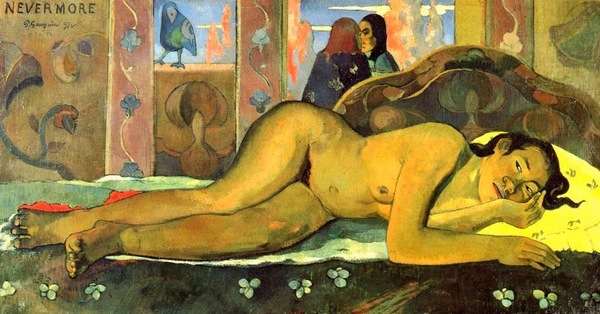
-- "Nevermore" by Gauguin
(6): assonance: the repetition of vowel sounds in a sequence of words with different endings, for example, " To Helen" by Edgar Allan Poe.
(7) blank verse: the metrical verse form most like everyday human speech; blank verse consists of unrhymed lines in imabic pentameter. Many of Shakespeare's plays are in blank verse, as in John Milton's Paradise Lost and Alfred Tennyson's "Ulysses".
To strive, to seek, to find, and not to yield.
"Ulysses" by Alfred Tennyson
The last line of "Ulysses" by Alfred Tennyson appears in the film 007: Skyfall.
(8) elegy: since the Reinaissance, usually a formal lament on the death of a particular person, but focusing mainly on the speaker's effort to come to terms with his or her grief; more broadly, any lyric in sorrowful mood that takees death as its primary subject. An example is W.H.Auden's " Stop all the clocks, cut off the telephone".
(9) couplet: two consecutive lines of verse linked by rhyme and meter; the meter of a heroic couplet is iambic pentameter.
(10) personificcation: a figure of speech that involves treating something nonhuman, such as an abstraction, as if it were a person by endowing it with humanlike quality, as in " I Wandered Lonely as a Cloud".

The last lines of the first and second stanza-- Beside the lake, beneath the trees, fluttering and dancing in the breeze. Ten thousand saw I at a glance, tossing their heads in sprightly dance-- personfiy the daffodiles, who are dancing and tossing their heads.
(11) metaphor: a figure of speech in which two unlike things are compared implicitly--taht is, without the use of a signal such as the word "like" or "as". An example is " That time of year thou mayst in me behold".
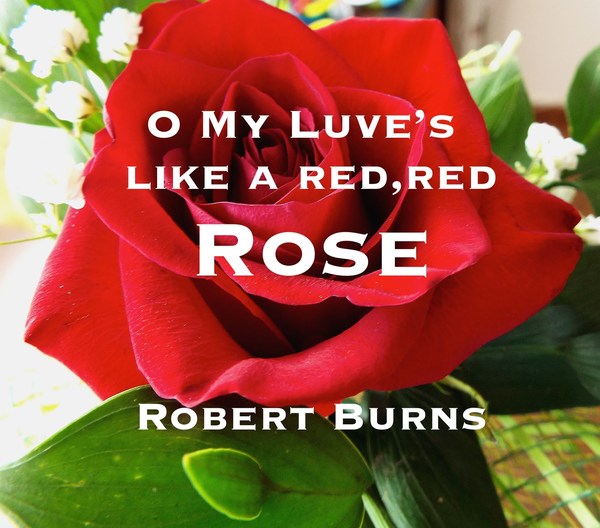
(12) simile: a figure of speech involing a direct, explicit comparison of one thing to another, usually using the words "like" or "as" to draw the connection, as the first line in " A Red, Red Rose" by Robert Burns-- My love is like a red, red rose.
2. Vocabulary
(1) penta: five
pentameter, pentateuch
(2) hexa: Forming compound words with the sense of "six".
hexameter
(3) oct: eight
octave
(4) sol: the Latin name for sun
solo, solitude
限會員,要發表迴響,請先登入


