The Romantic Period: In the United States, at least by 1818 with William Cullen Bryant's "To a Waterfowl", Romantic poetry was being published. American Romantic Gothic literature made an early appearance with Washington Irving's The Legend of Sleepy Hollow (1820) and Rip Van Winkle (1819). The dominant strain right through the literature of these years is Romantic. Characteristically, the American writer stresses individualism and emotionalism.
Inferiority complex: Only a very youth colonial nation, unsure in its youth, could have been so aggressively self-assertive, so proud of its lack of culture, so vocally confident in its future, and so fearful of European “evils,” particularly what was thought to be European “effeminacy.”
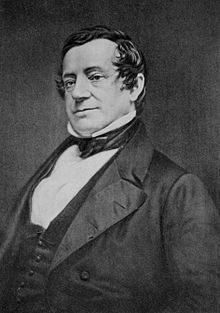
Washington Irving: Washington Irving was an American author, essayist, biographer, historian, and diplomat of the early 19th century. He is best known for his short stories "Rip Van Winkle" (1819). Irving is largely credited as the first American Man of Letters, and the first to earn his living solely by his pen.
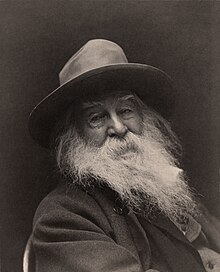
Walt Whitman: Walter "Walt" Whitman was an American poet, essayist and journalist. A humanist, he was a part of the transition between transcendentalism and realism, incorporating both views in his works. Whitman is among the most influential poets in the American canon, often called the father of free verse.
下列這段是在向transcendentalism 致敬,
Walt Whitman (1819–1892). Leaves of Grass. 1900.
39. A Song
COME, I will make the continent indissoluble;
I will make the most splendid race the sun ever yet shone upon;
I will make divine magnetic lands,
With the love of comrades,
With the life-long love of comrades.
I will plant companionship thick as trees along all the rivers of America, and along the shores of the great lakes, and all over the prairies;
I will make inseparable cities, with their arms about each other’s necks;
By the love of comrades,
By the manly love of comrades.
For you these, from me, O Democracy, to serve you, ma femme!
For you! for you, I am trilling these songs.
補充: splendour in the grass 為浪漫時期常出現的字
Splendour in the Grass by William Wordsworth
What though the radiance
which was once so bright
Be now for ever taken from my sight,
Though nothing can bring back the hour
Of splendour in the grass,
of glory in the flower,
We will grieve not, rather find
Strength in what remains behind;
In the primal sympathy
Which having been must ever be;
In the soothing thoughts that spring
Out of human suffering;
In the faith that looks through death,
In years that bring the philosophic mind.
對林肯的悼亡
When Lilacs Last in the Dooryard Bloom’d written by Walt Whitman
Lilacs 紫丁香花
↓Walt Whitman 本來要寫給林肯的
O Captain! My Captain! by Walt Whitman
擷取最後一段:
My Captain does not answer, his lips are pale and still,
My father does not feel my arm, he has no pulse nor will,
The ship is anchor’d safe and sound, its voyage closed and done,
From fearful trip the victor ship comes in with object won;
Exult O shores, and ring O bells!
But I with mournful tread,
Walk the deck my Captain lies,
Fallen cold and dead.
1865年結束南北戰爭以及結束the romantic period,從mournful可知是悼亡,輓歌。Elegy 的一種型態:
Elegy: In English literature, an elegy is a mournful, melancholic or plaintive poem, especially a funeral song or a lament for the dead.
Free verse: Although free verse requires no meter, rhyme, or other traditional poetic techniques, a poet can still use them to create some sense of structure. A clear example of this can be found in Walt Whitman's poems, where he repeats certain phrases and uses commas to create both a rhythm and structure. Much pattern and discipline is to be found in free verse: the internal pattern of sounds, the choice of exact words, and the effect of associations give free verse its beauty. With the Imagists free verse became a discipline and acquired status as a legitimate poetic form.
Blank verse: Blank verse is poetry written in regular metrical but unrhymed lines, almost always iambic pentameters. Among American poets, Hart Crane and Wallace Stevens are notable for using blank verse in extended compositions at a time when many other poets were turning to free verse.
Free verse 和 blank verse主要差別在於抑揚五音部
Heroic couplet: 一行裡面押韻
Imagism: Imagism was a movement in early 20th-century Anglo-American poetry that favored precision of imagery and clear, sharp language. The Imagists rejected the sentiment and discursiveness typical of much Romantic and Victorian poetry. Imagists use free verse.
Funeral Blues by W. H. Auden
Stop all the clocks, cut off the telephone,
Prevent the dog from barking with a juicy bone,
Silence the pianos and with muffled drum
Bring out the coffin, let the mourners come.
Let aeroplanes circle moaning overhead
Scribbling on the sky the message 'He is Dead'.
Put crepe bows round the white necks of the public doves,
Let the traffic policemen wear black cotton gloves.
He was my North, my South, my East and West,
My working week and my Sunday rest,
My noon, my midnight, my talk, my song;
I thought that love would last forever: I was wrong. →Irony
The stars are not wanted now; put out every one,
Pack up the moon and dismantle the sun,
Pour away the ocean and sweep up the wood;
For nothing now can ever come to any good.
“April is the cruellest month” from The Waste land by T.S. Eliot
林肯死在四月
Naturalism (跟natural無關): Naturalism was a literary movement or tendency from the 1880s to 1930s that used detailed realism to suggest that social conditions, heredity, and environment had inescapable force in shaping human character. It was a mainly unorganized literary movement that sought to depict believable everyday reality, as opposed to such movements as Romanticism or Surrealism, in which subjects may receive highly symbolic, idealistic or even supernatural treatment.
Representative authors of Naturalism:
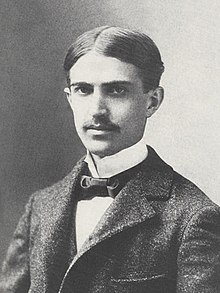
Stephen Crane: Stephen Crane (November 1, 1871 – June 5, 1900) was an American author. Prolific throughout his short life, he wrote notable works in the Realist tradition as well as early examples of American Naturalism and Impressionism. He is recognized by modern critics as one of the most innovative writers of his generation.
The Open Boat written by Stephen Crane. 少年Pi 的奇幻漂流原型
↓對初夜的恐懼
A narrow fellow in the grass by Emily Dickinson
A narrow fellow in the grass → a metaphor
Occasionally rides;
You may have met him—did you not
His notice sudden is,
The grass divides as with a comb,
A spotted shaft is seen,
And then it closes at your feet,
And opens further on.
He likes a boggy acre,
A floor too cool for corn,
But when a boy and barefoot,
I more than once at noon
Have passed, I thought, a whip lash,
Unbraiding in the sun,
When stooping to secure it,
It wrinkled and was gone. → 陽物崇拜 phallic symbol
Several of nature’s people
I know, and they know me;
I feel for them a transport
Of cordiality.
But never met this fellow,
Attended or alone,
Without a tighter breathing,
And zero at the bone.
限會員,要發表迴響,請先登入