Tariff 關稅
歐盟前身 → 關稅貿易總協定 GATT: General Agreement on Tariffs and Trade
1. “The realism practiced by Edith Wharton and Henry James focused on the interior moral and psychological lives of upper-class people. . . . Wharton and James hoped to convince readers—most of whom were from the middle class—that the inner lives of the privileged were in accord with the truths of human nature. Wealthy people had what working people did not—time to develop and display their inner selves; they were just like everybody else, although more so.”
延伸:
malpractice 不當醫療行為、誤診
the privileged, upper-class people 指受到特權保護的人們
international theme → transatlantic theme
free will (典故來自聖經,You have to responsible for your choices.)
Literary realism: Literary realism is part of the realist art movement beginning with mid nineteenth-century French literature and extending to the late nineteenth and early twentieth-century. Mark Twain, and Stephen Crane are the representative writers of Literary realism.
Naturalism: Naturalism was a literary movement or tendency from the 1880s to 1930s that used detailed realism to suggest that social conditions, heredity, and environment had inescapable force in shaping human character.
Naturalism was an outgrowth of literary realism, a prominent literary movement in mid-19th-century France and elsewhere. Naturalistic writers were influenced by Charles Darwin's theory of evolution. Naturalistic works often include uncouth or sordid subject matter; for example, Émile Zola's works had a frankness about sexuality along with a pervasive pessimism. Émile Zola is the representative writer of Naturalism.
單字:
migration → move into之意
segregationist → apart from之意
Poetry
Emily Dickinson and Walt Whitman 在美國文學中的詩有特別的貢獻
These two poets can be said to represent the birth of two major American poetic idioms—the free metric and direct emotional expression of Whitman, and the gnomic obscurity and irony of Dickinson—both of which would profoundly stamp the American poetry of the 20th century.
The development of these idioms, as well as more conservative reactions against them, can be traced through the works of poets such as Edwin Arlington Robinson (1869–1935), Stephen Crane (1871–1900), Robert Frost (1874–1963) and Carl Sandburg (1878–1967). Frost, in particular, is a commanding figure, who aligned strict poetic meter, particularly blank verse and terser lyrical forms, with a "vurry Amur'k'n" (as Pound put it) idiom.
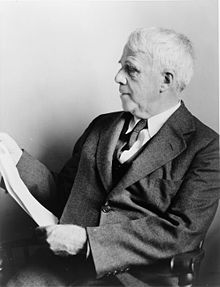
Robert Frost 美國典型詩人was an American poet. He is highly regarded for his realistic depictions of rural life and his command of American colloquial speech. The well-known poetry include "The road not taken", "Sunday Morning", Stopping by Woods On a Snowy Evening". Below is one of his poetry,"Stopping by Woods On a Snowy Evening."
適合形容政治人物前黯淡期
Stopping by Woods On a Snowy Evening
Whose woods these are I think I know.
His house is in the village though;
He will not see me stopping here
To watch his woods fill up with snow.
My little horse must think it queer
To stop without a farmhouse near
Between the woods and frozen lake
The darkest evening of the year.
He gives his harness bells a shake
To ask if there is some mistake.
The only other sound’s the sweep
Of easy wind and downy flake.
The woods are lovely, dark and deep,
But I have promises to keep,
And miles to go before I sleep,
And miles to go before I sleep.
Modernist poetry: Modernist poetry refers to poetry written, mainly in Europe and North America, between 1890 and 1950 in the tradition of modernist literature, but the dates of the term depend upon a number of factors, including the nation of origin, the particular school in question, and the biases of the critic setting the dates. Notwithstanding it is usually said to have begun with the French Symbolist movement and it artificially ends with the Second World War,[citation needed] the beginning and ending of the modernist period are of course arbitrary.

Wallace Stevens: was an American Modernist poet. Stevens, whose work was meditative and philosophical, is very much a poet of ideas. “The poem must resist the intelligence / Almost successfully,” he wrote. Concerning the relation between consciousness and the world, in Steven's work "imagination" is not equivalent to consciousness nor is "reality" equivalent to the world as it exists outside our minds. Reality is the product of the imagination as it shapes the world. Because it is constantly changing as we attempt to find imaginatively satisfying ways to perceive the world, reality is an activity, not a static object. his best-known poems include "Anecdote of the Jar".
Anecdote of the Jar → (是因為我的想像)
I placed a jar in Tennessee,
And round it was, upon a hill.
It made the slovenly wilderness
Surround that hill.
The wilderness rose up to it,
And sprawled around, no longer wild.
The jar was round upon the ground
And tall and of a port in air.
It took dominion everywhere.
The jar was gray and bare.
It did not give of bird or bush,
Like nothing else in Tennessee.
另一個與瓶子相關poetry
擷取自Ode on a Grecian Urn by John Keats
Ah, happy, happy boughs! that cannot shed
Your leaves, nor ever bid the Spring adieu;
And, happy melodist, unwearied,
For ever piping songs for ever new;
More happy love! more happy, happy love!
For ever warm and still to be enjoy'd,
For ever panting, and for ever young;
All breathing human passion far above,
That leaves a heart high-sorrowful and cloy'd,
A burning forehead, and a parching tongue.
The Journey Of The Magi by T.S. Eliot (有文明悲歌的意味)
講述精神文明破產 → 後浪漫主義
應景歌曲
Let it snow Frank Sinatra
https://www.youtube.com/watch?v=aQzlJRjXSGY
限會員,要發表迴響,請先登入