Herman Melville: Herman Melville (August 1, 1819 – September 28, 1891) was an American novelist, writer of short stories, and poet from the American Renaissance period.
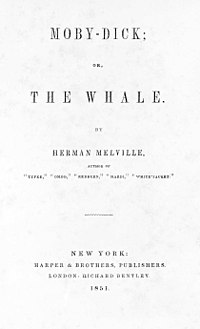
Moby-Dick: Moby-Dick is considered a Great American Novel and an outstanding work of the Romantic period in America and the American Renaissance. "Call me Ishmael" is one of world literature's most famous opening sentences.
Moby-Dick講得是leadership, 人與人之間的衝突
Notes
(Lincoln’s leadership, friendship of Nathaniel Hawthorne and Herman Melville, the Gospel of the century, the classic of mystery of skepticism Hope.)
電影2012裡留下的一本書是Moby-Dick
Epical →史詩般的壯闊
Critics see Moby-Dick variously as an allegory of man’s struggle against malignant nature, a parable of the mystery of cosmic evil, a fictionalized autobiography of personal disillusionment ending in a dead-wish, a symbolical drama of the struggle within man’s dual-ego, etc. Certainly it makes us aware of the evil at work in the world and of our need to struggle courageously against it, but beyond and above whatever thesis it may have it is an enthralling reading experience, a great work of art.
Young Goodman Brown: "Young Goodman Brown" is a short story published in 1835 by American writer Nathaniel Hawthorne. Hawthorne frequently attempts to expose the hypocrisy of Puritan culture in his literature. In a symbolic fashion, the story follows Young Goodman Brown's journey into self-scrutiny, which results in his loss of virtue and belief. "Young Goodman Brown" is often characterized as an allegory about the recognition of evil and depravity as the nature of humanity. (旅途去了之後回來是不一樣的人,因為心境有所改變)
Allegory: As a literary device, an allegory in its most general sense is an extended metaphor. Allegory has been used widely throughout the histories of all forms of art, largely because it readily illustrates complex ideas and concepts in ways that are comprehensible to its viewers, readers, or listeners. Allegories are typically used as literary devices or rhetorical devices that convey hidden meanings through symbolic figures, actions, imagery, and/or events, which together create the moral, spiritual, or political meaning the author wishes to convey.
The Faerie Queene written by Edmund Spenser: The Faerie Queene is an incomplete English epic poem. It is an allegorical work, and can be read (as Spenser presumably intended) on several levels of allegory, including as praise of Queen Elizabeth I.
The Philosophy of Composition: "The Philosophy of Composition" is an 1846 essay written by American writer Edgar Allan Poe that elucidates a theory about how good writers write when they write well. (一本好的小說不應該有道德教訓在裡面)
The Raven: The poem also makes heavy use of alliteration ("Doubting, dreaming dreams ...").
Edgar Allan Poe and William Faulkner → Magic realism(魔幻寫實)
限會員,要發表迴響,請先登入