Miss Potter
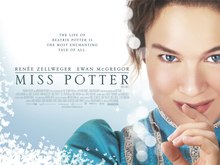
Miss Potter is a 2006 English-American biographical fiction family drama film directed by Chris Noonan. It is a biographical film of children's author and illustrator Beatrix Potter, and combines stories from her own life with animated sequences featuring characters from her stories, such as Peter Rabbit.
.
"There's something delicious about writing those first few words of a story. You can never quite tell where they will take you. Mine took me here, where I belong."
.
.
Beartix vs. Beatrice
Beatrix Potter: the author of children's literature ...
Beatrice Webb: sociologist, economist, socialist, labour historian and social reformer ...
.
Lake District

The Lake District, also known as The Lakes or Lakeland, is a mountainous region in North West England. A popular holiday destination, it is famous for its lakes, forests and mountains (or fells) and its associations with the early 19th century writings of William Wordsworth and the other Lake Poets.
Lake Poets
The Lake Poets were a group of English poets who all lived in the Lake District of England, United Kingdom at the turn of the nineteenth century. As a group, they followed no single "school" of thought or literary practice then known. They were named, only to be uniformly disparaged, by the Edinburgh Review. They are considered part of the RomanticMovement.
The three main figures of what has become known as the Lakes School were William Wordsworth, Samuel Taylor Coleridge, and Robert Southey. They were associated with several other poets and writers, including Dorothy Wordsworth, Charles Lamb, Charles Lloyd, Hartley Coleridge, John Wilson, and Thomas De Quincey.
The beauty of the Lake District has also inspired many other writers over the years, beyond the core Lake Poets. These include their contemporaries Bryan Procter, Felicia Hemans, and Walter Scott, as well as the labouring-class and slightly later John Close, who catered particularly to the growing tourist trade. Other poets include James Payn, andNorman Nicholson.
Children's literature
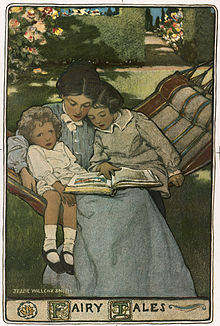
Children's literature or juvenile literature includes stories, books, magazines, and poems that are enjoyed by children. Modern children's literature is classified in two different ways: genre or the intended age of the reader.
Children's literature can be traced to stories and songs, part of a wider oral tradition, that adults shared with children before publishing existed. The development of early children's literature, before printing was invented, is difficult to trace. Even after printing became widespread, many classic "children's" tales were originally created for adults and later adapted for a younger audience. Since the 15th century, a large quantity of literature, often with a moral or religious message, has been aimed specifically at children. The late nineteenth and early twentieth centuries became known as the "Golden Age of Children's Literature" as this period included the publication of many books acknowledged today as classics.
.
Pan
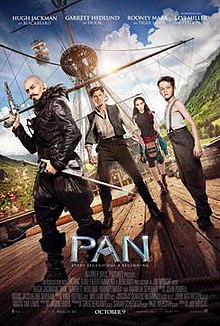
Pan is a 2015 American 3D fantasy action-adventure family film directed by Joe Wright, produced by Greg Berlanti, Sarah Schechter, Paul Webster, Warner Bros., Berlanti Productions and RatPac-Dune Entertainment, distributed by Warner Bros.
.
Peter Pan
Peter Pan is a character created by Scottish novelist and playwright J. M. Barrie. A mischievous boy who can fly and never grows up, Peter Pan spends his never-ending childhood having adventures on the small island of Neverland as the leader of his gang, the Lost Boys, interacting with mermaids, Native Americans, fairies, pirates, and occasionally ordinary children from the world outside Neverland. In addition to two distinct works by Barrie, the character has been featured in a variety of media and merchandise, both adapting and expanding on Barrie's works. These include an animated film, a dramatic film, a TV series and other works.
.
The Little Prince

The Little Prince, first published in 1943, is a novella, the most famous work of the French aristocrat, writer, poet, and pioneering aviator Antoine de Saint-Exupéry (1900–1944).
The novella is the fourth most-translated book in the world and was voted the best book of the 20th century in France. Translated into more than 250 languages and dialects (as well as Braille), selling nearly two million copies annually with sales totaling over 140 million copies worldwide, it has become one of the best-selling books ever published.
After the outbreak of the Second World War Saint-Exupéry was exiled to North America. In the midst of personal upheavals and failing health, he produced almost half of the writings for which he would be remembered, including a tender tale of loneliness, friendship, love, and loss, in the form of a young prince fallen to Earth. An earlier memoir by the author had recounted his aviation experiences in the Sahara Desert, and he is thought to have drawn on those same experiences in The Little Prince.
Since its first publication in the United States, the novella has been adapted to numerous art forms and media, including audio recordings, radio plays, live stage, film screen, television, ballet, and operatic works.
Utopian and dystopian fiction
The utopia and its offshoot, the dystopia, are genres of literature that explore social and political structures. Utopian fiction is the creation of an ideal society, or utopia, as the setting for a novel. Dystopian fiction (sometimes combined with, but distinct from apocalyptic literature) is the opposite: creation of an utterly horrible or degraded society that is generally headed to an irreversible oblivion, or dystopia. Many novels combine both, often as a metaphor for the different directions humanity can take in its choices, ending up with one of two possible futures. Both utopias and dystopias are commonly found in science fiction and other speculative fiction genres, and arguably are by definition a type of speculative fiction.
 dystopian
 dystopian
Orlando: A Biography

Orlando: A Biography is a novel by Virginia Woolf, first published on 11 October 1928. A high-spirited romp inspired by the tumultuous family history of Woolf's partner, the aristocratic poet and novelist Vita Sackville-West, it is arguably one of Woolf's most popular and accessible novels: a history of English literature in satiric form. The book describes the adventures of a poet who changes sex from man to woman and lives for centuries, meeting the key figures of English literary history. Considered a feminist classic, the book has been written about extensively by scholars of women's writing and gender and transgender studies.
The Holiday

The Holiday is a 2006 American romantic comedy film written, produced and directed by Nancy Meyers, distributed by Columbia Pictures and Universal Pictures, filmed in both California and England, and starring Cameron Diaz and Kate Winslet as two lovelorn women from opposite sides of the Atlantic Ocean, who temporarily exchange homes to escape heartbreak during the holiday season. Jude Law and Jack Black are the movie's leading men, with Eli Wallach, Shannyn Sossamon, Edward Burns and Rufus Sewell playing key supporting roles.
Chip 'n' Dale

Chip and Dale (also rendered as Chip 'n' Dale or Chip an' Dale) are two chipmunk cartoon characters created in 1943, at Walt Disney Productions. Their names are a pun based on the name of the famous 18th-century cabinet maker Thomas Chippendale.
Chip is the logical schemer while Dale is the goofy, dim-witted one. Originally the two had a very similar appearance but, as a way to tell them apart, some differences were introduced: Chip has a small black nose (it looks a bit like a chocolate "chip") and two centered protruding teeth. Dale has a larger, dark red nose and it is his canine teeth that are exposed. Dale has a very strong sense of humor while Chip is more of the safe, focused one. Chip is also depicted as having smooth, short hair atop his head while Dale's is ruffled.
Rosencrantz and Guildenstern Are Dead
Rosencrantz and Guildenstern Are Dead, often referred to as just Rosencrantz and Guildenstern, is an absurdist, existentialisttragicomedy by Tom Stoppard, first staged at the Edinburgh Festival Fringe in 1966. The play expands upon the exploits of two minor characters from Shakespeare's Hamlet, the courtiers Rosencrantz and Guildenstern. The action of Stoppard's play takes place mainly "in the wings" of Shakespeare's, with brief appearances of major characters from Hamlet who enact fragments of the original's scenes. Between these episodes the two protagonists voice their confusion at the progress of events of which—occurring onstage without them in Hamlet—they have no direct knowledge.
下一則: WEEK 06 英文兒童文學筆記 (English Children's Literature)
限會員,要發表迴響,請先登入


