Onomatopoeia
An onomatopoeia is a word that phonetically imitates, resembles or suggests the source of the sound that it describes (give you information in a hidden way). Onomatopoeia (as an uncountable noun) refers to the property of such words. Common occurrences of onomatopoeias include animal noises such as "oink", "miaow" (or "meow"), "roar" or "chirp". Onomatopoeias are not the same across all languages; they conform to some extent to the broader linguistic system they are part of; hence the sound of a clock may be tick tock in English, dī dā in Mandarin, or katchin katchin in Japanese, or "tik-tik" (टिक-टिक) in Hindi.
Although in the English language the term onomatopoeia means the imitation of a sound, in the Greek language the compound word onomatopoeia (ονοματοποιία) means "making or creating names". For words that imitate sounds, the term Ηχομιμητικό (echomimetico or echomimetic) is used. Ηχομιμητικό (echomimetico) derives from Ηχώ, meaning "echo or sound", and μιμητικό, meaning "mimetic or imitation".
.
Examples
Old MacDonald had a Farm
.
Bildungsroman
In literary criticism, a Bildungsroman ,[a] novel of formation, novel of education, or coming of age story (though it may also be known as a subset of the coming-of-age story) is a literary genre that focuses on the psychological and moral growth of the protagonist from youth to adulthood (coming of age), in which character change is extremely important.
The term was coined in 1819 by philologist Karl Morgenstern in his university lectures, and later famously reprised by Wilhelm Dilthey, who legitimated it in 1870 and popularized it in 1905. The genre is further characterized by a number of formal, topical, and thematic features. The term coming-of-age novel is sometimes used interchangeably with Bildungsroman, but its use is usually wider and less technical.
The birth of the Bildungsroman is normally dated to the publication of Wilhelm Meister's Apprenticeship by Johann Wolfgang Goethe in 1795–96. Although the Bildungsroman arose in Germany, it has had extensive influence first in Europe and later throughout the world. Thomas Carlyle translated Goethe’s novel into English, and after its publication in 1824, many British authors wrote novels inspired by it. In the 20th century, it spread to Germany, Britain, France, and several other countries around the globe.
The genre translates fairly directly into cinematic form, the coming-of-age film.
Johann Wolfgang von Goethe

Johann Wolfgang von Goethe (28 August 1749 – 22 March 1832) was a German writer and statesman. His body of work includes epic and lyric poetry written in a variety of metres and styles; prose and verse dramas; memoirs; an autobiography; literary and aesthetic criticism; treatises on botany, anatomy, and colour; and four novels. In addition, numerous literary and scientific fragments, more than 10,000 letters, and nearly 3,000 drawings by him are extant. A literary celebrity by the age of 25, Goethe was ennobled by the Duke of Saxe-Weimar, Karl August in 1782 after first taking up residence there in November 1775 following the success of his first novel, The Sorrows of Young Werther.
.
The Sorrows of Young Werther
The Sorrows of Young Werther is an epistolary, loosely autobiographical novel byJohann Wolfgang von Goethe, first published in 1774. A revised edition appeared in 1787. It was an important novel of the Sturm und Drang period in German literature, and influenced the later Romantic movement in literature.
Goethe, 24 years old at the time, finished Werther in six weeks of intensive writing in January–March 1774. It instantly put him among the first international literary celebrities, and remains the best known of his works to the general public. Towards the end of Goethe's life, a personal visit to Weimar became a crucial stage in any young man's Grand Tour of Europe.
.
Epistolary novel
An epistolary novel is a novel written as a series of documents. The usual form is letters, although diary entries, newspaper clippings and other documents are sometimes used. Recently, electronic "documents" such as recordings and radio, blogs, and e-mails have also come into use. The word epistolary is derived from Latin from the Greek word ἐπιστολή epistolē, meaning a letter (see epistle).
The epistolary form can add greater realism to a story, because it mimics the workings of real life. It is thus able to demonstrate differing points of view without recourse to the device of an omniscient narrator.
.
FOR EXAMPLE
Pamela
Pamela; or, Virtue Rewarded is an epistolary novel by Samuel Richardson, first published in 1740. It tells the story of a beautiful 15-year-old maidservant named Pamela Andrews, whose country landowner master, Mr. B, makes unwanted advances towards her after the death of his mother. After attempting unsuccessfully to seduce and rape her, her virtue is eventually rewarded when he sincerely proposes an equitable marriage to her. In the novel's second part, Pamela marries Mr. B and tries to acclimatise to upper-class society. The story, a best-seller of its time, was very widely read but was also criticized for its perceived licentiousness.
Allegory
As a literary device, an allegory in its most general sense is an extended metaphor. Writers or speakers typically use allegories as literary devices or as rhetorical devices that convey hidden meanings through symbolic figures, actions, imagery, and/or events, which together create the moral, spiritual, or political meaning the author wishes to convey.
.
Fable
Fable is a literary genre: a succinct fictional story, in prose or verse, that features animals, mythical creatures, plants, inanimate objects, or forces of nature that are anthropomorphized (given human qualities, such as verbal communication) and that illustrates or leads to an interpretation of a moral lesson (a "moral"), which may at the end be added explicitly as a pithy maxim.
.
Parable
A parable is a succinct, didactic story, in prose or verse, which illustrates one or more instructive lessons or principles. It differs from a fable in that fables employ animals, plants, inanimate objects, or forces of nature as characters, whereas parables have human characters. A parable is a type of analogy.
.
*** HINT ***
What are the differences between “allegories”, “fables” and “parables”?
Allegory: A story in which ideas are symbolized as people. E.g., The Faerie Queene
Parable: A short story designed to teach a moral or religious lesson. E.g., The Prodigal Son
Fable: A short story in which animals or objects speaks a story, to teach a moral or religious lesson. E.g., Aesop's Fables
Oscar Wilde

Oscar Fingal O'Flahertie Wills Wilde (16 October 1854 – 30 November 1900) was an Irish playwright, novelist, essayist, and poet. After writing in different forms throughout the 1880s, he became one of London's most popular playwrights in the early 1890s. He is remembered for his epigrams, his novel The Picture of Dorian Gray, his plays, as well as the circumstances of his imprisonment and early death.
.
巨人的花園:王爾德專集
http://www.books.com.tw/products/CN10791928
.
"The Happy Prince"

In a town where a lot of poor people suffer, a swallow who was left behind after his flock flew off to Egypt for the winter meets the statue of the late "Happy Prince", who in reality has never experienced true happiness. Viewing various scenes of people suffering in poverty from his tall monument, the Happy Prince asks the swallow to take the ruby from his hilt, the sapphires from his eyes, and the golden leaf covering his body to give to the poor. As the winter comes and the Happy Prince is stripped of all of his beauty, his lead heart breaks when the swallow dies as a result of his selfless deeds and severe cold. The statue is then torn down and melted leaving behind the broken heart and the dead swallow. These are taken up to heaven by an angel that has deemed them the two most precious things in the city. This is affirmed by God and they live forever in his city of gold and garden of paradise.
Peter Rabbit
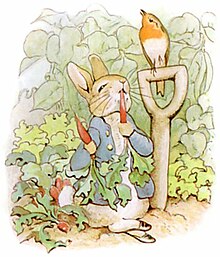
Peter Rabbit is a fictional anthropomorphic character in various children's stories by Beatrix Potter. He first appeared in The Tale of Peter Rabbit in 1902 and subsequently in five more books between 1904 and 1912. Spinoff merchandise includes dishes, wallpaper, and dolls. He appears as a character in a number of adaptations.
.
Beatrix Potter

Helen Beatrix Potter (28 July 1866 – 22 December 1943) was an English author, illustrator, natural scientist, and conservationist best known for her children's books featuring animals such as those in The Tale of Peter Rabbit.
.
The Tale of Peter Rabbit

The Tale of Peter Rabbit is a British children's book written and illustrated by Beatrix Potter that follows mischievous and disobedient young Peter Rabbit as he is chased about the garden of Mr. McGregor. He escapes and returns home to his mother who puts him to bed after dosing him with camomile tea. The tale was written for five-year-old Noel Moore, son of Potter's former governess Annie Carter Moore, in 1893. It was revised and privately printed by Potter in 1901 after several publishers' rejections but was printed in a trade edition by Frederick Warne & Co. in 1902. The book was a success, and multiple reprints were issued in the years immediately following its debut. It has been translated into 36 languages and with 45 million copies sold it is one of the best-selling books of all time.
The book has generated considerable merchandise over the decades since its release for both children and adults with toys, dishes, foods, clothing, videos and other products made available. Potter was one of the first to be responsible for such merchandise when she patented a Peter Rabbit doll in 1903 and followed it almost immediately with a Peter Rabbit board game.
* 對於他爸爸的死輕描淡寫(understatement):
"your Father had an accident there; he was put in a pie by Mrs. McGregor"
Fantasy
Fantasy is a genre of fiction that uses magic or other supernatural elements as a main plot element, theme, or setting. Many works within the genre take place in imaginary worlds where magic and magical creatures are common. Fantasy is generally distinguished from the genres of science fiction and horror by the expectation that it steers clear of scientific and macabre themes, respectively, though there is a great deal of overlap between the three, all of which are subgenres of speculative fiction.
In popular culture, the fantasy genre is predominantly of the medievalist form. In its broadest sense, however, fantasy comprises works by many writers, artists, filmmakers, and musicians, from ancient myths and legends to many recent and popular works.
Fantasy is studied in a number of disciplines including English and other language studies, cultural studies, comparative literature, history, and medieval studies. Work in this area ranges widely, from the structuralist theory of Tzvetan Todorov, which emphasizes the fantastic as a liminal space, to work on the connections (political, historical, literary) between medievalism and popular culture.
下一則: WEEK 04 英文兒童文學筆記 (English Children's Literature)
限會員,要發表迴響,請先登入


