● Glossary
an imaginary personage who acts, appears, or is referred to in a literary work. Major or main characters are those that receive most attention, minor characters least. Flat characters are relatively simple, have a few dominant traits, and tend to be predictable. Conversely, round characters are complex and multifaceted and act in a way that readers might not expect but accept as possible. Static characters do not change; dynamic characters do. Stock characters represent familiar types that recur frequently in literary works, especially of a particular genre (e.g., the "mad scientist" of horror fiction and film or the fool in Renaissance, especially Shakespearean, drama).
.
the arrangement of the action. The five main parts or phases of plot are exposition, rising action, climax or turning point, falling action, and conclusion or resolution. See also subplot, overplot.
.
the time and place of the action in a work of fiction, poetry, or drama. The spatial setting is the place or places in which action unfolds, the temporal setting is the time. (Temporal setting is thus the same as plot time.) It is sometimes also helpful to distinguish between general setting—the general time and place in which all the action unfolds—and particular settings—the times and places in which individual episodes or scenes take place. The film version of Gone with the Wind, for example, is generally set in Civil War– era Georgia, while its opening scene takes place on the porch of Tara, Scarlett O’Hara’s family home, before the war begins.
.
(1) broadly and commonly, a topic explored in a literary work (e.g., "the value of all life"); (2) more narrowly, the insight about a topic communicated in a work (e.g., "All living things are equally precious"). Most literary works have multiple themes, though some people reserve the term theme for the central or main insight and refer to others as subthemes. Usually, a theme is implicitly communicated by the work as a whole rather than explicitly stated in it, though fables are an exception.
.
the perspective from which people, events, and other details in a work of fiction are viewed; also called focus, though the term point of view is sometimes used to include both focus and voice. The point of view is said to be limited when we see things only from one character’s perspective; it is said to be omniscient or unlimited when we get the perspective of multiple characters.
.
(1) broadly, the act of telling a story or recounting a narrative; (2) more narrowly, the portions of a narrative attributable to the narrator rather than words spoken by characters (that is, dialogue).
.
● Vocabulary
malaria /məˈleəriə/ 瘧疾
a serious illness caused by being bitten by a mosquito, usually in a hot country

.
resignation /ˌrezɪɡˈneɪʃ(ə)n/ n. 無可奈何
the attitude of someone who accepts that something unpleasant must happen and that they cannot change it
e.g., speak with resignation
e.g., a sigh of resignation
.
obliterate /əˈblɪtəreɪt/ v.
to cover something completely so that you cannot see it
e.g., The park had been obliterated beneath a layer of snow.
.
obscure /əbˈskjʊə(r)/ v.
to cover something so that it cannot be seen
e.g., His face was partially obscured by sunglasses.
.
crescent /ˈkrez(ə)nt/ n.
1. a curved shape that is wide in the middle and pointed at the ends. The moon sometimes has this shape.
2. a curved street. Used especially in street names
2. e.g., Mornington Crescent
.
● Notes on "A Rose for Emily"
august names
The word "august" here means distinguished, or important. That means that the august names in the town are the names of the people who are important in that town.
In this case, the term is used to refer to people who are dead. We are not told exactly who they are, but we do know that these were the people who built the houses in the rich neighborhood where Miss Emily lived. It may be that they were the slaveholders who were once rich, but who lost much of their wealth after the Civil War.
.
● William Faulkner's speech at the Nobel Banquet
www.nobelprize.org/nobel_prizes/literature/laureates/1949/faulkner-speech.html

...
Our tragedy today is a general and universal physical fear so long sustained by now that we can even bear it. There are no longer problems of the spirit. There is only the question: When will I be blown up? Because of this, the young man or woman writing today has forgotten the problems of the human heart in conflict with itself which alone can make good writing because only that is worth writing about, worth the agony and the sweat.
...
I refuse to accept this. I believe that man will not merely endure: he will prevail. He is immortal, not because he alone among creatures has an inexhaustible voice, but because he has a soul, a spirit capable of compassion and sacrifice and endurance. The poet's, the writer's, duty is to write about these things. It is his privilege to help man endure by lifting his heart, by reminding him of the courage and honor and hope and pride and compassion and pity and sacrifice which have been the glory of his past. The poet's voice need not merely be the record of man, it can be one of the props, the pillars to help him endure and prevail.
.
Banquet Speech by William Faulkner (excerpt)
www.youtube.com/watch?v=nk9_1oww4FY
.
● The Significance of the Title "Roman Fever"
www.enotes.com/homework-help/discuss-irony-symbolic-significance-title-roman-177153
The title is a form of verbal irony because "Roman Fever" has a dual meaning: on the surface, it means malaria but it also symbolizes Alida's raging, disease-like jealousy of Grace Ansley that she has harbored for all of these years.
.
● The Five Parts of Plot

.
● Literature
classiclit.about.com/od/literaryterms/g/aa_whatisliter.htm

What is literature?
Literature is a term used to describe written or spoken material. Broadly speaking, "literature" is used to describe anything from creative writing to more technical or scientific works, but the term is most commonly used to refer to works of the creative imagination, including works of poetry, drama, fiction, and nonfiction.
Why do we read literature?
Literature represents a language or a people: culture and tradition. But, literature is more important than just a historical or cultural artifact. Literature introduces us to new worlds of experience. We learn about books and literature; we enjoy the comedies and the tragedies of poems, stories, and plays; and we may even grow and evolve through our literary journey with books.
Ultimately, we may discover meaning in literature by looking at what the author says and how he/she says it. We may interpret the author's message. In academic circles, this decoding of the text is often carried out through the use of literary theory, using a mythological, sociological, psychological, historical, or other approach.
Whatever critical paradigm we use to discuss and analyze literature, there is still an artistic quality to the works. Literature is important to us because it speaks to us, it is universal, and it affects us. Even when it is ugly, literature is beautiful.
Also Known As
Classics, learning, erudition, belles-lettres, lit, literary works, written work, writings, books.
Examples
"The difficulty of literature is not to write, but to write what you mean; not to affect your reader, but to affect him precisely as you wish." -- Robert Louis Stevenson
.
● "Shall I compare thee to a summer’s day?" (Sonnet 18)
William Shakespeare, 1564 - 1616
Shall I compare thee to a summer’s day?
Thou art more lovely and more temperate.
Rough winds do shake the darling buds of May,
And summer’s lease hath all too short a date.
Sometime too hot the eye of heaven shines,
And often is his gold complexion dimmed;
And every fair from fair sometime declines,
By chance, or nature’s changing course, untrimmed;
But thy eternal summer shall not fade,
Nor lose possession of that fair thou ow’st,
Nor shall death brag thou wand’rest in his shade,
When in eternal lines to Time thou grow’st.
     So long as men can breathe, or eyes can see,
     So long lives this, and this gives life to thee.
.
● Robinson Crusoe

Robinson Crusoe is a novel by Daniel Defoe, first published on 25 April 1719.
Epistolary, confessional, and didactic in form, the book is presented as an autobiography of the title character (whose birth name is Robinson Kreutznaer)—a castaway who spends thirty years on a remote tropical island near Trinidad, encountering cannibals, captives, and mutineers before being rescued.
.
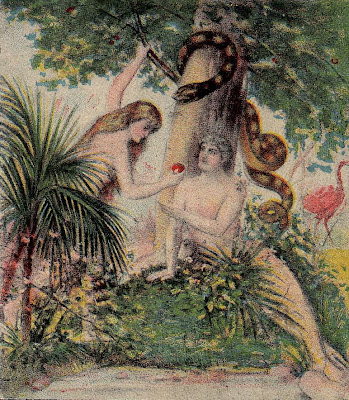
● "The Evil One has beguiled me."
"Believe me, believe me, I beseech you . . ." she said. "I love a pure, honest life, and sin is loathsome to me. I don't know what I am doing. Simple people say: 'The Evil One has beguiled me.' And I may say of myself now that the Evil One has beguiled me." --- Anton Chekhov, The Lady eith the Dog
What Does it Mean that Eve was Beguiled?
www.womeninthescriptures.com/2013/08/what-does-it-mean-that-eve-was-beguiled.html
.
下一則: WEEK 07 文導筆記 (Approaches to Literature)
限會員,要發表迴響,請先登入


