● Yalta

Yalta is a resort city on the north coast of the Black Sea in the Crimean peninsula. It serves as the administrative center of Yalta Municipality, one of the regions Crimea is divided into.
.
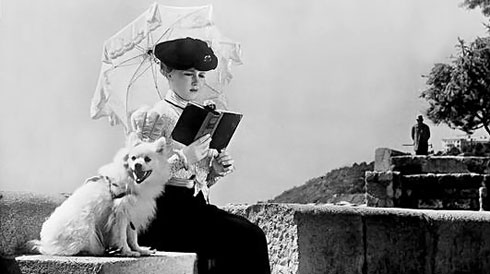
The Lady with the Dog is a short story by Anton Chekhov first published in 1899. It tells the story of an adulterous affair between a Russian banker and a young lady he meets while vacationing in Yalta.
.
● Glossary
Setting
the time and place of the action in a work of fiction, poetry, or drama. The spatial setting is the place or places in which action unfolds, the temporal setting is the time. (Temporal setting is thus the same as plot time.) It is sometimes also helpful to distinguish between general setting—the general time and place in which all the action unfolds—and particular settings—the times and places in which individual episodes or scenes take place. The film version of Gone with the Wind, for example, is generally set in Civil War– era Georgia, while its opening scene takes place on the porch of Tara, Scarlett O’Hara’s family home, before the war begins.
.
Theme
(1) broadly and commonly, a topic explored in a literary work (e.g., "the value of all life"); (2) more narrowly, the insight about a topic communicated in a work (e.g., "All living things are equally precious"). Most literary works have multiple themes, though some people reserve the term theme for the central or main insight and refer to others as subthemes. Usually, a theme is implicitly communicated by the work as a whole rather than explicitly stated in it, though fables are an exception.
.
Catharsis
A Catharsis is an emotional discharge through which one can achieve a state of moral or spiritual renewal or achieve a state of liberation from anxiety and stress. Catharsis is a Greek word and it means cleansing. In literature it is used for the cleansing of emotions of the characters. It can also be any other radical change that leads to emotional rejuvenation of a person. Originally, the term was used as a metaphor in Poetics by Aristotle to explain the impact of tragedy on the audiences. He believed that catharsis was the ultimate end of a tragic artistic work and it marked its quality. He further said in Poetics:
“Tragedy is an imitation of an action that is serious, complete, and of a certain magnitude; . . . through pity [eleos] and fear [phobos] effecting the proper purgation [catharsis] of these emotions” (c. 350 BCE, Book 6.2).
.
Bildungsroman
In literary criticism, a Bildungsroman , novel of formation, novel of education, or coming-of-age story (though it may also be known as a subset of the coming-of-age story) is a literary genre that focuses on the psychological and moral growth of the protagonist from youth to adulthood (coming of age), in which character change is extremely important.
.
● Vocabulary
plantation noun /plɑːnˈteɪʃ(ə)n/
a large farm where crops such as tea, coffee, cotton, and sugar are grown
e.g., a sugar plantation
.
temp/tempo: time
e.g., extemporaneously, contemporary, temporary
.
dic/dict: say, speak
e.g., predict, dictionary, dictator
.
para: beside
e.g., paradox, paramedic, paraphrase, parachute
.
spec/spect/spi/spic: look, see
e.g., spectator, spectacle, aspect
.
magn: great, big
e.g., magnify, magnificent, magnanimous
.
spatial vs. special
Spatial (adjective) Concerning size, area or position
e.g., What are the spatial qualities of a new concert hall?
.
resort (noun) a place that many people go to for a holiday
e.g., a ski/seaside/mountain resort
resort (verb) to do something extreme or unpleasant in order to solve a problem
e.g., I think we can solve this problem without resorting to legal action.
.
indentation noun /ˌɪndenˈteɪʃ(ə)n/
a mark or hole in the surface of something
e.g., Use a knife to make indentations in the icing.
.
● Charles Dickens
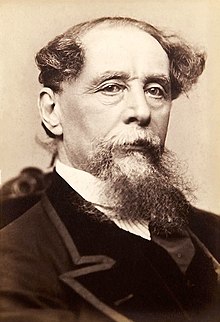
Charles John Huffam Dickens (7 February 1812 – 9 June 1870) was an English writer and social critic. He created some of the world's best-known fictional characters and is regarded as the greatest novelist of the Victorian era. His works enjoyed unprecedented popularity during his lifetime, and by the twentieth century critics and scholars had recognised him as a literary genius. His novels and short stories enjoy lasting popularity.
.
A Tale of Two Cities
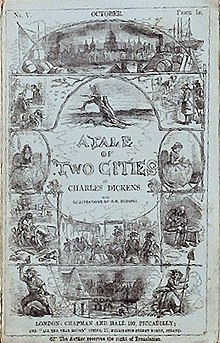 A Tale of Two Cities (1859) is a novel by Charles Dickens, set in London and Paris before and during the French Revolution. The novel depicts the plight of the French peasantry demoralised by the French aristocracy in the years leading up to the revolution, the corresponding brutality demonstrated by the revolutionaries toward the former aristocrats in the early years of the revolution, and many unflattering social parallels with life in London during the same period. It follows the lives of several characters through these events.
"It was the best of times, it was the worst of times, it was the age of wisdom, it was the age of foolishness, it was the epoch of belief, it was the epoch of incredulity, it was the season of Light, it was the season of Darkness, it was the spring of hope, it was the winter of despair, we had everything before us, we had nothing before us, we were all going direct to Heaven, we were all going direct the other way. . . ."
.
● Gone with the Wind (亂世佳人)

Gone with the Wind is a novel written by Margaret Mitchell, first published in 1936. The story is set in Clayton County, Georgia, and Atlanta during the American Civil War and Reconstruction era. It depicts the experiences of Scarlett O'Hara, the spoiled daughter of a well-to-do plantation owner, who must use every means at her disposal to come out of the poverty she finds herself in afterSherman's March to the Sea. A historical novel, the story is a Bildungsroman or coming-of-age story, with the title taken from a poem written by Ernest Dowson.
http://tv.sohu.com/20090121/n261883863.shtml
http://en.wikipedia.org/wiki/Gone_with_the_Wind
.

.
● Cathedral, by Raymond Carver

Themes, Motifs, and Symbols- http://www.sparknotes.com/short-stories/cathedral/themes.html
Important Quotations Explained- http://www.sparknotes.com/short-stories/cathedral/quotes.html
.
● Poetics


“Tragedy, then, is an imitation of an action that is serious, complete, and of a certain magnitude; in language embellished with each kind of artistic ornament, the several kinds being found in separate parts of the play; in the form of action, not of narrative; with incidents arousing pity and fear, wherewith to accomplish its katharsis of such emotions. . . . Every Tragedy, therefore, must have six parts, which parts determine its quality—namely, Plot, Characters, Diction, Thought, Spectacle, Melody.” (translation by S. H. Butcher; click on the context links to consult the full online text)
.
The general origin of poetry is natural human inclination toward imitation. Imitation is natural and naturally enjoyable. Far from being demeaning and stultifying, as Plato contended, imitation is a very powerful source of knowledge and entertainment.
1. We learn (at first) by imitation.
2. We find delight in imitation.
3. To be learning is itself a pleasure = gathering information + enjoying the execution.
The pleasure of imitation is not identical with the realistic representation of objects; we can enjoy imitation even of disgusting objects or those that we have not seen before precisely because the pleasure stems from the quality of execution.
.
● Gothic Fiction

Gothic fiction, which is largely dominated by the subgenre of Gothic horror, is a genre or mode of literature that combines fiction, horror and Romanticism. Its origin is attributed to English author Horace Walpole, with his 1764 novel The Castle of Otranto, subtitled (in its second edition) "A Gothic Story." The effect of Gothic fiction feeds on a pleasing sort of terror, an extension of Romantic literary pleasures that were relatively new at the time of Walpole's novel. Melodrama and parody (including self-parody) were other long-standing features of the Gothic initiated by Walpole. It originated in England in the second half of the 18th century and had much success in the 19th, as witnessed by Mary Shelley’s Frankenstein and the works of Edgar Allan Poe. Another well known novel in this genre, dating from the late Victorian era, is Bram Stoker’s Dracula. The name Gothic refers to the (pseudo)-medieval buildings in which many of these stories take place. This extreme form of romanticism was very popular in England and Germany. The English Gothic novel also led to new novel types such as the German Schauerroman and the French roman noir.
.
● Western Canon
The term Western canon is most often used to refer to a body of literature which is considered to have had the greatest influence on Western culture. It encompasses poetry, fiction and drama, philosophy, essays and autobiographical works. In a broader sense, the canon refers to the greatest works of art and music and represents the belief that the works included in it have shaped and defined Western civilization. The teaching of the canon is a cornerstone of Western universities and the handing down of knowledge and cultural heritage. Works in the canon are those without which scholarship would have no context.
The word canon has ecclesiastical origins and was first used to denote sacred writings. It also means a standard to which all other works are held. The Western canon implies the existence of people qualified to make determinations about what belongs in the canon and why. This has traditionally been the function of universities and their scholars. Academia is a setting in which scholars can devote their time to the study of artistic works and their meanings, and it allows for the canon to be explained and transmitted to succeeding generations.
What the Western canon consists of, at least regarding the older works of Western culture, does not seem to pose any difficulty. There is no serious question as to whether the works of Plato, Shakespeare, Cervantes, and Dante are a part of it. Why some works are included can have a variety of explanations. One is simply the beauty of the work and its aesthetic value, its effort at perfection of expression. Other works may have such originality that they are a quantum leap in the use of language or a way of perceiving the world.
Examples of these leaps can be found in different writers from different eras. These artists seem to know exactly what they are trying to accomplish in their work and its contribution to their culture. Shakespeare is credited with having for all time changed the nature of expressing dialogue and internal thinking. James Joyce in a sense changed the way people think about the way people think. His reported comment to his brother that his work would “keep the scholars busy for the next 200 years” was accurate.
Another way in which a work may become part of the Western canon has to do with the relationship of the artist to society. Many great writers are considered to be seekers after truth, sometimes to the exclusion of all other values. The writer is not speaking to the reader as a social being, but as a person alone with himself. It is the expression of this truth seeking that may cause the wider culture to reexamine its own values and rethink the nature and purpose of human existence.
下一則: WEEK 04 文導筆記 (Approaches to Literature)
限會員,要發表迴響,請先登入


