◎ Vocabulary
* notorious: famous for something bad
┌ fame = reputation
└ infame / infamous
.
* board = to live
boarding school
.
* narration: the process of telling a story
Narration is the use of—or the process of using—written or spoken words to convey a story to an audience. Narration encompasses a set of methods, known collectively as thenarrative mode, through which the creator of the story presents their work, including:
- Narrative point of view: the type of personal or non-personal perspective through which a story is communicated
- Narrative voice: the general "look" or "feel" of how a story is communicated
- Narrative time: the grammatical positioning of a story in the past, present, or future
.
* allude: to make indirect reference
* allusion: an implied or indirect reference especially in literature; also : the use of such references
.
◎ Prefix
extra- : beyond
for example, extracurricular: extracurricular activities are things that you do at school or college thatare not part of your course
for example, extraordinary: very unusual and surprising
for example, extrapolate: to say what is likely to happen or be true by using informationthat you already have
for example, extravagant: spending or costing a lot of money, especially more than is reasonable
.
◎ myrtle: Venus's favorite flower
◎ owl: Athena's favorite bird


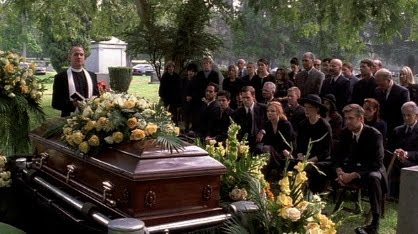
◎ Funeral
The Creation of Man (Genesis 2:7)
…But a mist used to rise from the earth and water the whole surface of the ground. Then the LORD God formed man of dust from the ground, and breathed into his nostrils the breath of life; and man became a living being.
- "Earth to earth, ashes to ashes, dust to dust", a phrase from the funeral service in the Book of Common Prayer
- Six feet under refers to a euphemistic phrase for burial in a grave
.
◎ Charon's obol
Charon's obol is an allusive term for the coin placed in or on the mouth of a dead person before burial. Greek and Latin literary sources specify the coin as an obol, and explain it as a payment or bribe for Charon, the ferryman who conveyed souls across the river that divided the world of the living from the world of the dead. Archaeological examples of these coins, of various denominations in practice, have been called "the most famous grave goods from antiquity." The custom is primarily associated with the ancient Greeks and Romans, though it is also found in the ancient Near East.

Charon and Psyche (1883), a pre-Raphaelite interpretation of the myth by John Roddam Spencer Stanhope
.
◎ The Waste Land
T.S. Eliot (1888–1965). The Waste Land. 1922.
click me to read the entire poem...

◎ Serendipity (film)
http://en.wikipedia.org/wiki/Serendipity_(film)
A couple reunite years after the night they first met, fell in love, and separated, convinced that one day they'd end up together.

Movie trailer: https://www.youtube.com/watch?v=ePU2Ux9JIMM
.
p.s. serene: calm, or peaceful
.
from http://blog.udn.com/tysunnhcue/9726153
a. 五段論證法
Introduction (thesis statement) + 3 supporting paragraphs (topic sentences) + conclusion
b. 1. Exposition 2. Argumentation 3. Description 4. Narration
.
◎
cia

Vocabulary from Text Book & The Great Gatsby WEEK12
.
* associate (v.) /əˈsəʊsiˌeɪt/
to form a connection in your mind between different people or things
e.g. How do humans associate these seemingly opposed ideas?
Origin of ASSOCIATE
Middle English associat associated, from Latin associatus, past participle of associare to unite, from ad- + sociare to join, from socius companion
.
* destination (n.) /ˌdestɪˈneɪʃ(ə)n/
the place where someone or something is going
e.g. a popular holiday destination
.
* engulf (v.) /ɪnˈɡʌlf/
to cover or surround something in a way that harms or destroys it
e.g. Several workers died in the landslide that engulfed the old factory.
.
* fee (n.) /fiː/
[USUALLY PLURAL] money that you pay to a professional person or institution for their work
e.g. Many doctors have a standard scale of fees.
Origin of FEE
Middle English, from Anglo-French fé, fief, of Germanic origin; akin to Old English feoh cattle, property, Old High German fihu cattle; akin to Latin pecus cattle, pecunia money
.
* flood (n.) /flʌd/
a large amount of water that covers an area that was dry before
e.g. The southwest of England has been badly hit by floods.
Origin of FLOOD
Middle English, from Old English flōd; akin to Old High German fluot flood, Old English flōwan to flow
.
* foresight (n.) /ˈfɔː(r)ˌsaɪt/
the good judgment to think and plan before an event, so that you are prepared for whatever may happen
e.g. I'm glad you had the foresight to bring warm clothes.
.
* subscribe (v.) /səbˈskraɪb/
to pay money so that you will regularly receive copies of a newspaper or magazine
e.g. We subscribe to all the main medical journals.
Origin of SUBSCRIBE
Middle English, from Latin subscribere, literally, to write beneath, from sub- + scribere to write
.
* violent (adj.) /ˈvaɪələnt/
involving the use of physical force, with the deliberate intention of causing damage to property or injury or death to people
e.g. Statistics show a fall in both violent and non-violent crime.
Origin of VIOLENT
Middle English, from Anglo-French, from Latin violentus; akin to Latin vis strength
.
* haunted (adj.) /ˈhɔːntɪd/
lived in or visited by the spirit of a dead person
e.g. Everyone said the house was haunted.
.
* dungeon (n.) /ˈdʌndʒ(ə)n/
a dark usually underground prison or vault
e.g. The king threw them in the dungeon.
Origin of DUNGEON
Middle English dongeon, donjon, from Anglo-French donjun, from Vulgar Latin *domnion-, domnio keep, mastery, from Latin dominus lord
.
* antique (n.) /ænˈtiːk/
an old object such as a piece of furniture or jewellery that is valuable because it is rare, beautiful, or well made
e.g. The desk is an antique.
Origin of ANTIQUE
Middle French, from Latin antiquus, from ante before — more
.
* circuit (n.) /ˈsɜː(r)kɪt/
a series of places that are regularly visited by someone involved in a particular activity
e.g. She has competed in many golf tournaments on the European circuit.
Origin of CIRCUIT
Middle English, from Middle French & Latin; Middle French circuite, from Latin circuitus, from circumire, circuire to go around, from circum- + ire to go
.
* crate (n.) /kreɪt/
a container that is divided into smaller individual sections and used for moving bottles
e.g. a milk crate
Origin of CRATE
Middle English, from Latin cratis
.
* dawn (n.) /dɔːn/
the beginning of the day, when it begins to get light
e.g. I don't think he went to sleep until dawn.
Origin of DAWN
Middle English, probably back-formation from dawning daybreak, alteration of dawing, from Old English dagung, from dagian
.
* depth (n.) /depθ/
[COUNTABLE/UNCOUNTABLE] the distance from the top to the bottom of something, for example the sea, a river, or a hole
e.g. What's the depth of the water here?
Origin of DEPTH
Middle English, from dep deep
.
* ferry (n.) /ˈferi/
ferry or ferryboat a boat that makes short regular journeys between two or more places
e.g. There is no ferry service to the island in the winter.
Origin of FERRY
Middle English ferien, from Old English ferian to carry, convey; akin to Old English faran to go
.
* invader (n.) /ɪnˈveɪdə(r)/
a country, army etc that uses force to enter another country
e.g. Quick massive air reinforcements of malaya could cut off and doom the jap invaders .
.
* retreat (v.) /rɪˈtriːt/
to avoid a dangerous, unpleasant, or embarrassing situation, especially by moving away from it
e.g. The elephants retreated to the safety of the forest.
.
* tide (n.) /taɪd/
[COUNTABLE] the way that the level of the sea regularly rises and falls during the day. The tide comes in or rises, then it turns and goes out or falls, and then turns again. At its highest point the tide is in and it is high tide, and at its lowest point the tide is out and it is low tide.
e.g. The boat got swept away in the tide.
.
* wade (v.) /weɪd/
to walk in or through water or other liquid that is not very deep
e.g. She waded across the stream to get the ball.
Origin of WADE
Middle English, from Old English wadan; akin to Old High German watan to go, wade, Latin vadere to go
.
* submerge (v.) /səbˈmɜː(r)dʒ/
[TRANSITIVE] to put something completely under water
e.g. Floods have submerged parts of the island, killing 29 people.
Origin of SUBMERGE
Latin submergere, from sub- + mergere to plunge
.
* recede (v.) /rɪˈsiːd/
to move back from a high point or level
e.g. The flood waters receded.
Origin of RECEDE
Middle English, from Latin recedere to go back, from re- + cedere to go
.
* flotsam (n.) /ˈflɒtsəm/
floating pieces, parts, etc., from a ship that has been wrecked
e.g. Flotsam washed up on the shore.
Origin of FLOTSAM
Anglo-French floteson, from floter to float, of Germanic origin; akin to Old English flotian to float, flota ship
.
* betray (v.) /bɪˈtreɪ/
if you betray your country, or if you betray someone who needs your support, you deliberately do something that harms them or helps their opponents
e.g. In wartime many people accused of betraying their country were executed.
Origin of BETRAY
Middle English, from be- + trayen to betray, from Anglo-French trahir, from Latin tradere
.
* bob (v.) /bɒb/
to move up and down with short regular movements, especially on water that is rising and falling
e.g. The little boat bobbed up and down on the waves.
Origin of BOB
Middle English boben
限會員,要發表迴響,請先登入


