2016.12.15
🎃 Western Literature 🎃
🍙 Drama
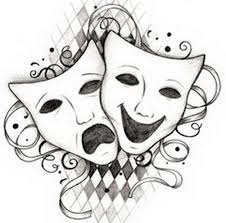
Drama is the specific mode of fiction represented in performance. The term comes from a Greek word meaning "action" (Classical Greek: δρᾶμα, drama), which is derived from "to do" (Classical Greek: δράω, drao). The two masks associated with drama represent the traditional generic division between comedy and tragedy. They are symbols of the ancient Greek Muses, Thalia and Melpomene. Thalia was the Muse of comedy (the laughing face), while Melpomene was the Muse of tragedy (the weeping face). Considered as a genre of poetry in general, the dramatic mode has been contrasted with the epic and the lyrical modes ever since Aristotle's Poetics (c. 335 BCE)—the earliest work of dramatic theory.In English (as was the analogous case in many other European languages), the word "play" or "game" (translating the Anglo-Saxon plèga or Latinludus) was the standard term used to describe drama until William Shakespeare's time—just as its creator was a "play-maker" rather than a "dramatist" and the building was a "play-house" rather than a "theatre." The use of "drama" in a more narrow sense to designate a specific type of play dates from the modern era. "Drama" in this sense refers to a play that is neither a comedy nor a tragedy—for example, Zola's Thérèse Raquin (1873) or Chekhov's Ivanov (1887). It is this narrower sense that the film and television industries, along with film studies, adopted to describe "drama" as a genre within their respective media. "Radio drama" has been used in both senses—originally transmitted in a live performance, it has also been used to describe the more high-brow and serious end of the dramatic output of radio.
🍙 Tragedy
Tragedy is a form of drama based on human suffering that invokes an accompanying catharsis or pleasure in audiences. While many cultures have developed forms that provoke this paradoxical response, the term tragedy often refers to a specific tradition of drama that has played a unique and important role historically in the self-definition of Western civilisation. That tradition has been multiple and discontinuous, yet the term has often been used to invoke a powerful effect of cultural identity and historical continuity—"the Greeks and the Elizabethans, in one cultural form; Hellenes and Christians, in a common activity," as Raymond Williams puts it.From its origins in the theatre of ancient Greece 2500 years ago, from which there survives only a fraction of the work of Aeschylus, Sophocles and Euripides.In the modern era, tragedy has also been defined against drama, melodrama, the tragicomic, and epic theatre.Drama, in the narrow sense, cuts across the traditional division between comedy and tragedy in an anti- or a-generic deterritorialisation from the mid-19th century onwards.
🍙 Comedy
In a modern sense, comedy refers to any discourse or work generally intended to be humorous or amusing by inducing laughter, especially in theatre, television, film, and stand-up comedy. The origins of the term are found in Ancient Greece. In the Athenian democracy, the public opinion of voters was influenced by the political satire performed by the comic poets at the theaters. The theatrical genre of Greek comedy can be described as a dramatic performance which pits two groups or societies against each other in an amusing agon or conflict. Northrop Frye depicted these two opposing sides as a "Society of Youth" and a "Society of the Old". A revised view characterizes the essential agon of comedy as a struggle between a relatively powerless youth and the societal conventions that pose obstacles to his hopes. In this struggle, the youth is understood to be constrained by his lack of social authority, and is left with little choice but to take recourse in ruses which engender very dramatic irony which provokes laughter.
👉 Greek Theater
Greek tragedies and comedies were always performed in outdoor theaters. Early Greek theaters were probably little more than open areas in city centers or next to hillsides where the audience, standing or sitting, could watch and listen to the chorus singing about the exploits of a god or hero. From the late 6th century BC to the 4th and 3rd centuries BC there was a gradual evolution towards more elaborate theater structures, but the basic layout of the Greek theater remained the same. The major components of Greek theater are labled on the diagram above.
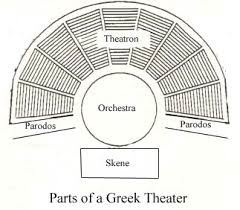
👉 Orchestra: The orchestra (literally, "dancing space") was normally circular. It was a level space where the chorus would dance, sing, and interact with the actors who were on the stage near the skene. The earliest orchestras were simply made of hard earth, but in the Classical period some orchestras began to be paved with marble and other materials. In the center of the orchestra there was often a thymele, or altar. The orchestra of the theater of Dionysus in Athens was about 60 feet in diameter.
👉 Theatron: The theatron (literally, "viewing-place") is where the spectators sat. The theatron was usually part of hillside overlooking the orchestra, and often wrapped around a large portion of the orchestra (see the diagram above). Spectators in the fifth century BC probably sat on cushions or boards, but by the fourth century the theatron of many Greek theaters had marble seats.
👉 Skene: The skene (literally, "tent") was the building directly behind the stage. During the 5th century, the stage of the theater of Dionysus in Athens was probably raised only two or three steps above the level of the orchestra, and was perhaps 25 feet wide and 10 feet deep. The skene was directly in back of the stage, and was usually decorated as a palace, temple, or other building, depending on the needs of the play. It had at least one set of doors, and actors could make entrances and exits through them. There was also access to the roof of the skene from behind, so that actors playing gods and other characters (such as the Watchman at the beginning of Aeschylus' Agamemnon) could appear on the roof, if needed.
👉 Parodos: The parodoi (literally, "passageways") are the paths by which the chorus and some actors (such as those representing messengers or people returning from abroad) made their entrances and exits. The audience also used them to enter and exit the theater before and after the performance.
👉 Altar: An altar was in the middle of the orchestra; in Athens the altar was dedicated to Dionysus.the greek theatre was a sacred space and the entire building was used to honour Dionysus god of wine, the vine and theatre. The theatre was only used once each year for the festival Dionysia. In the theatre of Athens there were sacrifices made to Dionysus at the alter. Sacrifices were very important to the ancient greeks as it gave them piece of mind that the gods would appreciate them.
👉 Chorus: The chorus could also function as a separate character rather than a narrator. In addition, the subject matter of the plays expanded so that rather than just Dionysus, they treated the whole body of Greek mythology.The chorus usually communicated in song form, but sometimes the message was spoken. It was the author's job to choreograph the chorus. The chorus offered background and summary information to help the audience follow the performance, commented on main themes, and showed how an ideal audience might react to the drama as it was presented. They also represent the general populace of any particular story. In the second generation of Athenian tragedy the chorus often had a more substantial role in the narrative; in Euripedes' Bacchae, for example, the chorus, representing the frenzied female worshippers of Dionysus becomes a central character in itself.
限會員,要發表迴響,請先登入


