week 7
A. Quiz
1
According to legend, in what sense was Homer deficient?
A. Touch
B. Taste
C. Hearing
D. Sight
2
What is the Greek term for hospitality?
A. Warrior Princess
B. Xenia
C. Dactlyic
D. Nostos
3
What immortal is Odysseus' greatest ally?
A. Zeus
B. Athena
C. Poseidon
D. Hermes
4
What immortal is Odysseus' greatest nemesis?
A. Poseidon
B. Zeus
C. Athena
D. Hermes
5
Which immortal rules over the other gods?
A. Poseidon
B. Zeus
C. Athena
D. Hermes
6
What name does Odysseus first give to Polyphemus?
A. He does not give him a name
B. No one
C. Nothing
D. Nobody
7
Which immortal imprisons Odysseus on her island for eight years?
A. Penelope
B. Circe
C. Athena
D. Calypso
8
How did Penelope try to trick the suitors at first by weaving a shroud?
A. She worked on it very slowly
B. She took on other projects as well
C. She did a shoddy job of weaving
D. She unwound the shroud each night
9
What animals are Odysseus' men turned into by Circe?
A. Snakes
B. Rabbits
C. Pigs
D. Horses
10
Which younger character most likely has a crush on Odysseus?
A. Nausicaa
B. Telemachus' girlfriend
C. Melantho
D. Athena
11
Which male servant is the least faithful to Odysseus?
A. Philoitios
B. Eumaeus
C. Melanthius
D. Mentor
12
Which female servant is the least faithful to Odysseus?
A. Nausicaa
B. Eurykleia
C. Melantho
D. Pilates
13
Which suitor dies first?
A. Antinous
B. Amphinomos
C. Agelaos
D. Eurymakhos
14
Which suitor is the most rational?
A. Amphinomos
B. Agelaos
C. Antinoos
D. Eurymakhos
15
Which suitor is the most hotheaded?
A. Eurymakhos
B. Amphinomos
C. Antinous
D. Agelaos
16
How does Eurykleia identify Odysseus?
A. By his eyes
B. By his scar
C. By his hair
D. By his teeth
17
How does Odysseus prove his identity to Penelope?
A. By a private joke
B. By his knowledge of their bed
C. By his knowledge of her birthmark
D. By his knowledge of her ancestry
18
What does Odysseus disguise himself as in the palace?
A. A bard
B. A salesman
C. A beggar
D. A king
19
What is Odysseus frequently compared to in omens and dreams?
A. A shark
B. A bird of prey
C. A lion
D. A rabbit
20
Who is Odysseus' father?
A. Agamemnon
B. Achilles
C. Telemachus
D. Laertes
21
What is the descriptive tag frequently attached to a character's name called (i.e., "gray-eyed Athena")?
A. Homeric slang
B. Homeric identification
C. Homeric epithet
D. Homeric curse
22
What is the comparative description frequently attached to a natural phenomenon (i.e., "the wine-dark sea") called?
A. Homeric comparison
B. Homeric simile
C. Homeric definition
D. Homeric metaphor
23
How many "acts," or distinct, major, and equal sections of narrative, is The Odyssey broken into?
A. Three
B. Two
C. One
D. Four
24
How did Homer originally convey the poem to others?
A. Through lectures
B. Through song
C. Through publication
D. Through spoken word
25
What rhythm and meter was The Odyssey originally composed in?
A. Blank verse
B. Dactylic hexameter
C. Iambic pentameter
D. Anapestic tetrameter
B. Virgil
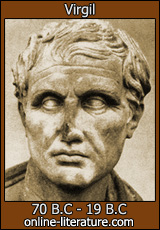
Virgil (70 B.C-19 B.C), regarded as the greatest Roman poet, known for his epic, the Aeneid (written about 29 B.C.E), which had taken its literary model from Homer's epic poems Iliad and Odyssey.
C. The Aeneid
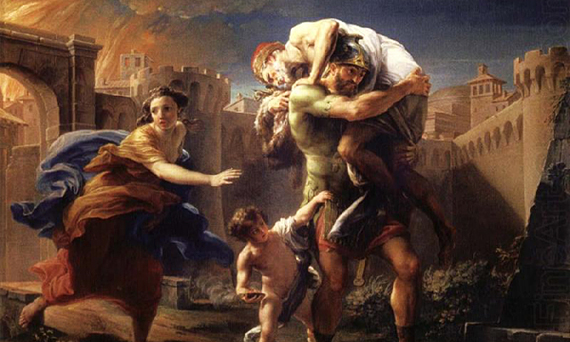
The Aeneid is a Latin epic poem, written by Virgil between 29 and 19 BC, that tells the legendary story of Aeneas, a Trojan who travelled to Italy, where he became the ancestor of the Romans. It comprises 9,896 lines in dactylic hexameter. The first six of the poem's twelve books tell the story of Aeneas's wanderings from Troy to Italy, and the poem's second half tells of the Trojans' ultimately victorious war upon the Latins, under whose name Aeneas and his Trojan followers are destined to be subsumed.
The hero Aeneas was already known to Greco-Roman legend and myth, having been a character in the Iliad. Virgil took the disconnected tales of Aeneas's wanderings, his vague association with the foundation of Rome and a personage of no fixed characteristics other than a scrupulous pietas, and fashioned this into a compelling founding myth or national epic that at once tied Rome to the legends of Troy, explained the Punic Wars, glorified traditional Roman virtues, and legitimized the Julio-Claudian dynasty as descendants of the founders, heroes, and gods of Rome and Troy.

限會員,要發表迴響,請先登入


