Maintenance skills of magnetic particle clutch
2026/04/07 17:11
瀏覽94
迴響0
推薦0
引用0
1.Basic knowing about the magnetic particle clutch
A magnetic particle clutch (MPC) is a non-contact torque transmission device consisting of an electromagnetic coil, ferromagnetic particles, and two rotating components. When an electric current is applied to the coil, it generates a magnetic field that aligns the ferromagnetic particles into a dense, rigid matrix, connecting the input and output shafts to transmit torque. The magnitude of torque is directly proportional to the strength of the magnetic field, which is controlled by adjusting the input current—enabling stepless, precise torque modulation. When the current is removed, the magnetic field dissipates, the particles disengage, and the shafts operate independently with minimal drag.
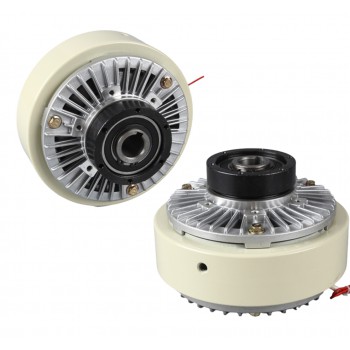
2.Working steps of magnetic particle clutch
1.Initial State: When no electric current is applied to the electromagnetic coil, the ferromagnetic particles are freely suspended in the working gap between the input rotor and output stator.
2.Magnetic Field Generation: When an electric current is supplied to the electromagnetic coil, the coil generates a uniform magnetic field that permeates the working gap and the ferromagnetic particles.
3.Particle Alignment and Torque Transmission: Under the influence of the magnetic field, the ferromagnetic particles align along the magnetic field lines, forming dense, rigid "magnetic chains" that bridge the gap between the input rotor and output stator.
4.Disengagement and Reset: When the input current is turned off, the magnetic field dissipates immediately. The magnetic chains break apart, and the ferromagnetic particles return to their freely suspended state in the working gap. The input and output shafts decouple, and the output shaft stops while the input shaft maintains its rotation.
3.Structual advantages of magnetic particle clutch
1.Non-Contact Operation and Minimal Wear: Unlike friction clutches that rely on physical contact between friction plates, MPCs have no contact between moving parts. The torque is transmitted through magnetic particle chains, eliminating mechanical wear, friction-induced heat, and debris generation.
2.Stepless, Precise Torque Control: The torque transmitted by an MPC is directly proportional to the input current, enabling stepless adjustment across the entire torque range with high accuracy. This precision makes MPCs indispensable for applications requiring tight tension control,where even small torque variations can cause material damage or product defects.
3.Fast Response Speed and Smooth Operation: MPCs have a rapid response time, significantly faster than hydraulic clutches and most friction clutches. The non-contact design also ensures smooth, jerk-free engagement and disengagement, eliminating shock loads that can damage machinery or materials.
4.Compact Structure and Easy Integration: MPCs have a simple, compact design—consisting of only a coil, particles, and two rotating components—making them smaller and lighter than hydraulic or mechanical clutches of the same torque rating. Their modular design allows for easy integration into existing systems, with minimal modifications to the drive train.
5.Overload Protection and Torque Independence from Speed: MPCs inherently provide overload protection: if the output torque exceeds the clutch’s rated capacity, the magnetic particle chains slip, preventing damage to the motor, clutch, or connected equipment.
6.Low Power Consumption and Silent Operation: MPCs require minimal power to generate the magnetic field, making them more energy-efficient than hydraulic clutches, which require power-hungry pumps and fluid systems. The non-contact operation also results in silent operation, making MPCs suitable for noise-sensitive environments.
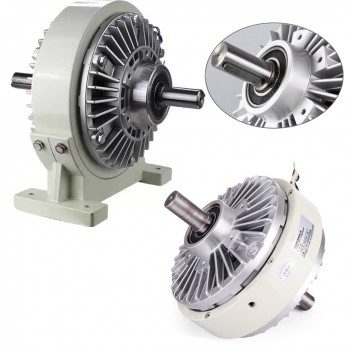
4.Maintenance skills of magnetic particle clutch
1.Daily Visual Inspection:Look for signs of magnetic powder leakage around shaft seals and end cover joints. Even a small amount of escaping powder indicates a compromised seal.Check for oil or moisture on the housing. Contamination can enter through worn seals and degrade the powder.Inspect cooling fins or water hoses for blockages or damage.
2.Torque‑Current Curve Test:Record the output torque at several excitation current levels.Compare the curve to the original factory curve. A drop of more than 15% in torque at rated current, or a nonlinear response, indicates powder degradation.
3.Visual Sampling:If the clutch design allows, remove a small inspection plug or open the end cover and extract a sample of powder using a clean tool.Healthy powder looks like fine, dry, metallic dust with a uniform dark gray color. Degraded powder appears brown, clumpy, or contains shiny wear debris.
4.Lubrication Interval:Add grease every 2000 operating hours, or every six months if the clutch runs continuously.For high‑speed or high‑temperature applications (surface temperature >50 °C), shorten the interval to 1000 hours.
5.Initial Alignment Check:After installation, use a dial indicator on the coupling hub. Rotate the shaft and measure radial runout. Permissible misalignment is usually ≤0.1 mm (0.004 in) total indicator reading.For flexible couplings, also check angular alignment using a feeler gauge between coupling faces.
6.Coil Resistance Measurement:Disconnect the coil wires from the controller.Measure resistance between the two coil leads using a multimeter. Compare to the specification. An open circuit means a broken coil wire; a short indicates insulation failure.Measure resistance from each lead to the clutch housing.
7.Monitoring Surface Temperature:Attach a thermocouple or infrared thermometer to the clutch housing at a location away from cooling fins or water jackets.For air‑cooled clutches, keep surface temperature below 60 °C (140 °F). For water‑cooled clutches, keep it below 90 °C (194 °F).
自訂分類:不分類
上一則: Design challenges of manual linear stage下一則: How a Pancake Stepper Motor Works and its Applications
你可能會有興趣的文章:
- How a Pancake Stepper Motor Works and its Applications
- 7 Key Points to Consider When Choosing a Servo Motor
- What are the precautions for using linear guide rail?
- What are the installation precautions for helical planetary gearboxes?
- Working principle and design requirements of worm gear reducer gearbox
- Energy-saving measures and maintenance methods for hollow shaft stepper motors
限會員,要發表迴響,請先登入


