Composition of Variable-frequency Drive
2024/07/15 16:40
瀏覽177
迴響0
推薦0
引用0
1. Definition
(VFD) is a power control device that uses frequency conversion technology and microelectronics technology to control AC motors by changing the frequency of the motor's working power supply. The inverter is mainly composed of rectification (AC to DC), filtering, inversion (DC to AC), braking unit, drive unit, detection unit, microprocessor unit, etc. The inverter adjusts the voltage and frequency of the output power supply by the internal IGBT's disconnection, and provides the required power supply voltage according to the actual needs of the motor, thereby achieving the purpose of energy saving and speed regulation. In addition, the inverter has many protection functions, such as overcurrent, overvoltage, overload protection, etc. With the continuous improvement of the degree of industrial automation, inverters have also been widely used.
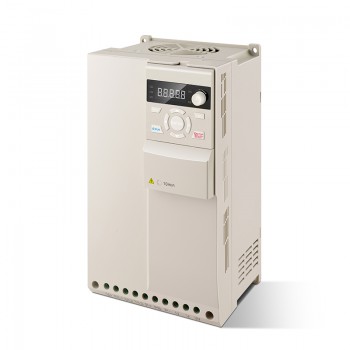
2. Composition of Variable-frequency Drive
Main circuit
The main circuit is the power conversion part that provides voltage and frequency modulation power supply to asynchronous motors. The main circuit of the inverter can be roughly divided into two categories: the voltage type is a inverter that converts the DC of the voltage source into AC, and the filter of the DC circuit is a capacitor. The current type is a frequency converter that converts the DC of the current source into AC, and its DC circuit filter is an inductor. It consists of three parts: a "rectifier" that converts the industrial frequency power supply into DC power, a "smoothing circuit" that absorbs the voltage pulsation generated by the converter and inverter, and an "inverter" that converts DC power into AC power.
Rectifier
Diode converters are widely used, which convert industrial frequency power supply into DC power supply. Two sets of transistor converters can also be used to form a reversible converter. Since its power direction is reversible, it can be regenerated.
Smoothing circuit
The DC voltage rectified by the rectifier contains a pulsating voltage with a frequency of 6 times that of the power supply. In addition, the pulsating current generated by the inverter also causes the DC voltage to fluctuate. In order to suppress voltage fluctuations, inductors and capacitors are used to absorb pulsating voltage (current). When the device capacity is small, if there is a margin in the power supply and main circuit components, the inductor can be omitted and a simple smoothing circuit can be used.
Inverter
In contrast to the rectifier, the inverter converts DC power into AC power of the required frequency. By turning on and off the six switching devices at a determined time, a three-phase AC output can be obtained. The switching time and voltage waveform are shown using a voltage-type PWM inverter as an example.
The control circuit is a loop that provides control signals to the main circuit that supplies power to the asynchronous motor (voltage and frequency are adjustable). It consists of a frequency and voltage "operation circuit", a main circuit "voltage and current detection circuit", a motor "speed detection circuit", a "drive circuit" that amplifies the control signal of the operation circuit, and a "protection circuit" for the inverter and the motor.
自訂分類:不分類
上一則: Methods for judging and maintaining stepper motor encoder faults下一則: How to realize the motor-driven slider movement on the linear slide
你可能會有興趣的文章:
- How a Pancake Stepper Motor Works and its Applications
- How to maintain an integrated stepper motor?
- Working principle and design requirements of worm gear reducer gearbox
- Main advantages and selection criteria of servo motors
- Characteristics and application fields of DC gear motors
- Some important information about stepper motor encoders
限會員,要發表迴響,請先登入


