1.
What is poetry?
Poetry is a form of literature that uses aesthetic and rhythmic qualities of language—such as phonaesthetics, sound symbolism, and metre—to evoke meanings in addition to, or in place of, the prosaic ostensible meaning. Poetry uses forms and conventions to suggest differential interpretation to words, or to evoke emotive responses. Devices such as assonance, alliteration, onomatopoeia and rhythm are sometimes used to achieve musical or incantatory effects. The use of ambiguity, symbolism, irony and other stylistic elements of poetic diction often leaves a poem open to multiple interpretations. Similarly figures of speech such as metaphor, simile and metonymy create a resonance between otherwise disparate images—a layering of meanings, forming connections previously not perceived. Kindred forms of resonance may exist, between individual verses, in their patterns of rhyme or rhythm.
2. Term Explanation
(1)sonnet- The term sonnet is derived from the Italian word sonetto. By the thirteenth century it signified a poem of fourteen lines that follows a strict rhyme scheme and specific structure. Conventions associated with the sonnet have evolved over its history. Writers of sonnets are sometimes called "sonneteers", although the term can be used derisively.
(2)dactyl- is a foot in poetic meter. In quantitative verse, often used in Greek or Latin, a dactyl is a long syllable followed by two short syllables, as determined by syllable weight. In accentual verse, often used in English, it is a stressed syllable followed by two unstressed syllables—the opposite is the anapaest (two unstressed followed by a stressed syllable).
(3)diction- in its original, primary meaning, refers to the writer's or the speaker's distinctive vocabulary choices and style of expression in a poem or story. A secondary, common meaning of "diction" means the distinctiveness of speech, the art of speaking so that each word is clearly heard and understood to its fullest complexity and extremity, and concerns pronunciation and tone, rather than word choice and style. This secondary sense is more precisely and commonly expressed with the term enunciation, or with its synonym articulation.
(4)poetic metre- In poetry, metre (meter in US spelling) is the basic rhythmic structure of a verse or lines in verse. Many traditional verse forms prescribe a specific verse metre, or a certain set of metres alternating in a particular order. The study and the actual use of metres and forms of versification are both known as prosody.
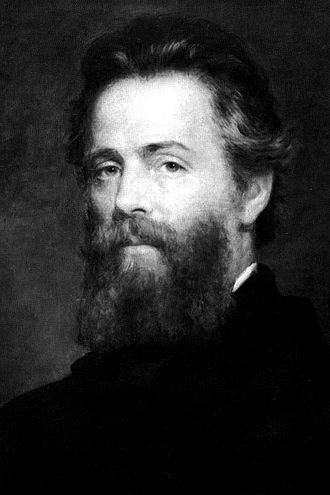
(5)Herman Melville- was an American novelist, short story writer, and poet of the American Renaissance period best known for Typee (1846), a romantic account of his experiences in Polynesian life, and his whaling novel Moby-Dick(1851). His writing draws on his experience at sea as a common sailor, exploration of literature and philosophy, and engagement in the contradictions of American society in a period of rapid change. He developed a complex, baroque style: the vocabulary is rich and original, a strong sense of rhythm infuses the elaborate sentences, the imagery is often mystical or ironic, and the abundance of allusion extends to Scripture, myth, philosophy, literature, and the visual arts.
(6)Free Verse- is an open form of poetry. It does not use consistent meter patterns, rhyme, or any other musical pattern. It thus tends to follow the rhythm of natural speech.
(7)proscription- is, in current usage, a "decree of condemnation to death or banishment" (OED) and can be used in a political context to refer to state-approved murder or banishment.
3.
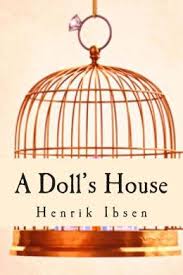
A Doll's House- is a three-act play in prose by Henrik Ibsen. It premiered at the Royal Theatre in Copenhagen, Denmark, on 21 December 1879, having been published earlier that month. The play is significant for its critical attitude toward 19th-century marriage norms. It aroused great controversy at the time, as it concludes with the protagonist, Nora, leaving her husband and children because she wants to discover herself. Ibsen was inspired by the belief that "a woman cannot be herself in modern society," since it is "an exclusively male society, with laws made by men and with prosecutors and judges who assess feminine conduct from a masculine standpoint."
4. Vocabulary
(1)dic, dict- to say, to tell, word
contradict - to express the opposite of.
prediction - a statement foretelling the future.
dictate - to speak out loud for another person to write down.
(2)discipline-training expected to produce a specific character or pattern of behavior,
especially training that produces moral or mental improvement.