1.
Homeric Simile- also called an epic simile is a detailed comparison in the form of a simile that is many lines in length. The word "Homeric" is based on the Greek author, Homer, who composed the two famous Greek epics, the Iliad and the Odyssey. Many authors continue to use this type of simile in their writings. The typical Homeric simile makes a comparison to some kind of event, in the form "like a ____ when it ______." The object of the comparison is usually something strange or unfamiliar to something ordinary and familiar.
simile-a figure of speech in which two essentially unlike things are compared, often in a phrase introduced by like or as, as in "How like thewinter hath my absence been" or "So are you to my thoughts as food to life" (Shakespeare).
the wine-dark sea: the expression appears dozens of times in those epics, the Iliad and the Odyssey. Yet the sea in question, the Aegean, is no less blue or blue-green than any other.
2.
Dactylic hexameter - is a form of meter or rhythmic scheme in poetry. It is traditionally associated with the quantitative meter of classical epic poetry in both Greek and Latin and was consequently considered to be the Grand Style of classical poetry. The premier examples of its use are Homer's Iliad and Odyssey and Virgil's Aeneid.
the dactylic line: — U | — U | — U | — U | — u u | — X
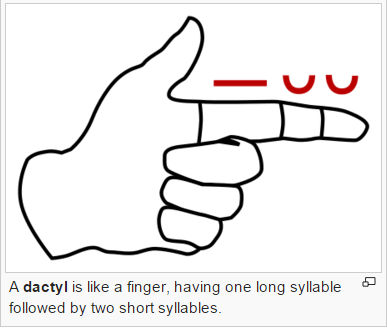
dactyl - is a foot in poetic meter. In quantitative verse, often used in Greek or Latin, a dactyl is a long syllable followed by two short syllables, as determined by syllable weight. In accentual verse, often used in English, it is a stressed syllable followed by two unstressed syllables—the opposite is the anapaest (two unstressed followed by a stressed syllable).
3.
Xerox copy- is a dry photocopying technique. Its fundamental principle was invented by Hungarian physicist Pál Selényi and based on Selényi's publications Chester Carlson applied for. The technique was originally called electrophotography. It was later renamed xerography—from the Greek roots ξηρόςxeros, "dry" and -γραφία -graphia, "writing"—to emphasize that, unlike reproduction techniques then in use such as cyanotype, this process used no liquid chemicals. (影本)
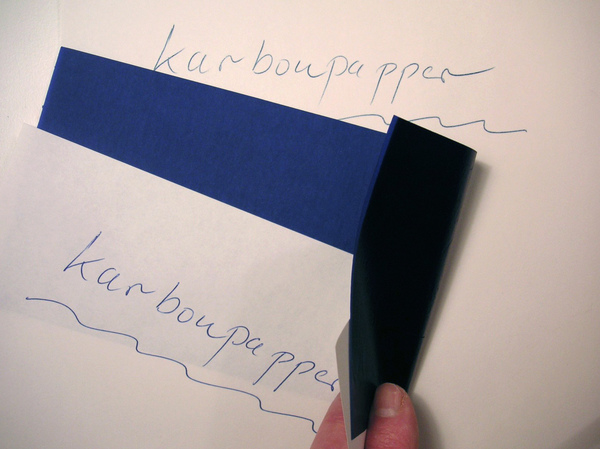
carbon copy- is the under-copy of a document created when carbon paper is placed between the original and the under-copy during the production of a document. With the advent of email, the abbreviation cc or bcc (blind carbon copy) has also come to refer to simultaneously sending copies of an electronic message to secondary recipients.(副本)
4. vocabulary
rational- consistent with or based on reason or good judgment; logical or sensible.
ally- one in helpful association with another.
allies-the nations allied against the Central Powers of Europe during World War I.
They were Russia, France, Great Britain, andlater many others, including
the United States.
-the nations, primarily Great Britain, France, the Soviet Union, and the United States,
allied against the Axis during World War II.
5.
mourning- the actions or expressions of one who has suffered a bereavement.
lament- a feeling or expression of grief or a song or poem expressing deep grief or mourning.
elegy- a poem or song composed especially as a lament for a deceased person.
6.