*metamorphosis (n.)
1. (in an insect or amphibian) the process of transformation from an immature form to an adult form in two or more distinct stages
Ex: the persistence of the larval tail during metamorphosis
Ex: in insects with a complete metamorphosis the wings arise from thickenings of the epidermis
Origin :
Late Middle English: via Latin from Greek metamorphōsis, from metamorphoun transform, change shape.

* disciple (n.)
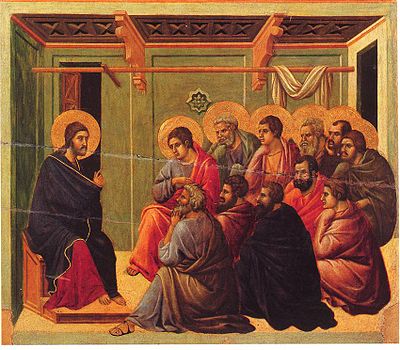
1.A personal follower of Christ during his life, especially one of the twelve Apostles.
Origin :
Old English, from Latin discipulus learner, from discere learn;reinforced by Old French deciple.
* salvation (n.)
1. Preservation or deliverance from harm, ruin, or loss
Ex:they try to sell it to us as economic salvation
2. Theology
Deliverance from sin and its consequences, believed by Christians to be brought about by faith in Christ:
Ex: the Christian gospel of salvationfor all mankind.

Origin :
Middle English: from Old French salvacion, from ecclesiastical Latin salvation- (from salvare to save), translating Greek sōtēria.
* bona fide (adj.)
1. Genuine; real
Ex: she was a bona fide expert
Origin :
Latin, literally with good faith, ablative singular of bona fides.
* ponder (v.)
1. Think about (something) carefully, especially before making a decision or reaching a conclusion:
Ex: I pondered the question of what clothes to wear for the occasion
Ex: she sat pondering over her problem
Origin :
Middle English (in the sense ‘appraise, judge the worth of’): from Old French ponderer consider, from Latin ponderare weigh, reflect on, from pondus, ponder- weight.

megalomania (n.)
"delusions of greatness," 1866, from French mégalomanie; see megalo- + mania "madness."
profligate (adj.)
1520s, "overthrown, routed" (now obsolete in this sense), from Latin profligatus "destroyed, ruined, corrupt, abandoned, dissolute," past participle of profligare "to cast down, defeat, ruin," from pro "down, forth" (see pro-) + fligere "to strike" (see afflict). Main modern meaning "recklessly extravagant" is 1779, via notion of "ruined by vice" (1640s, implied in a use of profligation). Related: Profligately. As a noun from 1709.
strife (n.)
c. 1200, "quarrel, fight, discord," from Old French estrif "fight, battle, combat, conflict; torment, distress; dispute, quarrel," variant of estrit "quarrel, dispute, impetuosity," probably from Frankish *strid "strife, combat" or another Germanic source (compare Old High German strit "quarrel, dispute"), related to Old High German stritan "to fight;" see stride (v.).
legion (n.)
c. 1200, "a Roman legion," from Old French legion "squad, band, company, Roman legion" from Latin legionem (nominative legio) "Roman legion, body of soldiers, a levy of troops," from legere "to gather; to choose, pick out, select" (also "to read;" see lecture (n.)). Tucker writes that "The common sense is 'pick,'" but it is unclear whether the use here is "picking up or picking out." Roughly 3,000 to 6,000 men, under Marius usually with attached cavalry. "The legions were numbered in the order of their levy, but were often known by particular names" [Lewis].
coup (n.)
c. 1400, "a blow," from Old French coup, colp "a blow, strike" (12c.), from Medieval Latin colpus, from Vulgar Latin colapus, from Latin colaphus "a cuff, box on the ear," from Greek kolaphos "a blow, buffet, punch, slap," "a lowly word without clear etymology" [Beekes]. Meaning "a sudden decisive act" is 1852, short for coup d'etat. In Modern French the word is a workhorse, describing everything from a pat on the back to a whipping, and is used as well of thunder, gusts of wind, gunshots, and chess moves.
amnesty (n.)
1570s, "a ruling authority's pardon of past offenses," from French amnistie "intentional overlooking" (16c.), from Latin amnestia, from Greek amnestia "forgetfulness (especially of wrong); an amnesty," from amnestos "forgotten; forgetful," from a- "not" (see a- (3)) + mnestis "remembrance," which is related to mnaomai "I remember" (see mind (n.)).
expatriate (v.)
1768, modeled on French expatrier "banish" (14c.), from ex- "out of" (see ex-) + patrie "native land," from Latin patria "one's native country," from pater (genitive patris) "father" (see father (n.); also compare patriot). Related: Expatriated; expatriating. The noun is by 1818, "one who has been banished;" main modern sense of "one who chooses to live abroad" is by 1902.
exonerate (v.)
mid-15c., from Latin exoneratus, past participle of exonerare "remove a burden, discharge, unload," from ex "out, out of, off" (see ex-) + onerare "to unload; overload, oppress," from onus (genitive oneris) "burden" (see onus). Related: Exonerated; exonerating.
fiat (n.)
1630s, "authoritative sanction," from Latin fiat "let it be done" (used in the opening of Medieval Latin proclamations and commands), third person singular present subjunctive of fieri "be done, become, come into existence," used as passive of facere "to make, do" (see factitious). Meaning "a decree, command, order" is from 1750. In English the word also sometimes is a reference to fiat lux "let there be light" in Genesis i.3.
mendacious (adj.)
1610s, from Middle French mendacieux, from Latin mendacium "a lie, untruth, falsehood, fiction," from mendax (genitive mendacis) "lying, deceitful," from menda "fault, defect, carelessness in writing," from PIE root *mend- "physical defect, fault" (see amend (v.)). The sense evolution of Latin mendax was influenced by mentiri "to speak falsely, lie, deceive." Related: Mendaciously; mendaciousness.
parsimonious (adj.)
1590s, from Latin parsimonia "frugality, thrift" (see parsimony) + -ous. Not originally with the suggestion of stinginess. Related: Parsimoniously; parsimoniousness.
pecuniary (adj.)
c. 1500, from Latin pecuniarius "pertaining to money," from pecunia "money, property, wealth," from pecu "cattle, flock," from PIE root *peku- "wealth, movable property, livestock" (source of Sanskrit pasu- "cattle," Gothic faihu "money, fortune," Old English feoh "cattle, money").
dismantle (v.)
1570s, from Middle French desmanteler "to tear down the walls of a fortress," literally "strip of a cloak," from des- "off, away" (see dis-) + manteler "to cloak" (see mantle). Related: Dismantled; dismantling.
sumptuous (adj.)
late 15c., from Old French sumptueux or directly from Latin sumptuosus "costly, very expensive; lavish, wasteful," from sumptus, past participle of sumere "to borrow, buy, spend, eat, drink, consume, employ, take, take up," contraction of *sub-emere, from sub "under" (see sub-) + emere "to take, buy" (see exempt (adj.)). Related: Sumptuously; sumptuousness.
underwrite (v.)
Old English underwritan "write at the foot of; subscribe;" see under + write (v.). A loan-translation of Latin subscribere (see subscribe). Used literally at first; modern sense of "to accept the risk of insurance" (1620s) is from notion of signing a marine insurance policy. Meaning "to support by a guarantee of money" is recorded from 1890.
restrictive (adj.)
early 15c., "serving to bind or draw together," from Middle French restrictif, from Late Latin restrictivus, from Latin restrict-, past participle stem of restringere (see restriction). Meaning "imposing restriction" is from 1570s. Related: Restrictively; restrictiveness.
balk (v.)
late 14c., "to leave an unplowed ridge when plowing," from balk (n.). Extended meaning "to omit, intentionally neglect" is mid-15c. Most modern senses are figurative, from the notion of a balk in the fields as a hindrance or obstruction: sense of "stop short" (as a horse confronted with an obstacle) is late 15c.; that of "to refuse" is 1580s. Related: Balked; balking.
blunt (n.)
street slang for "marijuana and tobacco cigar" (easier to pass around, easier to disguise, and the stimulant in the tobacco enhances the high from the pot) surfaced c. 1993, but is said to have originated among Jamaicans in New York City in the early 1980s; from Phillies Blunt brand cigars; see blunt (adj.), which has been used of certain cigars since 19c.
nostalgia (n.)
1770, "severe homesickness considered as a disease," Modern Latin, coined 1668 in a dissertation on the topic at the University of Basel by scholar Johannes Hofer (1669-1752) as a rendering of German heimweh "homesickness" (for which see home + woe). From Greek algos "pain, grief, distress" (see -algia) + nostos "homecoming," from neomai "to reach some place, escape, return, get home," from PIE *nes- "to return safely home" (cognate with Old Norse nest "food for a journey," Sanskrit nasate "approaches, joins," German genesen "to recover," Gothic ganisan "to heal," Old English genesen "to recover"). French nostalgie is in French army medical manuals by 1754.
rife (adj.)
Old English rife "abundant, common, prevalent," from Proto-Germanic *rif- (source also of Old Norse rifr, Swedish river, Norwegian riv, Middle Dutch riif, Middle Low German rive "abundant, generous"), said to be from PIE root *rei- "to scratch, tear, cut" "The prevalence of the word in early southern texts is in favour of its being native in English, rather than an adoption from Scandinavian." [OED]
rife (adj.)
Old English rife "abundant, common, prevalent," from Proto-Germanic *rif- (source also of Old Norse rifr, Swedish river, Norwegian riv, Middle Dutch riif, Middle Low German rive "abundant, generous"), said to be from PIE root *rei- "to scratch, tear, cut" "The prevalence of the word in early southern texts is in favour of its being native in English, rather than an adoption from Scandinavian."
derogatory (adj.)
c. 1500, from Late Latin derogatorius, from Latin derogatus, past participle of derogare "to take away, detract from, diminish," also "repeal partly, restrict, modify," from de- "away" (see de-) + rogare "ask, question; propose" (see rogation).
indict (v.)
formerly also endict, c. 1300, enditen, inditen, "bring formal charges against (someone); accuse of a crime," from Anglo-French enditer "accuse, indict, find chargeable with a criminal offense" (late 13c.), Old French enditier, enditer "to dictate, write, compose; (legally) indict," from Vulgar Latin *indictare "to declare, accuse, proclaim in writing," from in- "in" (see in- (2)) + Latin dictare "to say, compose in words" (see dictate (v.)).
nebulous (adj.)
late 14c., "cloudy, misty," from Latin nebulosus "cloudy, misty, foggy, full of vapor," from nebula (see nebula). The figurative sense of "hazy, vague, formless" is first attested 1831. Astronomical sense is from 1670s. Related: Nebulously; nebulousness.
pesky (adj.)
1775, originally in New England dialect, perhaps a dialectal formation from pest (compare plaguy "confounded, annoying, disagreeable"). Partridge suggests an origin in Essex dialect.
redolent (adj.)
c. 1400, from Old French redolent "emitting an odor" and directly from Latin redolentem (moninative redolens), present participle of redolere "emit a scent, diffuse odor," from red-, intensive prefix (see re-), + olere "give off a smell" (see odor).
repose (n.)
"rest," c. 1500, from Middle French repos (11c.), back-formation from reposer (see repose (v.1)).
omnivorous (adj.)
1650s, from Latin omnivorus "all-devouring," from omnis "all" (see omni-) + vorare "devour, swallow" (see voracity). Related: Omnivorously; omnivorousness.
disparate (adj.)
c. 1600, "unlike in kind," from Latin disparatus, past participle of disparare "divide, separate," from dis- "apart" (see dis-) + parare "get ready, prepare" (see pare); meaning influenced by Latin dispar "unequal, unlike." Related: Disparately; disparateness.
abstemious (adj.)
"sparing or moderate in eating or drinking," c. 1600, from Latin abstemius "sober, temperate, abstaining from wine," from assimilated form of ab "off, away from" (see ab-) + stem of temetum "strong drink," which is related to temulentus "drunken." Etymologically it refers only to abstaining from alcoholic drink, but it was extended in Latin to temperance in living generally. Related: Abstemiously; abstemiousness.
extant (adj.)
1540s, "standing out above a surface," from Latin extantem (nominative extans), present participle of extare "stand out, be visible, exist," from ex "out" (see ex-) + stare "to stand," from PIE root *stā- "to stand" (see stet). Sense of "in existence" attested in English by 1560s. Related: Extance; extancy, both 17c., both obsolete.
vicissitude (n.)
"a passing from one state to another," whether regular or not, 1560s, from Middle French vicissitude (14c.), from Latin vicissitudinem (nominative vicissitudo) "change, interchange, alternation," from vicissim (adv.) "changeably, on the other hand, by turns, in turn," from vicis "a turn, change" (see vicarious). Related: Vicissitudes.
edifice (n.)
late 14c., from Old French edifice "building" (12c.), from Latin aedificium "building," from aedificare "to erect a building," from aedis, variant of aedes "temple, sanctuary," usually a single edifice without partitions, also, in the plural, "dwelling house, building," originally "a place with a hearth" + the root of facere "to make" (see factitious).
sultry (adj.)
1590s, "oppressively hot, close and moist" (of weather), ultimately from swelter + alteration of -y (2), either as a contraction of sweltry or from obsolete verb sulter "to swelter" (1580s), alteration of swelter. Figurative sense of "hot with lust" is attested from 1704; of women, "lascivious, sensual, arousing desire" it is recorded from 1940. Related: Sultriness.
puissant (adj.)
mid-15c., from Middle French puissant "strong, mighty, powerful," earlier poissant (12c.), from stem of Old French poeir "to be able" (see power (n.)). Related: Puissantly.
unabated (adj.)
1610s, from un- (1) "not" + past participle of abate (v.).
maudlin (adj.)
c. 1600, "tearful," from Middle English fem. proper name Maudelen (early 14c.), from Magdalene (Old French Madelaine), woman's name, originally surname of Mary the repentant sinner forgiven by Jesus in Luke vii.37 (see Magdalene). In paintings, she often was shown weeping as a sign of repentance. Meaning "characterized by tearful sentimentality" is recorded by 1630s.
levity (n.)
1560s, "want of seriousness, frivolity," from French levite, from Latin levitatem (nominative levitas) "lightness," literal and figurative; "light-mindedness, frivolity," from levis "light" in weight, from PIE root *legwh- "lightness" (see lever). In old science (16c.-17c.), the name of a force or property of physical bodies, the opposite of gravity, causing them to tend to rise.
lugubrious (adj.)
c. 1600, formerly also lugubrous, from -ous + Latin lugubris "mournful, doleful, pertaining to mourning," from lugere "to mourn," from PIE root *leug- "to break; to cause pain" (source also of Greek lygros "mournful, sad," Sanskrit rujati "breaks, torments," Lettish lauzit "to break the heart"). Related: Lugubriously; lugubriousness.
scion (n.)
c. 1300, "a shoot or twig," especially one for grafting, from Old French sion, cion "descendant; shoot, twig; offspring" (12c., Modern French scion, Picard chion), of uncertain origin. OED rejects derivation from Old French scier "to saw." Perhaps a diminutive from Frankish *kid-, from Proto-Germanic *kidon-, from PIE *geie- "to sprout, split, open" (see chink (n.1)). Figurative use is attested from 1580s in English; meaning "an heir, a descendant" is from 1814, from the "family tree" image.
indoctrinate (v.)
formerly also endoctrinate, 1620s, "to teach," formed as if from Latin (but there seems to have been no word *indoctrinare), perhaps modeled on French endoctriner or extended from earlier (now obsolete) verb indoctrine, endoctrine, "to instruct" (mid-15c.); see in- (2) "in" + doctrine + -ate (2)). Meaning "to imbue with an idea or opinion" first recorded 1832. Related: Indoctrinated; indoctrinating.
opulence (n.)
c. 1510, from Middle French opulence (16c.), from Latin opulentia, from opulentus "wealthy," dissimilated from *op-en-ent-, related to ops "wealth, power, resources," opus "work, labor, exertion," from PIE root *op- (1) "to work, produce in abundance" (see opus).
obsequious (adj.)
late 15c., "prompt to serve," from Middle French obséquieux (15c.), from Latin obsequiosus "compliant, obedient," from obsequium "compliance, dutiful service," from obsequi "to accommodate oneself to the will of another," from ob "after" (see ob-) + sequi "to follow" (see sequel). Pejorative sense of "fawning, sycophantic" had emerged by 1590s. Related: Obsequiously; obsequiousness (mid-15c.).
fulsome (adj.)
mid-13c., "abundant, plentiful," Middle English compound of ful "full" (see full (adj.)) + -som "to a considerable degree" (see -some (1)). Perhaps a case of ironic understatement. Sense extended to "plump, well-fed" (mid-14c.), then "arousing disgust" (similar to the feeling of having over-eaten), late 14c. Via the sense of "causing nausea" it came to be used of language, "offensive to taste or good manners" (early 15c.); especially "excessively flattering" (1660s). Since the 1960s, however, it commonly has been used in its original, favorable sense, especially in fulsome praise. Related: Fulsomely; fulsomeness.
lush (n.)
"drunkard," 1890, from earlier slang meaning "liquor" (1790, especially in phrase lush ken "alehouse"), of obscure origin; perhaps a humorous use of lush (adj.) or from a word in Romany or Shelta (tinkers' jargon). It also was a verb, "to drink heavily" (1811).
destitution (n.)
early 15c., from Old French destitution and directly from Latin destitutionem (nominative destitutio) "a forsaking, deserting," from destitutus, past participle of destituere (see destitute).
ponder (v.)
early 14c., "to estimate the worth of, to appraise," from Old French ponderer "to weigh, poise" (14c., Modern French pondérer) and directly from Latin ponderare "ponder, consider, reflect," literally "to weigh," from pondus (genitive ponderis) "weight" (see pound (n.1)). Meaning "to weigh a matter mentally" is attested from late 14c. Related: Pondered; pondering; ponderation.
supplication (n.)
late 14c., from Old French suplicacion "humble request," from Latin supplicationem (nominative supplicatio) "a public prayer, thanksgiving day," noun of action from past participle stem of supplicare "plead humbly" (see supple). In ancient Rome, a religious solemnity, especially in thanksgiving for a victory or in times of public danger.
decadence (n.)
1540s, from Middle French décadence (early 15c.), from Medieval Latin decadentia "decay," from decadentem (nominative decadens) "decaying," present participle of decadere "to decay," from Latin de- "apart, down" (see de-) + cadere "to fall," from PIE root *kad- "to lay out, fall or make fall" (see case (n.1)). Used of periods in art since 1852, on French model.
penance (n.)
late 13c., "religious discipline or self-mortification as a token of repentance and as atonement for some sin," from Anglo-French penaunce, Old French peneance (12c.), from Latin pænitentia (see penitence). Transferred sense is recorded from c. 1300.
ascetic (adj.)
1640s, from Greek asketikos "rigorously self-disciplined, laborious," from asketes "monk, hermit," earlier "one who practices an art or trade," from askein "to exercise, train," originally "to train for athletic competition, practice gymnastics, exercise."
desultory (adj.)
1580s, "skipping about," from Latin desultorius "hasty, casual, superficial," adjective form of desultor (n.) "a rider in the circus who jumps from one horse to another while they are in gallop," from desul-, stem of desilire "jump down," from de- "down" (see de-) + salire "to jump, leap" (see salient (adj.)). Sense of "irregular, without aim or method" is c. 1740. Related: Desultorily; desultoriness.
salvation (n.)
c. 1200, originally in the Christian sense, "the saving of the soul," from Old French salvaciun and directly from Late Latin salvationem (nominative salvatio, a Church Latin translation of Greek soteria), noun of action from past participle stem of salvare "to save" (see save (v.)). In general (non-religious) sense, attested from late 14c. Meaning "source of salvation" is from late 14c. Salvation Army is from 1878, founded by the Rev. William Booth.
materialism (n.)
1748, "philosophy that nothing exists except matter" (from French matérialisme); 1851 as "a way of life based entirely on consumer goods." From material (n.) + ism.
nurture (v.)
"to feed or nourish," early 15c., from nurture (n.). Related: Nurtured; nurturing.
nirvana (n.)
1836, from Sanskrit nirvana-s "extinction, disappearance" (of the individual soul into the universal), literally "to blow out, a blowing out" ("not transitively, but as a fire ceases to draw;" a literal Latinization would be de-spiration), from nis-, nir- "out" + va- "to blow" (see wind (n.1)). Figurative sense of "perfect bliss" is from 1895.
限會員,要發表迴響,請先登入


