Pearls have fascinated jewelers for centuries, yet one of the most delicate steps in working with them has always been drilling. Unlike diamonds or sapphires, pearls are soft organic gems with fragile outer layers. A single mistake during drilling can ruin their surface, crack the nacre, or leave visible damage around the hole. Because of this, pearl drilling technology has evolved slowly but significantly, shaped by both craftsmanship and engineering.
In earlier periods of jewelry making, pearl drilling was done entirely by hand. Craftsmen used simple bow drills or manually rotated tools fitted with fine metal points. The process demanded patience and an extremely steady hand. Since natural pearls were rare and expensive, jewelers often practiced on lower-quality specimens before attempting to drill valuable pieces. Even then, breakage rates remained high.
As jewelry workshops became more specialized during the nineteenth and early twentieth centuries, mechanical drilling tools began replacing purely manual methods. Foot-powered systems allowed more consistent rotation speeds, giving jewelers greater control over depth and alignment. This change may seem small today, but it dramatically improved efficiency for pearl stringing and luxury necklace production.
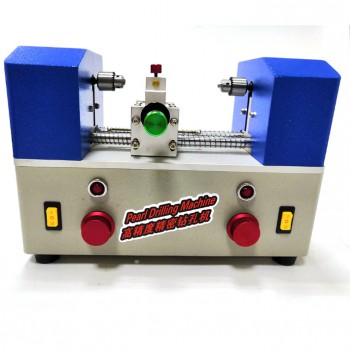
The introduction of electric pearl drilling machines transformed the trade even further. Small motors replaced foot pedals, reducing operator fatigue and improving precision. Jewelers could now work on large batches with better consistency, especially when matching pearls for necklaces or earrings. Adjustable speed controls became particularly important because different pearls reacted differently under pressure. Freshwater pearls, Akoya pearls, and South Sea pearls each required careful handling to avoid overheating or chipping.
Another major advancement came with the development of specialized drill bits. Earlier bits often generated too much friction, which could burn the nacre or produce uneven holes. Modern pearl drilling machines use ultra-fine bits designed specifically for organic gems. Some are diamond-coated, while others focus on minimizing vibration during operation. These improvements allow jewelers to create cleaner holes even in smaller pearls that would once have been considered too risky to drill.
Cooling systems also changed the process. Many contemporary drilling setups use water-assisted drilling to reduce heat buildup. This protects the pearl’s surface while extending the lifespan of the drill bit itself. In high-end workshops, magnification systems are often integrated into the workstation so operators can monitor the drilling angle in real time.
Today, precision has reached a level that earlier jewelers could hardly imagine. Computer-assisted drilling equipment exists for industrial-scale pearl processing, especially in factories producing perfectly matched strands. However, many artisan jewelers still prefer hands-on control, combining modern machines with traditional craftsmanship.
Despite all the technological progress, pearl drilling remains an art as much as a technical process. Every pearl has its own structure, thickness, and balance point. Machines can improve speed and accuracy, but experience still determines whether the finished jewelry appears elegant or flawed.
The evolution of pearl drilling technology reflects the broader story of jewelry making itself: tradition continuously shaped and refined by innovation.
下一則: The Impact of Jewelry Micromotors on Production Efficiency
限會員,要發表迴響,請先登入


