Diamond testers are widely used tools in the jewelry industry, valued for their speed and convenience in distinguishing diamonds from common simulants. However, despite their apparent simplicity, diamond testers are often misused. Incorrect operation or misunderstanding of their limitations can easily lead to false results. To ensure accurate identification and avoid costly mistakes, it is important to be aware of the most common errors when using a professional diamond tester.
One of the most frequent mistakes is ignoring the limitations of the device. Most standard diamond testers measure thermal conductivity, which works well for separating diamonds from materials like glass or cubic zirconia. However, this method cannot reliably distinguish diamonds from moissanite, as moissanite has a similar thermal conductivity. Users who assume the tester provides a definitive answer in all cases may misidentify stones. Understanding what your specific tester can and cannot detect is essential.
Another common error is improper calibration. Diamond testers must be calibrated according to the manufacturer’s instructions, often before each use or after a period of inactivity. Skipping this step can result in inconsistent readings. Environmental factors such as temperature and humidity can also affect performance, making calibration even more critical for reliable results.
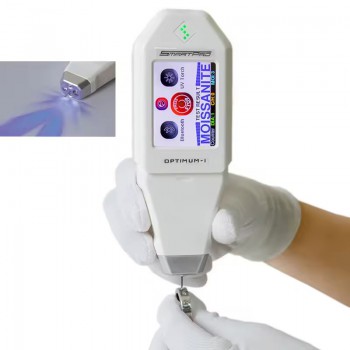
Incorrect contact with the stone is also a major issue. The probe tip must touch the stone firmly and at the correct angle, ideally on a clean, flat facet. Touching the metal setting instead of the gemstone, or placing the probe on a dirty or oily surface, can interfere with heat transfer and lead to false readings. Many misidentifications occur simply because the tester was not applied correctly.
Testing mounted stones without caution is another mistake to avoid. When a gemstone is set in metal, heat can transfer quickly into the setting, especially with small stones. This may cause the tester to give a misleading result. Whenever possible, loose stones should be tested, or extra care should be taken to ensure the probe contacts only the gemstone and not the surrounding metal.
Users also often overlook the importance of stone temperature. Diamonds and simulants that are too cold or too warm may not respond accurately to testing. Holding the stone with bare fingers for too long before testing can warm it up, affecting the reading. Allowing the stone to rest at room temperature before testing helps improve accuracy.
Finally, overreliance on the diamond tester is a critical mistake. While diamond testers are useful screening tools, they should not replace professional gemological analysis. Visual inspection, weight comparison, electrical conductivity testing, and laboratory certification all play important roles in accurate gemstone identification.
In conclusion, diamond testers are effective tools when used correctly, but they are not foolproof. By understanding their limitations, calibrating them properly, applying correct testing techniques, and using them as part of a broader evaluation process, jewelers and enthusiasts can avoid common mistakes and achieve more reliable results.
下一則: Using a Drill Press for Stone Setting and Bead Drilling
- How to Control Abrasive Flow in a Jewelry Sandblaster?
- Improving Production Consistency with a Pearl Drilling Machine
- The Importance of Temperature Control in Automatic Jewelry Casting Systems
- The Future of Small Induction Melting Furnaces in Jewelry Manufacturing
- How Automatic Casting Machines Enhance Precision in Jewelry Manufacturing
- Exploring the Technology Behind Modern Pearl Drilling Machines
限會員,要發表迴響,請先登入


