Drilling pearls is a task that sits at the intersection of delicacy and precision. Unlike harder gemstones, pearls are organic structures composed of layered nacre, sensitive to heat, vibration, and mechanical stress. Therefore, choosing the right pearl drilling machine is not only about efficiency, but also about the preservation of pearls.
High-speed drilling is often associated with modern production environments where throughput matters. When executed correctly, a sharp micro drill spinning at high RPM can pass through a pearl quickly, reducing the time the tool remains in contact with the surface. In theory, this minimizes localized pressure and lowers the chance of surface chipping. Some technicians prefer this method for small, round pearls with consistent density, where the material structure offers predictable resistance.
However, high speed introduces a different challenge: heat buildup. Even brief friction at elevated RPM can raise the temperature at the contact point. Pearls, being sensitive to heat, may respond with internal stress or surface dulling. In extreme cases, microscopic fractures can develop along nacre layers, weakening the structural cohesion of the bead. Without careful lubrication and intermittent drilling control, high-speed operation becomes risky.
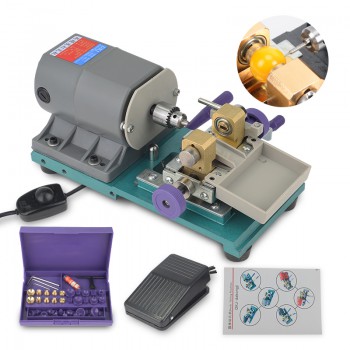
Low-speed drilling presents a different philosophy. Instead of speed, it relies on controlled penetration and tactile feedback. The operator advances slowly, allowing the drill bit to cut rather than burn through the material. This approach significantly reduces heat generation and gives more time to correct alignment errors. For irregular pearls or those with variable density, low-speed drilling offers a margin of safety that high-speed methods cannot match.
The trade-off is time. Low-speed drilling requires patience, especially when working with thicker or larger pearls. The risk of slippage increases if the bit is not perfectly sharp, and prolonged contact can sometimes cause localized pressure marks. Skilled operators compensate by using steady hand support systems or micro-motor rigs with fine torque control.
Tooling also plays a decisive role in how each method performs. Diamond-coated drill bits behave differently under varying speeds. At high RPM, they rely on rapid abrasion, while at low RPM they act more like precision scrapers. Cooling agents such as water or specialized lubricants become essential in both cases, but especially critical in high-speed operations where thermal accumulation happens quickly.
In professional workshops, the decision is rarely binary. Many craftsmen adopt a hybrid approach: starting with a low-speed pilot hole to establish alignment, then increasing speed slightly to complete the passage. This staged method combines precision with efficiency while reducing the likelihood of damage.
Ultimately, the choice between high-speed and low-speed drilling reflects a broader tension in pearl processing—productivity versus preservation. High-speed techniques favor scale and uniformity, while low-speed methods prioritize control and material respect. The most reliable outcomes often come not from choosing one over the other, but from understanding when each approach aligns with the character of the pearl itself.
下一則: Temperature Control in Mini Gold Melting Furnaces
- How Automatic Casting Machines Enhance Precision in Jewelry Manufacturing
- The Benefits of Digital Inside Ring Engraving Machines
- Pneumatic Jewelry Engravers and Modern Jewelry Production
- The Evolution of Pearl Drilling Technology in Jewelry Making
- Temperature Control in Mini Gold Melting Furnaces
- How Technology is Transforming Jewelry Gold Plating Equipment?
限會員,要發表迴響,請先登入


